-
The Common Good
The Concept of the Common Good
I have argued elsewhere that the current debate on Ireland’s crisis needs to move away from economist dominated reasoning and be replaced by something more fundamental–a deeper and altogether more important consideration of the basic principles that we should use to organise our society.
This week saw the publication of a document called From Crisis to Hope: Working to Achieve the Common Good by The Council for Justice and Peace of the Irish Episcopal Conference. This is a welcome and much needed addition to the current discourse. It is a thoughtful exposition of what it means to think ethically about the current situation particularly from the perspective of the common good.
As you would expect much of the analysis is underpinned by Catholic Church doctrine and as such, it could easily be dismissed by secular thinkers. For many, the notion of religious doctrine is synonymous with being told what to think and is therefore contrary to the justifiably high value placed today on self-determination and individual autonomy. However, often on closer reading we find something different as is the case with this text. Here we are challenged, encouraged to think critically and above all we are stimulated to give deeper consideration to the fundamental notion of the common good.
The core value at the heart of this vision is the common good, a value that
emphasizes the essential equality of all persons irrespective of gender, race,
colour or creed. This vision of the common good should not be confused with
the idea of the greatest good for the greatest number. Rather it is a reminder of
the duty of care on all of us to respect and to take account of the human dignity
of all persons – as groups or individuals.(p 4)As the quotation suggests the common good is not a value based on the economic well-being of the majority. It is not about wealth or income. It is simply about human dignity and respect for others.
Instrumental rationality alone (see Habermas’ Theory of communicative Action) is incapable of dealing with ethically based values such as the common good. This is why much of the current media focus on managing our way out of the economic crisis is missing the full extent of the problem.
Without doubt in years to come the Irish economy will recover but the underlying cause is not being addressed. While government policy and our financial institutions promoted a rampant individualistic, materialistic culture based on greed and self-interest, our universities and most of the academic community were either compliant or silent. Just as we need to rebuild our economy on something more sustainable than inflated house prices we also need to reframe our political, business and education systems to allow for more rigorous and ethical questioning of decisions and policies.
As the title of the episcopal statement suggests we need to move from ‘crisis to hope’. From crisis management to a vision for a better future. And hope–this is not the forlorn hope that we will never again get caught out by the vagaries of international economic forces but the very real hope we find in the nature and goodness of every human being. Let’s not loose sight of this again.
-
The Election Count- A Learning Opportunity
Why School Students Should Manage the Election and the Counting of Votes
In Ireland voting in the general election takes place this Friday and this means a weekend of ballot boxes, exit polls, tally men and counting. We use a system of proportional representation (PR) that is very fair but very complex. When you vote you mark candidates in order of preference on the ballot paper. You can go through all the candidates assigning a number to indicate 1st, 2nd, 3rd, 4th preferences and so on. You can influence the outcome of who gets elected by means of your later preferences. It is not unusual for the whole process to go through seven or more counts as the lower scoring candidates are eliminated and second and subsequent preferences from these votes are redistributed.
Although the whole process appears complicated it’s based on some straight forward rules. It is important however that voters understand the process so that they can avail of the full extent of their democratic choice.
Normally we use civil servants and casual employees to work in the count centres – in many cases the local school is appropriated as the ballot station and even count centre. Legally, the returning officer is responsible for managing the count.
I argue that we should use 15 to 18 year old school students in all functions at the ballot stations and at the count centres.
There would be many benefits to this idea:
- The students become active participants in our democratic process and through this experience they appreciate its importance.
- The best way to understand the operations of the PR system is to be part of the counting process. In a very real way we will be educating our future voters.
- It can be argued that young people are the biggest stakeholders in the consequences of the result and as such they see how decisions are made.
- Participating students would be more likely to vote when they reach 18 and perhaps even to wish to stand for election themselves.
- The important connection between schools and civic society would be reinforced.
- Student’s would learn about the operational and project management aspects of managing an election and count.
- The whole process would be cheaper and yes more reliable.
I can hear the murmurings now:
“Surely you can’t be serious – it will never work! How could we rely on them. They’d surely let us down.”
Yes, I suppose we can’t blame the young people for thinking that about us!
-
The Two Hour Club
It works like a book club but with a twist….
I have been working with some friends here in Maynooth to establish The Two Hour Club. I think this is something that could catch on. It’s a simple idea the goal is to provide a format for groups to get together frequently to discuss meaningful issues. I think this is a useful format for learning and it evolves from my interpretation of some of the ideas of Jurgan Habermas.
I have described this to other friends and colleagues and a number have indicated that they would like to establish their own version. To help this I have created some video presentations that explain what its all about. Have a look at these and click on the link above to connect with a Moodle support site.
If you are thinking of establishing a group let me know.
For more information on the Two Hour Club follow this link.
-
The English (Poets) Graveyard in Rome

If you’ve been to Rome as I have many times you begin to look beyond the usual tourist haunts for places of interest. Of course there is no shortage of these–the city has layer upon layer of stories to tell.
One such place of interest is the English Graveyard, or more precisely the graveyard for non-Catholics.
There are two famous poets buried here Keats and Shelly.
I loved poetry as a teenager. Reams of beautiful words, gifts from my school days, are still available to me. There is certainly something to be said for learning poetry ‘off by heart’.
Ode to a Nightingale
My heart aches, and a drowsy numbness pains
My sense, as though of hemlock I had drunk,
Or emptied some dull opiate to the drains
One minute past, and Lethe-wards had sunk:
‘Tis not through envy of thy happy lot,
But being too happy in thine happiness,–
That thou, light-winged Dryad of the trees
In some melodious plot
Of beechen green, and shadows numberless,
Singest of summer in full-throated ease.
…Ode to a Grecian Urn
 O Attic shape! Fair attitude! with brede
Of marble men and maidens overwrought,
With forest branches and the trodden weed;
Thou, silent form, dost tease us out of thought
As doth eternity: Cold pastoral!
When old age shall this generation waste,
Thou shalt remain, in midst of other woe
Than ours, a friend to man, to whom thou sayst,
“Beauty is truth, truth beauty, -that is all
Ye know on earth, and all ye need to know.” Keats asked that his headstone remain anonymous and should state the following:
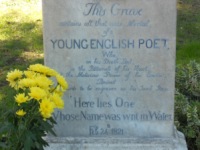
“Here lies One whose Name was Writ in Water“
His friends provided the explanation:
“This grave contains all that was mortal of a YOUNG ENGLISH POET who on his death bed in the bitterness of his heart, of the malicious power of his enemies, desired these words to be engraved on his tomb stone“
 Further along I came across the resting place of Shelly (actually only his ashes). The inscription reads:
” Nothing of him that doth fade
But suffer a sea-change
into something rich and strange“The cemetery contains many strange and beautiful sculptures.


It is indeed tranquil and silent place.

Strange indeed!
-
Ssshhh!!! Exams in Progress!
This is a quiet but busy time in National College of Ireland semester one exams are now in progress. We are encouraged to keep as quiet as possible as each room on the campus is now used to its fullest extent to facilitate the process.
There is always tension associated with exams. Students of all ages and all backgrounds find the prospect of being tested daunting. This is very understandable we live in a culture of measurement and accountability and education is an expensive process. So, especially for the self-motivated, we all want to see how much we know and how well we have progressed.
As discussed previously, there is a useful distinction between goals and achievements that are measured by independent criteria such as exams or tests and other achievements that are socially referenced such as how other people regard performance.
For many students the exam results provide important feedback on how they have coped with the learning challenges associated with a course. At some point in the future the result–put simply as a number–will be revealed.
However, this will only be a very small part of the story. The student, and the student alone, will know how to interpret it.
Best of luck to all concerned.
You May Also Like

Getting to Grips with Academic Writing
-
What are New Year’s resolutions and why they seldom work

New Year’s Celebration fireworks at Carton House, Maynooth Happy New Year!
It’s the start of 2011 and last night we celebrated as we said goodbye to 2010 and welcomed the turn over to a New Year.
At New Year and perhaps birthdays or other recurring significant dates we often conduct a self-appraisal and make decisions about our future behaviour.
This is typically framed as a New Year’s Resolution:
I will go to the gym and loose weight;
I will give up smoking;
I will do a course;
I will complete an unfinished project (I know someone who has resolved to complete her master’s dissertation).So what’s really happening–why do we make such self-resolutions? How likely are we to succeed in changing our own behaviour as a result of such public and private utterances?
Last night I had an idea (my first of 2011) that is to develop a Theory of Resolutions. Like many good theories will build extensively on the work of others. Don’t worry that I state my goal in such grand terms as ‘a theory’ – I am simply attempting to provide a new perspective on the familiar, a framework for understanding and making sense of an aspect of our life. There is no proof. The quality indicator for such a theory is its utility – is it useful and does it help?
Actually, when you think about it, although New Year’s resolutions are seen as part of the festive ritual there is often a very serious side to them. Promises are frequently connected with one’s health and well-being: smoking, weight loss, alcohol etc.. These can be life changing, even life saving. We are not dealing here with trivia. The stakes can be very high indeed and therefore, I argue, we need a better understanding of what’s going on. Hence my theory.

Proposition One: Resolutions arise from Self-desire
Desire is a necessary but not a sufficient condition for motivation. We desire many things but very few of our desires or wishes are fulfilled. For example, I could place a bet on a racehorse to win at long odds. I may wish it to come first but there is little I can do about it other than wait and observe the outcome.So, we can desire things that we can do nothing about “I wish for fine weather on my holiday” or , in contrast, we may desire things that we have capacity to act toward “I wish to go back to college and get a degree“. A desire, together with a capacity to act, becomes motivation.
I argue that resolutions are predicated by a specific type of desire. I call this Self-desire. Note that I am using the proper noun ‘Self’ indicating how we each think about who we are. A way of understanding this is to think in terms of selfing – a lifelong constructive process of framing, shaping and refining our self-image (think beyond the pictorial to the wider concept of image involving attributes, characteristics, values etc.). The Self is the outcome of this process at any point in time.
It’s as if there is an on-going project ‘project-self’ that we engage in throughout our lives. We have desires or wishes that centre on the Self. We desire to be liked, to be virtuous, to be successful and so on. At any point in time, of these desires, there are some that we have the potential to act upon and others that will remain forever unfilled.
New Year resolutions may therefore be considered as expressions of desire, a desire to improve the Self; for example, to be the non-smoker, the thin person, the controlled drinker or the successful student.

Proposition Two: Resolutions are Goal Statements
We set goals all the time and the day-to-day trajectory of our lives may often be regarded in terms of goal-directed behaviour.
Often such goals are implicit we don’t even think about our actions in terms immediate goals. We set long-term goals and many of our actions are a means to an end.
However, there are times such as at the beginning of a New year when we state certain goals explicitly.
It is useful to think about different types of goals. Firstly, one can distinguish between goals that relate to mastery or competence and goals that relate to (social) performance. Consider, for example a stated goal such as to exercise regularly. There may be a mastery component to this goal “I can bound up four flights of stairs without loosing breath” and there may be a performance component “I will look great and people will admire my fitness”.There is another distinction in relation to goals that is also useful: ‘approach’ and ‘avoidance’ goals. Consider a typical approach goal stated as “I will pass my driving test” and the same desire expressed as an avoidance goal “I will not fail my driving test“.
Notice that desires can be expressed as any combinations of ‘mastery’, ‘performance’, ‘approach’ or ‘avoidance’. Similarly, new year’s resolutions can be expressed in terms of each of these types of goal-statement. For each there are certain characteristics and it’s useful to recognise these:
- Mastery Goals can usually be measured against some pre-determined independent criterion (e.g. to be a certain desired weight) as such, they are easy to set in specific terms and progress toward a mastery goal can be effectively measured.
- Performance Goals are less well defined but are very powerful in terms of incentive (note the discussion above on the Self). Further, positive encouragement from others can be very affirming for those trying to achieve challenging goals.
- Approach Goals are stated in terms of a desirable outcome and as, such they provide an incentive to act toward rather than away from a target.
- Avoidance Goals are necessary in certain situations (for example to stay away from danger) but for many aspects of human life they are problematic. In academic contexts they can lead to exam anxiety and the paralysis associated with fear of failure.

Proposition Three: The illusion of will powerNow that we have some framework in which to understand the nature of our resolutions it’s time to ask how successful we are at keeping them.
An underlying assertion that I make here, based only on my experience, is that we, including especially myself, are not very good at fulfilling such resolutions.
Even if we disregard the cases where we set resolutions trivially, perhaps in response to being asked to quickly supply one, even if we ignore these as not real examples of a resolution, we still seem to have a poor record. Why then is this the case?
One reason is that we often engage in quite literally ‘wishful thinking’; in other words, we focus on the desire rather than the means to achieve it. As stated above, desire without a means to act is quite impotent.
Furthermore, when we make resolutions we tend to focus on significant and previously unachieved outcomes. So we set the stakes very high, usually at the level of life-changes, but we often fail to recognise that these will take planning and effort over time. We wish the result instantly and in fact get some small part of that wish fulfilled through the statement of the resolution (see performance goals above).
A third reason is that we frequently misunderstand the role and the potential of will power. Let me take as an example a person who desires to give up smoking. It is now generally understood that giving up cigarettes is not an easy achievement and people make a serious appraisal of the effort involved prior to resolving to give them up. Here is a typical sequence of events:
- In the beginning our subject estimates the scale of the challenge and deems it to be significant and therefore calls upon a great effort of will power.
- This works well for let’s say the first week – the person has successfully used significant will power to deal with what is perceived as a significant challenge.
- What then happens? Having managed to stay ‘off them’ for week the subject makes a revised estimate of the scale of the challenge. This revision is downward on the basis that the challenge has already been met successfully for the first week. Of course, less will power will be required to meet this diminished challenge.
- Inevitably, sometime around the second or third week temptation arises. An argument is made that having been ‘successful” in giving up cigarettes up to now there is no reason to believe that just one lapse will scupper the whole project. Where is will power? It is stood down because of recent success!
Summary
I have tried here to provide some insight into the nature of New Year’s resolutions and, rather grandly I admit, I have called it a Theory of Resolutions.In this I have provided three propositions:
First, that resolutions are connected with Self-desires and are part of the process of self improvement that we engage in throughout our lives.
Second, I have argued that we should consider resolutions in terms of explicitly stated goals and I provided a classification of goals in terms of mastery, performance, approach and avoidance goals. And thirdly, I have discussed the illusion of will power and how we have a tenancy to apply an effort of will only when we consider a project as daunting. Early success in such a project can be misinterpreted as evidence of efficacy (easiness) and hence the investment of effort is reduced. This can seriously undermine the intended outcome.So if you have made a New year’s resolution keep these propositions in mind and I hope you will be successful in 2011.
Further Reading
As stated the ideas contained herein build on the work of others.For a fuller treatment of the differences between desire and motivation I refer the reader to my own PhD thesis:
- Casey, L (2009) Pathways to Competence and Participation in the Digital World. NUIM PhD Dissertation. Available from http://eprints.nuim.ie/1545/
For further reading on the ideas of self see:
- McAdams, D. P. (1996). Personality, modernity, and the storied self: A contemporary framework for studying persons. Psychological Inquiry, 7(4), 295.
- McAdams, D. P., Josselson, R., & Lieblich, A. (2006). Identity and story: Creating self in narrative: American Psychological Association, Washington, DC.
The classification of goals draws primarily on the works of Dweck and Elliot see, for instance:
- Dweck, C. S., & Molden, D. C. (2005). Self-theories. In A. J. Elliot & C. S. Dweck (Eds.), Handbook of competence and motivation New York: The Guildford Press.
- Elliot, A. J. (1999). Approach and avoidance motivation and achievement goals. Educational Psychologist, 34(3), 169-189.
- Elliot, A. J. (2005). A conceptual history of the achievement goal construct. In A. J. Elliot & C. S. Dweck (Eds.), Handbook of competence and motivation. New York: The Guilford Press.
- Elliot, A. J., & Dweck, C. S. (2005). Competence and motivation. In A. J. Elliot & C. S. Dweck (Eds.), Handbook of competence and motivation New York: The Guildford Press.
- Elliot, A. J., & McGregor, H. A. (2001). A 2 x 2 achievement goal framework. Journal of Personality and Social Psychology, 80(3), 501-519.
- Elliot, A. J., & Reis, H. T. (2003). Attachment and exploration in adulthood. Journal of Personality and Social Psychology, 85(2), 317-331.
- Elliott, E. S., & Dweck, C. S. (1988). Goals -an approach to motivation and achievement. Journal of Personality and Social Psychology, 54(1), 5-12.
The discussion on will power derives from arguments made by Gregory Bateson on the nature of alcoholism in his book Steps to an ecology of mind.
You May Also Like
Getting to Grips with Academic Writing
-
Betty Casey One Life Happy Birthday

My sister Betty died this year.
At the time I could not bring myself to write about it but today, the 23rd of December, is Betty Casey’s birthday and I feel the need to comment.
Betty was the eldest of six children, I came in the middle, number three in line.
There was something magic about our childhood. We were reared in the Phoenix Park a vast enclosed piece of country located in the heart of the city of Dublin. Our father Harry was a gate keeper and we lived in a gate lodge.While I was young the universe was packed into that small lodge and its environs. What a universe that was! It extended only in one direction and that was up the park–past the married quarters of the Garda, past the depo, over to the People’s Gardens through the Hollow and of course, on into Dublin Zoo. This was our turf and the six of us and the other kids, friends and neighbours, were free to play, roam, explore and experience the world.
Here was the jungle where battles were fought and monsters lurked. Over there you could catch a whale in a pond. That’s the triangle where we played football. This is the tree I swung from.
On a path near the zoo I learned to ride a bike. It was a big black ugly ladies bike. I could not sit on the saddle I was too small. Reassured that my father had a good grasp of the back of the saddle we were encouraged to peddle away. Betty shrieked. The cycle wobbled and she was away The first to ride the bike. That was what big sisters did. They led the way.
There were mysterious stories from the zoo. Betty already had a job in the shops we were in awe. I couldn’t wait to get my chance and not long after my ninth birthday I was in as a pony boy. My job was to manage a queue of children waiting to ride the ponies. Fanny, Bubbles, May Blossom, Blackberry, Old Silver, Young Silver and the stallion Commando–these were now part of my life and would remain so for more than a decade.
Weekends would never be the same. At various times all six of us were working in the zoo. I was charging around with two ponies on a trap. Betty and others were in the shops or Pet’s Corner. On Sundays in the summer the zoo was packed and we were earning our keep. On a summer’s day the shops by the lake were “black”. Crowds needed to be catered for and despite the wasps, the cramped conditions and the spoilt kids we delivered a service. We were kids and it might be tempting to suggest that we were exploited but it was the very opposite. We loved every minute. We loved the responsibility, the social life, the animals, the notoriety and the money. The trailblazer of the Casey kids in the zoo was Betty. She led the way.
Years later each one of us travelled. Mainly to the UK but for me much shorter stints and much further away. My drive was wanderlust but for others, especially Betty, it was survival. In Ireland and in England Betty reared her family. It was never straightforward, like the bike there were wobbles, but she was in control and she knew what mattered. Betty’s kids, my nieces and nephews, are testament to her spirit. They are leaders like their mother.
In recent years Betty’s life became more complicated. She found happiness but perhaps it was too late. We are all vulnerable. Occasionally, in those last few months there were fleeting glimpses of the Betty we knew from childhood but in truth her spirit had faded. In the end it was sad and protracted.
It’s tough having your birthday just two days before Christmas. Presents get merged and the general festivities overshadow the specific. Many times I forgot to call, wish her a Happy Birthday, say that I was thinking about her, after all it was Christmas and we would all get together soon.
So Betty, Happy Birthday this time. You were a leader, a trailblazer and my big sister. I was proud to know you.
Leo
-
November 2010 Ireland in Turmoil – The Relevance of Habermas and the Theory of Communicative Action
It may seem odd to make a connection between the current upheavals – the political, economic and national identity crisis in Ireland – and the work of Jurgen Habermas, a German social philosopher and critical theorist born in 1929. However, I believe that insights from the work of Habermas have something to offer by way of explanation for the current predicament in which we now find ourselves and more enticingly, may also provide useful pointers for our emancipation through discourse and communicative action.
Habermas is still a very active writer and he comments regularly on political and social issues of our time. You can keep up to date with his outputs via the Habarmas forum website. Of note also is that Habermas was a recent recipient of the Ulysses Medal conferred by UCD – an interesting interview conducted by the Irish Times is also available.
The most notable work by Habermas is The Theory of Communicative Action published in German in 1981 and translated to English in 1984. This publication is in two volumes: Volume 1: Reason and the Rationalization of Society and Volume 2: Lifeword and System: A Critique of Functionalist Reason. These works integrate and draw upon the work of other critical thinkers (Mead, Durkheim, Weber, Adorno, Marx) to unfurl Habermas’ own insights on language, reason, rationality, society, discourse and communications. The works of Habermas are the subject of active scholarship and because of the (relative) recency and complexity of his theories most people have not had a chance to become acquainted with his ideas and to make meaningful connections to their own life and circumstances.
What I’d like to do is to introduce some of the core concepts from Habermas’ work and to invite the reader to reflect on the implications for what is happening today. These are my interpretations of Habermas; understandably, I have had to summarise and reduce some quite complex theory. What’s intended here is a beginners guide, an appetiser – if you want the main course go directly to the works cited above.
Instrumental and Communicative Rationality
Let’s start where Habermas starts with a re-examination of the notion of rationality. In Reason and the Rationalization of Society Habermas suggests that we distinguish between two forms of rationality; first cognitive-instrumental rationality and secondly communicative rationality.The first of these relates to how we act instrumentally on the world – this is the realm of science, mastery of the environment and logical problem solving. When we make predictions based on empirical evidence or use mathematics to propose new theories of physics or even apply our knowledge of forces and structures to build bridges, in all these practices, we draw on instrumental rationality.
In contrast, communicative rationality is a wider concept and
“… carries with it connotations based ultimately on the central experience of the unconstrained, unifying, consensus-bridging force of argument of speech, in which different participants overcome their merely subjective views and, owing to the mutuality of rationally motivated conviction, assure themselves of both the unity of the objective world and the intersubjectivity of their lifeworld.”
(Habermas, 1984, Vol 1 p 10)What does Habermas mean by this? Look again at the quotation above and consider what he is suggesting. He is proposing that communicative rationality is process oriented rather than mastery or output oriented. What is this process? It is the ‘consensus-bridging force of argument’.Here is my own explanation for understanding communicative rationality. Let’s say that you are a jury member in a criminal trial and on completion of the hearing you retire with others to consider a verdict. You consider the evidence – forensic scientists have made assertions, witnesses described their perspectives – all together the case is quite compelling: the woman certainly killed her husband. But was it murder or self-defence? Together you discuss further aspects of the case. Was she defending herself, or her children, did she have other options? Was her action justified? In this scenario we see both forms of rationality at work – instrumental reasoning establishes the basic ‘facts’ but in this case, and many aspects of human endeavour, we need another form of thinking, we need to deal with something altogether more complex (guilt versus justification) and instrumental reasoning is of little value. We need a process of communicative rationality to establish an acceptable truth. In our society we see this as a collective process – that’s why we have juries and even when we rely on judges for verdicts they need to cite precedence – wisdom from the collective.
The Lifeworld
Habermas also introduces the concept of lifeworld (Lebenswelt). In deriving this concept Habermas builds on the work of the learning theorist, Jean Piaget. Piaget is best known for his stage theory – descriptions of the phases in which children develop cognitive structures for abstract reasoning and formal thought. Piaget’s basic idea is to distinguish between two forms of learning – that which adds to our existing knowledge and that which transforms the structures we use to deal with new knowledge. It is through this second form of learning (often called development) that we develop our capacity for thinking. As adults we have developed these structures into rather elaborate models of the world. It’s as if we have an internal working model of the universe that we constantly adjust as we gain more and more insights from the external world through experience. So, for Habermas, this internal lifeworld is of critical importance when it comes to communication.Here is my own explanation. Suppose people are engaged in conversation about the “knowledge economy”. For each participant, we can regard the subjective view of what constitutes the knowledge economy as comprising part of their lifeworld. Obviously, for a socially-construed construct such as the knowledge economy, there will be elements of common understanding among the participants. However, it is also likely that their will be considerable differences among the participants as to what constitutes the knowledge economy. Each participant will bring their own pre-formed assumptions into the conversation. Lifeworld’s are both personal and social, and this is why Habermas talks about ‘the intersubjectivity of their lifeworld’ in the quotation above. Habermas argues that “subjects (LC people) acting communicatively always come to an understanding in the horizon of a lifeworld” (p 70). So it is through these conversations, or larger communicative processes, that we form and change the foundational assumptions upon which we build our understanding of the world.
Discourse and Communicative Action
We use the term discourse to describe the truth seeking process or quest involving communicative rationality. In this we seek a course of action that best serves the needs of society – the common good so to speak. Thus, the discursive process may be regarded as a universal value underpinning humanity; transcending cultural, religious and social norms (this relates back to Kant’s notion of universalism) . What I am really saying, and what I think is the key message from Habermas, is that quality in how we listen, discuss, argue, accept (other perspectives), reason and decide is an essential quality and is core to what it means to be human.What constitutes the ideal argument? Or to put it another way, what are the ideals of argument? Habermas proposes ‘discourse ethics’ as a means of articulating these ideals. Simon Chambers discussion on “Discourse and Democratic Practices” summarises Habermas:
Communicative actors are primarily interested in mutual understanding as opposed to external behavior. Therefore, they attempt to convince each other that there are inherently good reasons to pursue one course of action over another. Only the “force of the better argument” should have the power to sway participants. Discourse, as an idealization of this kind of activity, must set conditions such that only rational, that is, “argumentative convincing,” is allowed to take place. It must be a structure that is immunized in a special way against repression and inequality.
The immunization is gained through a set of rules designed to guarantee discursive equality, freedom, and fair play: No one with the competency to speak and act may be excluded from discourse; everyone is allowed to question and/or introduce any assertion whatever as well as express her attitudes, desires, and needs; no one may be prevented, by internal or external coercion, from exercising these rights.
Ireland Today
Where and how can we participate in discourse to find the best way forward for the common good? The first and most important point is that collectively we have failed so far because we have ‘out-sourced’ argument. We have left it to the politicians, media commentators and academics to do our reasoning for us. When we seek expertise to fix the problem we look to the epitome or instrumental rationalists, the economists, for guidance. But our problem is not economic, or political or cultural or national; it is the abandonment of discourse.We are all responsible!
.
-
Stream of my Blended Learning Presentation
I delivered the following presentation at the National Academy for the Integration of Teaching and Learning (NAIRTL) Conference on Flexible Learning held at the Royal College of Surgeons of Ireland on the 6th of October 2010.
Blended Not Scrambled: Pedagogic Design for the 21st Century
Would be interested in any comments


