-
Uncategorised
“Christ Deliver Us”
 A new play at the Abbey Theatre written by Thomas Kilroy inspired by Inspired by German dramatist Frank Wedekind’s 1891 masterpiece Spring Awakening.There is an archetypal story that can be found in folklore, fairytales and mythology and it recurs again and again. It is the ‘coming of age’ narrative whereby the young gain wisdom, overcome adversity and become adults. Thus, each culture reproduces. The young learn and adapt, society is newly interpreted and modified and each generation inherits and subsequently passes on the values and norms of their parents.This process of ‘take-over’ from generation to generation is fundamental to the survival of a culture. Hence so many stories and the high value placed on the wisdom therein. We see this in The Godfather, Harry Potter and even the story of Moses – the storyline is similar in each case – an alternative life beckons for a short while but eventually one’s true nature wins out and the inherited core values are embraced.There is a particular variation of this theme which we all find disturbing and is at the root of Kilroy’s new play. What if “there’s something rotten” in society? What if it’s a monster? Who will inherit a culture of moral cowardice, oppression and miss-shapen values? Stories such as Sophocles’ Oedipus, and Shakespeare’s Hamlet deal with this variation – they are stories of doom. Tragedies. A rotten society, a deviant culture must not be passed on – the situation for the young is hopeless.Christ Deliver Us is not about Ireland, the 50’s or religious oppression – it is a variation of an age-old story. It is a warning. Each person must interpret the world and carryies a responsibility to be true to their own values. When this is not possible, as was the case for the young characters in this play, the situation is unsustainable. A society that hands over moral authority to others – in this case the church – cannot survive. There is no inheritance.In the play we find three main characters at the boundary of adulthood. Each in their own way experiences the stifling of ambition and the suppression of their individuality. We find a society in crisis where even the likeable mother (Winnie’s) and father figures (the Canon) are bereft of courage that they fail to assert their moral authority.This is a society where the voice of reason ( Fr Seamus) is quite literally stifled – incapable of being heard. Against these odds their is no possibility of a happy ending – the young are trapped and left with just questions unanswered and wishes unfulfilled. Here too we are reminded of the primal reality that sits immediately below the surface of any society – hence the savagery of what we see. This is the consequence of the malfunctioning society – the ironic price of ignoring the ‘real’ is that it wells up uncontrollably – the play contains scenes of rape, masturbation and physical violence.
Christ Deliver Us resonates long after the performance.
Congratulations to Thomas Kilroy, Wyane Jordan and the Abbey for such a superb production.
Christ Deliver Us! by Thomas Kilroy from Abbey Theatre on Vimeo.
-
“Grade Inflation” Getting Everything Wrong
This is a really important issue for Ireland and for everyone in the education sector. It is vital that get a clear understanding of what the problem is and what we need to do to rectify it.
First of all, the problem we need to solve is not “Grade Inflation” and it would be a huge mistake if we were all to get in a muddle comparing the numbers of first class honours’ degrees or 600 point Leaving Certs in the past few years.
Just like all measures based on our social circumstances, such as the spending power of the average weekly wage or the average life-expectancy, over time we should expect to see a gradual improvement in similar measures of quality and achievement in our education system.
Today, we are educating more people to a higher standard than ever before and I will be surprised if the emperical evidence from the soon-to-be released study will not show this to be the case.
But I do not believe we should be congratulating ourselves – there is a problem and a new challenge and we need to get to the heart of it.
Let me use one source Dr Craig Barrett, former CEO and Chairman of Intel and a frequent visitor to Ireland:
“Your primary and secondary schools are only average,” he said. “It is no longer good enough to be average. You have to be excellent at what you do … at the end of secondary school your young people are average. Your education system is being challenged by improvements in the rest of the world. Things have changed, the educational attainment of other countries have been increasing, and that increases competition for attracting investment.”Source: http://www.examiner.ie/opinion/columnists/matt-cooper/for-ireland-to-make-the-grade-we-need-radical-education-reform-111903.html#ixzz0h0o2hsCx
Barrett is providing us with a global perspective and he, rightly in my opinion, points to the progress made by other countries. Later in the same interview Barrett lays down the challenge:
“It is possible for Ireland to continue to be successful, but you have to worry about the capability of your workforce and what it does,” he said. “Why not a race to the top? Why not have more capability and jobs where you can add value? Increased capability and education is where you increase value.”
Later”Teachers should not be just competent but masters,” he argued. “How do you excite children about a subject? By having high-quality teachers. You must treat education like any quality service you aim to provide. Your employees have to be good and get paid on the basis of performance.”Source: http://www.examiner.ie/opinion/columnists/matt-cooper/for-ireland-to-make-the-grade-we-need-radical-education-reform-111903.html#ixzz0h0qGJr4JNow, let me make plea: let’s not get ourselves in a flap over grade inflation or comparisons between institutions. Let’s talk about what really matters – quality of teaching and quality of assessment.
It is a not sufficient for the Department of Education and Science to look to the State Exams Commission (note “exams” not “assessment”) to produce year-on-year comparisons of Leaving Cert grades – why don’t we look at what the Leaving Cert is really measuring – mostly memory, recall and strategic learning. Genuine problem-solving and creative thinking are not nurtured and not sufficiently recognised.
Similarly, in third level we are certainly guilty of over rewarding students who do not ask questions, suggest alternatives, write critically or challenge the norms of society.
This is the real threat! In short, it’s not that we are giving too many high grades in exams, it’s that we are not measuring what we should be measuring.
Certain skills are more important for competitive and connected workplaces – these include inquiry, problem solving, technical and scientific skills, critical thinking, research, collaboration, presentation and good writing.
These skills need to be nurtured and measured at all levels of education. This is the real challenge. -
Why We Blog
 Yes! With some help from the marketing department of the best college in Ireland (click here to find out).
I can proudly report that
Leo’s Learning Blog has been nominated for the Irish Blog Awards in the category of Best Specialist Blog.Well, surely this is something to blog about!
Yes! but before I get too carried away I note that there are many excellent blogs in this category including Eugene’s Blog, Deryk Thormy’s Blog and Jimmy Hill’s Blog.
So what’s going on with blogging?
What are we all doing and more importantly why do people blog?As you might expect I have a learning theory that might explain, in part, what may be happening.
I refer you the work of John Dewey (1859 – 1952) the American educationalist and philosopher and the further insights of Professor Chip Bruce a “master blogger” of many years, a great scholar and a friend of mine.
Chip and others have developed the notion of an Inquiry Cycle model of learning based on 4 basic human impulses identified by John Dewey (for a fuller treatment I recommend you read Chips Bruce’s work here).
The basic idea is that we all have a tendency to learn through a cyclical process involving Ask, Investigate, Create, Discuss and Reflect – as in the diagram below (source Chip Bruce):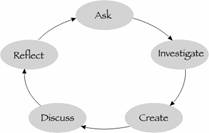
I contend that this is precisely what we seem to be doing when we blog.
We start by asking some kind of question, in my case for example:
Can we measure learning?
Top Ten Insights on Learning
The question “ask” or inquiry begins with the writer but gets passed on to the reader.
Next we “investigate” to get new insights and often source and build on the ideas of others. And, as a natural consequence, we seek to build on the ideas of others – this is the “create” part of the cycle.
With new insights and ideas its only natural (literally) that we seek to share, communicate and “discuss” with others – hence all this blogging.
Finally we we think back on the experience and “reflect” and this, in turn, initiates the cycle again.We live in a complex and challenging and for me, this blog helps me to sort things out – it is part of my inquiry, my way of making meaning and my learning.
-
Bateson
These days this is my favorite book.
I have blogged previously on one of Bateson’s “Metalogues” – look here to review. Bateson’s metalogues are styled as father daughter conversations.
Here’s another one I would like to consider – this is a short extract from the opening:
Mealaogue: About games and being serious
Daughter: Daddy, are these conversations serious?
Father: Certainly they are.
D: They’re not a sort of game you play with me?
F: God forbid … but they are a sort of game we play together.
D: Then they’re not serious!Through this conversation Bateson goes on to introduce many ideas about how we “play” together. The core of this idea is not new – there are always unspoken rules associated with how we communicate.
For me, the most useful question is: “What’s going on here?”. Ask yourself this question when attending meetings, participating in decisions or even writing (as I am now). Frequently, we interpret a situation at an immediate and shallow level. Often, what’s really going on can only be appreciated by interpreting what’s being said along with the unspoken rules of the encounter.
-
Learning and Motivation
Motivation is used as a catchall term to describe how people are moved to act in a certain manner or direction. In everyday use there is a tendency to conceptualise motivation as mono-dimensional we often seek the motive for why a person acted in a particular way.Single explanations for people’s actions or goals are often inadequate and misleading. People tend to justify past-behaviour and will report a retrospective rationale. However, models of motivation, if they are to be of use, need to provide predictions of future behaviour.
The term motivation is used in many different contexts and can mean different things in everyday language. Motivation is often used to describe a level of commitment even energy such as during half time at a football match where a manager gives a team a motivational talk to ‘lift’ the team for the second half.
In such uses of the term motivation is likened to a psychic booster; one could imagine an internal M meter reading either high or low. This meaning of motivation is not limited to physical activity – people might say “coming up to the exam I became really motivated and studied for five hours every day”. It’s even the case that certain speakers at business conferences describe themselves as ‘motivational speakers’. However important it is to be ‘psyched up’ and however interesting it might be to study motivation as degree-of-determination or drive toward a particular goal – this is not the aspect of motivation that is of interest here.
What I wish to focus on is the decision to set goals, the ‘why’ of action and in particular, decisions to learn. In order to explain most human behaviours a fuller spectrum of influences needs to be appreciated. Serious consideration of the concept of motivation leads to a realisation that motivation is both complex and multi-dimensional.
Ryan and Deci (2000) refer to motivation in terms of the ‘energy, direction, persistence and equifinality of activation and intent’. Equifinality, a term borrowed from systems theory, in this case meaning that the same result can be arrived at through many different paths or trajectories.A dictionary definition such as in Colman’s A Dictionary of Psychology (Colman, 2006), describes motivation as a driving force or forces responsible for the initiation, persistence, direction, and vigour of goal-directed behaviour. This introduces the notion of goals and goal-directedness within an individual. Where learning is the goal we may, within the framework of the above definition, regard motivation-for-learning as having a cuasal relationship with learning oriented behaviours.
Ahl (2006) summaries different theoretical orientations gleaned from her extensive literature review of learning motivation. Ahl argues that the concept of motivation is itself questionable and she challenges three assumptions that are often implicit in many of the theories: first that such an entity as motivation exists; second, that it resides with the individual; and third, that motivation causes behaviour (Ahl, 2006). Ahl argues the large variety of definitions of motivation from the literature contribute to the questionability of the motivation construct.Wlodkowski (1999) seems to support this:
We have invented a word to label this elusive topic –motivation- but even its definition continues to baffle the most scholarly of minds.(Wlodkowski, 1999: 1)Ahl also points out that motivation is socially and psychologically construed and that operational measures such as self-report surveys are mearly reinforcing research-generated concepts. For example, to ask people to report on their need for achievement is to create the notion of a ‘need for achievement’.The importance of learning decisions cannot be over-emphasised; almost all learning theorists make a seemingly obvious point that adults learn what they choose to learn. Time and again the capacity to make one’s own decisions and to self-initiate and self-manage learning is identified as a key characteristic of adult learning – see for example Knowles (1978), Cyr (1999) and Merriam, Cafferella and Baumgartner (2007).
Learning decisions are therefore important sites of investigation and can provide powerful insights for educators and policy makers on the development of skills and competence in future populations.
References
Ahl, H. (2006). Motivation in adult education: a problem solver or a euphemism for direction and control? International Journal of Lifelong Education, 25(4), 385 – 405
Colman, A. M. (2006). A Dictionary of Psychology: Oxford University Press.
Cyr, A. V. (1999). Overview of Theories and Principles Relating to Characteristics of Adult Learners: 1970s-1999. Access ERIC: FullText (070 Information Analyses). Florida.
Knowles, M. S. (1978). The adult learner : a neglected species (2d ed.). Houston: Gulf Pub. Co., Book Division.
Merriam, S. B., Caffarella, R. S., & Baumgartner, L. (2007). Learning in adulthood : a comprehensive guide (3rd ed.). San Francisco: Jossey-Bass.
Ryan, R. M., & Deci, E. L. (2000). Self-determination theory and the facilitation of intrinsic motivation, social development, and well-being, American Psychologist (Vol. 55, pp. 68-78).
Wlodkowski, R. J. (1999). Enhancing adult motivation to learn : a comprehensive guide for teaching all adults. The Jossey-Bass higher and adult education series.
-
The School
The recent 3-part RTE series “The School” broke new ground in terms of education and television.
What takes place in schools is both familiar and mysterious to most adult viewers.Our school experiences resonate throughout the entire span of our lives and, for many, learning identity forged during teenage, years remains fixed and unchallenged long after our initial schooling is complete.
Every society looks to young people to reproduce and reinvent itself for the future. Put simply, organised societies that are good at education will survive and outlast societies that fail to do so. Schools and education are our biggest investment apart from health systems.
Strangely, unless you are currently an active participant in the school system, there is little visibility of what’s going on. We seldom get an opportunity to compare schools today with the schools of our childhood. This issue is more important that a simple need to satisfy our curiosity: we need to know about how much has changed, the improvements, new ways of teaching, a new understanding of learning, and new thinking on what should take place in schools.
Since we left school we have grown and developed into who we are today – few of use would say that we have not radically changed since the day we left school. And yet, we often assume that the school system that we left so long ago has remained fixed and unchanged. Obviously this is not the case.
And this is why “The School” as a television series did us all a great service. It provided an opportunity to ‘open our minds’, to see and to experience contemporary school life.
The school principal, Eamon Gaffney is a good friend of mine. Eamon, the staff and students of St Peters Dunboyne showed great courage and self-confidence in facilitating the making of these programmes. I remember Eamon saying that he felt that this story needed to be told “people need to know about schools of today, the breath of learning and the holistic approach to education”.
“The School” has captured something that’s important to us all.
-
Uncategorised
Really Useful Websites on Learning and Teaching
As a follow-up to my previous blog on the Top Ten Insights on Learning I would like to provide a list of web sources and resources that may act as good places to start with insights on learning and teaching.
I’ll try to give a brief description of each and why it makes the cut for me.
Starting Points: Aggregation Sites
Theory into Practice (TIP)
Greg Kearsley has put together an excellent resource that deals with a wide variety of learning theories. This is an excellent starting point and it will give the beginner a good appreciation of the breath of theories and their practical applications.Emtech’s Learning Theories
This is another excellent starting point with a comprehensive list of learning theory orientations. What I like about this list is that each section is authored by a different person and you can cite each as an individual resource.Martyn Ryder’s Instructional Design Models
Martyn Ryder’s very comprehensive listing of instructional design and learning theory resources -this site is well maintained, comprehensive and deals with an wide expanse of theoretical orientations.Learning and Teaching
Teaching Tips Index
This is another great starting point for lot’s of interesting exploration. The index is compiled by the faculty development team at Honolulu Community College. I’ve looked at many of these teacher development sites and I have to say this is certainly one of the best!Angles on Learning
James Atherton’s resource for called: An introduction to ideas about learning for college, adult and professional education – brings together ideas about learning for college, adult and professional education. Great piece of work!The ETL Project
This project sought to identify evidence-based good practice in teaching-learning environments for a range of undergraduate courses.National Survey of Student Engagement If you are genuinely interested in what goes on in college classrooms then this site dealing with an extensive US research project is a good place to start.
Doing What Works
This is a US Government site that promotes research-based educational practices. This resource is particularly relevant for primary and second level teachers.Learning Research
ERIC
The Education Resources Information Center – a search-able database containing loads of journal articles and other resources on education and learning.Education and Policy
European Commission
The Education and Training Directorate of the European Commission – a good starting point for EU and national policy documents. -
Uncategorised
Top Ten Insights on Learning
 It’s the time of year for reviews. I call it the season of the “top tens”: we have the top ten songs of 2009, the top ten sporting moments, the top ten films and so on.I have decided to step on the band wagon and am now pleased to present my Top Ten Insights on Learning.
Here we go:
- Learning is constructed
- People are curious
- We learn best in social settings
- Much adult learning is child’s play
- We have a Learning Identity
- Meet the Digital World
- Adults learn what they want to learn
- Learning can be additive or transformative
- We learn throughout life
- We strive to be all that we can be
1 Learning is constructedThe best analogy is that of a tree with many branches. We learn through the integration of present and past experiences. As we experience the world we connect new experiences with our past – in other words we construct knowledge.
Learning has nothing to do with transmission of knowledge – it about personal construction.
Educators who recognise this focus on process rather than output and encourage students to make their own meaning rather than reproduce the work of others.
2 People are curious
 We can use whatever terms we wish: “learning as inquiry” “problem-solving” “achievement goals” – the plain fact of the matter is that people are curious.
 We can be both mentally and physically curious. We have evolved our higher order thinking skills because our curiosity has provided a competitive advantage on this planet.
Curiosity is at the root of learning – to make learning happen provide conditions where curiosity is aroused.
3 We learn best in social settings
 We have created our society and culture by developing systems to share knowledge, organise tasks, transmit knowledge between generations and collaborate with others to solve problems.
No matter how clever or knowledgeable a person is – very little can be achieved alone.
When we learn our instinct is to share and communicate with others.
Students who work together through group work will learn much more than the task at hand: they will have to listen, discuss, debate, concede, collaborate, co-operate and share. These are really usefull skills.
4 Much adult learning is child’s play
I said above that people are curious both mentally and physically. Curiosity can be very dangerous if it is left unregulated.I could be curious about what its like to walk on the central partition of the motorway, manage an international bank or pilot a 747 but I’ll never do these things.
However, through play and imagination I can experience these actions and their consequences.
 Many talk about “lifelong learning” I think we should call it “lifelong playing”. These day’s I’m playing with the Italian language.
Teachers should let students play – this is also important in 3rd level: role play, simulations, gaming, problem-solving, apprenticeship and peripheral participation can be regarded as adults at play.
5 We have a Learning Identity
We all have a Learning Identity and I have written about this in a previous blog post.In my own research on how adult’s go about learning digital skills late in their careers I found that Learning Identity loomed large whenever educational endeavour was considered. I would ask “why do you want to learn computer skills?” and people would respond with “well I was no good in school…”
Perhaps it’s because society places such a high value on schooling and educational qualification that those who have had difficult experiences in school feel so inadequate when it comes to learning in later life.
It’s as if what they learned in school was that they were not good learners.Educators and trainers should not underestimate learning identity. It’s not just about praising and encouraging (although we should do this all the time) it’s about being aware of social comparison, fear of humiliation and genuine exam anxiety. The big message should be – this is not like school.
6 Meet the Digital World

Your first thought might be that the digital world is “out there” in the places where people are using technology to make things happen. But what I want to talk about is the Digital World that’s “in here” – I mean inside your mind!
We all build the world in our mind and through this process we organise, ascribe our values, assumptions, unquestioned beliefs and preconceived patterns of thought about aspects of the world.
For me its the Digital World but for other people it may be the world of the literate, of the wealthy, of the workers, of the young or of the future.
The important point is critical awareness. That is the learning task: to be cognisant of our assumptions, prejudices and patterns of thought.
7 Adults learn what they want to learn
This should be written on the wall of every training room and college classroom.Learning decisions are often neglected. I find this a fascinating area of inquiry: why do people choose to learn at a particular point in time?
We can pack our children into a classroom and somehow get away with telling them what they need to know but there is no way this will work with adults.Connecting usefulness and application is integral to the learning task for adults.
8 Learning can be additive or transformative
 Of all the learning typologies this simple distinction is the most useful. We tend to think often about adding to our bank of knowledge but we seldom describe learning in terms of reorganising our thinking about something.
One of the characteristics of transformative learning is that it it involves loosing something (and this can be disconcerting) and rebuilding or putting something new in its place.
I think that transformative learning can take place at a societal level also. Imagine the upheavals caused by Calileo’s assertion that the Earth orbits the Sun or when Darwin described the Origin of the Species. It wasn’t so much that we rejected the new ideas but we also had to face the reality that to do so involved moving away from preexisting, more comfortable, beliefs.
Transformative learning can take people outside their comfort zone and challenge ‘the way we’ve always thought about things’. This is not always an easy experience.
One example of transformative learning that I frequently encounter is the process of college students moving beyond a positivist view of the world to become more comfortable with uncertainty, different perspectives and and awareness of their own subjectivity.Teachers who challenge students to think differently, to appreciate other perspectives and to self-reflect on practice will create conditions for transformative learning. When students argue and critique we know we have accomplished.
9 We learn throughout life
 We tend to compartmentalise our short existence into a series of stages each with its own tasks and challenges.
 We are born and grow in childhood developing of motor, language, thinking and communications skills. As teenagers, we build our identity and later we are tasked with our partner relations, parenting and success in the workplace. Later still, we face the challenges of ageing and the fragility of our bodies and finally we face the fact that we are mortal.
We need to learn as we go – there is no point of arrival where we have all the we need to confront the challenges ahead. This is why learning is often described as a journey, this journey parallels the journey of life.
People of all ages look for meaning in their life, learning is one way to give meaning. Senior learning is often regarded as “nice” – in fact it is much more, it is essential. Lifelong learning is also learning for a long life!
10 We strive to be all that we can be This is the so-called drive for individuation.
 One way to think about this is in terms of a desire to be competent no matter what the field of activity.
This is not the same as wanting to be good at everything. To strive to be ‘all that you can be’ is to take account of opportunity, capability and circumstance.But what you need to be good at is: who you are – you need to be the best “put your name here” possible. As we grow this guides our approach to learning and life.
We learn to be all that we can be.

 My pictures are from Christmas Day in Maynooth 2009 when Maire and I took a walk by the canal.
-
Lord Mayor’s Commission on Employment
 The Lord Mayor of Dublin, Cllr. Emer Costello, is to be commended for establishing a Commission on Employment for Dublin.
This is an inspired and necessary goal for the City Council and tackling unemployment or, to put it more positively, creating employment is essential for the future well-being of all who live and work in our city.
The Lord Mayor’s Commission has set up working groups on a number of key areas: (1) Unemployment & Employment, (2) Business, Entrepreneurship & Finance, (3) Education, Skills and Training, and (4) Volunteering & the Social Economy.
The commission have invited submissions and I have copied below my own contribution on the area of Education, Skills and Training.
Dublin City of Learning
Let’s stop and think and about learning. No I don’t mean schooling, or formal training or the pursuit of new qualifications. I want us to think about learning – what it means for each each of us and how it gives purpose to our lives.
We learn throughout our lives and each time we face new challenges, we take on new information, adapt our thinking and develop new skills. We learn how to build our identity as we emerge from teenage years, we learn relationships with our partners, to be successful parents and to face the horizon of our life.
The workplace is a specific context of learning and for those who are employed, valuable learning is embedded in the contribution of work effort. This is especially true for the so-called ‘smart economy’. In fact, economies of the kind envisioned in the government plan are better described by the on-going process ‘learning’ rather than the end-state ‘smart’ or ‘knowledgeable’.
This is not just a flaw in the language it is much more fundamental. People who find themselves unemployed are often people who know how to learn but who find themselves without a meaningful context for learning. This is the tragedy.
Some knowledge economy rhetoric does them no service – to talk about the need to upskill people to a condition of ‘smartness’ is to completely miss the point of how knowledge contributes to economic growth. If, on the other hand, we think process then we can make a much more plausible case – that learning itself can lead to innovation and contribute to economic and social well-being.
So when we ask “what can the City of Dublin do to ensure future employment and well-being of its people?” I suggest that we create a vision of a Dublin City of Learning.
What we mean is a city where learning is regarded as an activity rather than a commodity, and where we strive to provide contexts and meaning for everyone so that the learning process is nurtured and sustained through unemployment, retirement or other circumstances of disengagement.
There are many ways in which this vision can be brought about, and there are many challenges to be overcome. This submission does not provide all the answers. But if we get our thinking right from the start, if we challenge flawed policies and if we genuinly consider what it means to learn then we will have made a good first step. After all, it’s the process that matters, this is what will get us there in the end.
As to an action that Dublin City Council can lead and support I suggest the following:Dublin City of Learning Web Site
The best of the Internet is socially constructed. This process of construction is itself a learning process and for the millions of authors of Wikipedia, writers of blogs and contributors to Facebook, web boards and Twitter, participation in the social Internet brings meaning and purpose to their lives.
We are a city – not just buildings and spaces but a city of people.
With some basic infrastructure and initial support we could create a new structure for Dublin in the on-line world. Not like the institutional web sites that abound but something akin to the social spaces that we all enjoy.
Everyone who lives in, or has an interest in the city will be encouraged to contribute. Some can contribute technical expertise, some as editors and lead writers, some as teachers to help those who need support with the technical and writing skills. We will need projects to develop new areas of interest by theme or location, we will need to capture the stories of our city, install a photographic collection, display the paintings of our citizens and celebrate the achievements of all our sports people.
If we do this we will have the best resource ever to advertise the experience of Dublin to those who wish to visit, we will create a valuable resource for future generations but above all, we will be Dublin City of Learning.


