The Cycle of Life
Thoughts about life in Ireland, cycling and what I've learned along the way
-
Letter from Cambodia
I have been in Cambodia for three weeks, mostly working with SeeBeyondBorders, an NGO working to develop teaching capability in early grade primary schools.
Cambodia is a country of contrasts. The people here are among the most friendly you will ever meet and yet they were subjected to a terrible genocide in the last decades of the 20th Century.

Typical rural dwelling in Cambodia. Note the house is raised above ground as protection against flooding. The shaded area underneath is usually where the family rest during the day. The countryside is flat, characterised by jungle, rice fields and Asian cattle wandering the roadsides.
And yet there is a vibrancy in the towns and cities like Siem Reap, Phnom Penh and Battambang.
Everywhere you see the juxtaposition of the traditional and the modern. The banking system is good and you can order a tuk-tuk (a motorbike powered rickshaw) using a state-of-art hailing app on your phone (it’s called PassApp).
Cambodia is coming back to life as a tourist destination after the Covid pandemic. The numbers have not yet returned to their previous peaks but there is new energy at the tourist sites. The temples at Angkor Wat, Bayon, Angkor Thom, Ta Prohm and further out to Banteay Srei are all open to visitors.
It is difficult not to like the Cambodian people. They are welcoming and friendly and always willing to help. There is a wonderful calmness about the way they interact with you. Loosing one’s temper or becoming agitated is frowned upon.
While the traffic is chaotic you will not witness much road rage. People give way and concede rather than confront.

Great old trees grow over the temples in Ta Prohm. How does this happen? The answer is that seeds are eaten by birds and are then deposited on the temple walls. The motorbike is the main means of transport. There are motorbikes everywhere and it is quite common to see a complete family with two parents and two children on the same small bike. They don’t travel fast but everyone cuts corners and travels on the wrong side of the road!
The motorbike is the workhorse for famers, vendors and office workers alike. Motorbikes are also modified so they can pull a cart for crops or a people carriage as with the tuk-tuk.
The temple at Angkor Wat features on the Cambodian flag. It is a world heritage site and regarded as the biggest religious building in the world. Although Angkor Wat is the most widely known and visited it is just one of a collection of temples in the area around Siem Reap. They were built between the 11th and 14th centuries.
Most of the temples were originally erected as Hindu shrines however in many cases they were modified to reflect Buddhist traditions in line with the changing religious orientations of the rulers. They are exceptionally beautiful. One of my favourites is the Bayon Temple featuring many stone carved faces.

One of the many faces of the Bayon Temple The contrasts of Cambodia abound.
For centuries, these magnificent buildings of the ancient Khmer Kings were forgotten and overrun by jungle. They were only rediscovered in the last one hundred and fifty years.
The new Cambodian nation freed itself from the colonial shackles of the declining French empire in 1953. The country used these monuments to frame a new identity. The optimism was short lived as the American war in neighbouring Vietnam spilled over into Cambodia. The country was heavily bombed by the US and this, along with other factors, destabilised the country leading to its own civil war.
The appalling regime of the Khmer Rouge and Pol Pot began in April 1975. They took over Phnom Penh and declared a new social order. They emptied the city forcing everyone into the countryside with no exemption for the old and the sick. It was the beginning of a dreadful time with almost a quarter of the population lost through execution, famine or sickness.
The regime tried to establish a new economic order by forcing city people to work the land. Education was replaced by indoctrination. Anyone who had a profession or qualification was targeted for elimination.
People were forced to dig huge irrigation systems intended to re-engineer rice production and agriculture. It was a disastrous plan and led to famine and extreme poverty.
Communal ownership was compulsory with private property and ownership of goods and food outlawed. Transgressors were severely punished.
The country was not completely free of the Khmer Rouge until 1999.

Ta Prohm From those horrific times, Cambodia has experienced a remarkable recovery.
In my opinion the scars are still there under the surface, especially the psychological trauma. However, the burgeoning young population are full of energy and optimism.
Cambodia is a land of contrasts and the most noticeable of all, is overcoming despair with an optimism for the future.
This is especially true if we enhance education opportunities for Cambodian children. The dreadful legacy of the Khmer Rouge has led to the depletion of education and teaching expertise. This can and is being be rebuilt by Cambodians with the help and support of organisations such as SeeBeyondBorders. They need our support!
-
Away with the fairies
The Cycle of Life by Leon Ó Cáthasaigh
First published in Ireland of the Welcomes Magazine
It was going to be a long day. I started about an hour ago and knew I had at least five more ahead. Travelling west against the wind. At least the roads were quiet and the gentle landscape encouraged me along; hard pedalling in soft rain.

All around was bog; plain to see but also discernable in the saddle by the lumpy ground. You might think of long distances as hardship on a bike but the truth is quite the opposite. I suppose it depends on your approach. If you were in a hurry to get to where you want the experience might be troublesome but if the journey itself is your destination it can be a fulfilling experience regardless of conditions.
Imagine yourself on the road as I pass. There I was head down, legs working hard, water spraying from the wheels, all energy and puff. Based on this outward appearance you might reasonably assume I was hard at work fighting my way along. But that was not the case. Inside my head, I was in the zone. My brain’s senior management had gone home for tea and left unhindered, my thoughts were running amuck, strange images darted in and out as my imagination wandered about. I might as well have been snug in bed for I was dreaming away.
My mother, and many others from rural parts, would describe my condition as ‘away with the fairies’.
All around was bog; plain to see but also discernable in the saddle by the lumpy ground. It must be a great challenge for engineers to build a road across a bog. There seems to be no hard surface just a squelch underfoot that encourages caution. Bogs have always been regarded as mysterious places associated with danger and strange happenings. Tales were told of the otherworld and the gentle people who live alongside us. The bog was their place and we pass through with caution and respect. It would be a brave soul that wanders about the bog at night.
Looking around it was easy to understand why stories survive and the logical world of science and technology has not taken hold. In the misty rain small droplets formed on the bog cotton and twinkled as they caught the early light. The wee turf stacks left to dry were strangely regular and aligned. The rushes shifted unpredictably, perhaps it was the wind.

Our ancestors realised that we cannot explain everything Our ancestors realised that we cannot explain everything. We see only part of the world and there is more beyond our reach. Long ago young people had much to learn, dangers to be avoided, knowledge and skills to be acquired and lessons on how to survive and succeed. Wisdom resided in the old people but there were no schools of colleges. Stories were the backbone of learning and an important means of preserving culture and tradition.
Stories were also a means of entertainment; the soap-operas and block-busters of the day. Winter evenings spent around the fire listening to tales and sagas, some romantic, some heroic and some dark and scary. Like the Hollywood films of today there were popular genres and familiar plot lines that could be told and retold. And among the most well-liked and frequently used motifs wasthe notion of the parallel world of the fairies; the wee folk who go about their business and like to be left alone. Gentle people who offer no threat at all, until that is you disturb or annoy them, and then they become cantankerous, mischievous and malevolent trouble-makers.
I pulled in off the road just beside a Hawthorn tree. All around was quiet but for the faintest rustle of wind. It was time to take a break and what better place than this. Just beyond was an outcrop of bog oak the shape of which looked to make an excellent seat. I had a small snack bar and a bottle of water so I left my bike and carefully picked my way toward the spot. Bog oak is common enough in Ireland, the remnants of ancient forests thousands of years old. The alkaline conditions ensure the wood does not rot and often very large specimens remain intact. When the wood is eventually exposed due to shifting ground or turf-cutting the emergent trees have a bleached and sinuous quality. Strange contorted shapes are not uncommon. These were my thoughts as I approached, for as sure as I’m telling you this now, there was the queerest shape of a little fellow in the tree. He was sitting on my seat!

Strange contorted shapes are not uncommon. Stories were often used to warn young people about the dangers of wandering off or talking to strangers. A typical fairy story involves a poor lad, who wanders off in the night, often after too much of his favourite sup, only to find himself lost and alone. In the distance he hears sweet music and faint cries that indicate merriment and dancing. When he approaches the source he sees strange people with pale faces dancing away. The music is the most melodic and lyrical he has ever heard and the dance is fast and elegant. In the middle of all this, perched on a high seat, is the king of the fairies surveying the scene and directing affairs. Most story tellers suggest the best thing to do in this situation is to quietly sneak away and ‘leave well enough alone’. However, this never happens, the gormless drunk decides to join the party and rudely crashes in on the scene. The music stops! He’s immediately surrounded and brought before the king. Apologies are too late and some recompense needs to be paid. The unfortunate man is inflicted with a bad leg or a strange hump.
In other cases the person who happens on the scene is treated more fortunately. If appropriate respect and compliments are proffered the visitor may be invited to join in the merriment. The revelry goes on through the night and few can keep up with the pace and finesse of the dancing. In the morning the visitor awakes alone in the field and is left to tell the tale.Of course these are just stories and it’s impossible to find anyone who will provide a first-hand account of such an encounter.
In the beginning I wasn’t greatly troubled by the figure that seemed to emerge from the shape in the tree. It was a trick of light and shadow. The trunk was gnarled and folded and human beings are pre-programmed to see faces everywhere. However, this was uncanny. There was a clear outline of a full-figure of a man. He had a wide hat and he was looking slightly away from me as if in quiet contemplation. Despite my unease I continued to approach expecting the apparition to fade at any moment. Quite the opposite –the closer I got the more I became convinced there was someone really there!
There are several folk-theories to explain the existence of fairy people. One suggests they are Tuath DéDannen the mythical inhabitants of ancient Ireland. These people remained on but live now in their own way on the land. Another folk-theory is that they are fallen angels, not bad enough to go all the way down, now stuck here on earth. Regardless, fairies were considered to live quietly among us and were seldom seen. Most fairies have pale skin and a fair complexion –that’s the best way to recognise them as not all are small in stature. It was considered impolite to refer to them directly so they were often described as ‘the good folk’or the ‘gentle people’.
Fairies come it two types: there are the trooping fairies who march about on special nights such as mid-summer or better known hereabouts St Johns eve; and of course individual fairies such as the pooka, banshee and well known leprechaun. All have many talents and can bestow gifts such as special skills to help with music or dress-making or they can do damage and make milk go sour or inflict ailments on unfortunate people.
The fairy world is parallel to our own and in many ways they live similar to us. They rear cattle and sheep and sometimes they slip into market towns to replenish their stock. Few can see or recognise them for they are masters at disguise and trickery. There are many stories of interference with farm animals and crops. They are often blamed for a bad harvest or missing sheep. Trouble also arises when houses were built in the way of the trouping fairies favourite routes. Should this happen the occupier would be in for a noisy time at night until the good order of the route is restored.
Fairy superstition remains active to this day and although many people won’t admit it there are few who would desecrate the many ring forts, also known as fairy forts, on farms across the country. Let’s just say there’s less of it about but the old ways still linger.
That day as I approached the figure in the bog I applied all my wits to find a rational explanation for what I was seeing. One moment it’s a tree and the next it’s a man. If it’s a man what is he doing here? What if it’s a sculpture that would explain it? I decided go around a bit and see if I could look head on. As I shifted I had the strangest sensation that his head was shifting too. At this point I was getting a bit anxious. So I decided to make one big leap toward the tree and settle the matter for once and for all. As soon as I jumped I realised my mistake. I was so focused on the figure that I forgot I was in a bog. They all came together: the unmistakable slurp, the cold wet sensation as water entered my shoe and, most worrying of all, the feeling of being pulled downwards into the bog. I was stuck!
So there I was, about twenty paces in from the road, stuck up to my knees in a wet marsh staring at a piece of wood that was smiling back at me. I decided to do the only logical, rational and scientific thing I could think of. I bowed my head and apologised profusely. I explained that I had only wanted to stop for a short break, I meant no disrespect and if he wouldn’t mind releasing me I’d be on my way and happy to leave my fruity bar behind. I jiggled and pulled and eventually one foot, then the other, came loose minus my shoes. I fell over and scrambled on my knees toward the safety of the road. Moments later reunited with my bike, blackened and without shoes, I wasted no time in pedalling away from the scene. As I looked back I caught a glimpse of him again this time he seemed to be eating something and sporting what looked extremely like a new pair of shoes.
Later that evening, as I retold my story around the fire, my friends looked knowingly at each other as if to say ‘he’s away with the fairies’.
-
The Cycle of Life
Next Friday 28th of March I will take part in the Galway Cycle. This involves a cycle from Maynooth to Galway in one day. This will be by far and a way the longest and most challenging cycle I have done.
I have trained and prepared well but admit to being nervous and apprehensive. I am in my mid-fifties and not blessed with an athletic physique.
The journey is about 180 kilometers and I will need to keep up with the 25kph pace.
The Maynooth Galway Cycle has been running for many years and each year thousands of Euro is raised for a designated charity. This year’s charity is the Prader-Willie Syndrome Association Ireland. This is a well deserved cause and you have only to watch the associated video to appreciate how much they need support.
I am collecting so please give a little whatever you can to http://www.idonate.ie/leosgalwaycycle
My affair with the bicycle has spanned the cycle of my life. One of my early memories is accompanying my father on the crossbar of his bike as we cycled to the Garda station to collect another bike. My bike! It was a find he handed in more than a year before and, still unclaimed, he was notified to pick it up. I still remember with admiration how he cycled home guiding the second bike and with me still on the crossbar of the first.We lived in the Phoenix Park and with my two wheels my domain extended to all 32,000 acres. Through my youth the bike was like a part of me and I was rarely seen without it. Long before the concept of mountain bikes I was racing the trails of the Furry Glen or shooting down the Magazine Hill.
After a long absence I took up cycling again in my fifties. Its been a source of great joy and fun and each summer I tour parts of Ireland with some friends.
The wonderful thing about the Galway Cycle is the fact that it’s not easy or straightforward. There will be discomfort and strain and certainly its a bit of a stretch for someone like me. But then again it’s great to have a goal to strive for and something to achieve.
If you can please donate no matter how small to www.idonate.ie/leosgalwaycycle
Thanks it means a lot!
-
Richard Hannaford An Extraordinary Teacher
Some people are natural teachers.
I don’t mean ‘teachers’ in the everyday sense as in those who work in schools or colleges. I mean people who show us things and who we learn from in all manner of ways.
Richard Hannaford was such a person. I noticed this many years ago when I first met him as my sister Norah’s partner and later husband. Over the years I became more convinced this was the case, never more so than in the weeks leading up to his untimely death one month ago.
Richard probably did not realise that we were all learning from him and I know that he would be somewhat embarrassed at the idea of being described in this way. However, I think anyone who knew him would agree that with every encounter, on each occasion involving Richard, we came away with some new insight, something extra to make us better.
One thing we learned from Richard was the art of conversation. He cherished discourse and grasped the importance of listening to other voices and respecting different views. For Richard, discussion was an opportunity to see the world in a different way, as others see it. A frequent phrase he used was “do you think so?” For sure, he too always had something to say but it was never rash or trivial, he cared deeply about justice and social issues. When Richard spoke you knew he had been thinking beforehand.
 We also learned from the many small things he did. To put it succinctly, he had very good manners and was always polite. However, these were just the outward evidence of something altogether much deeper. Richard had a very real sense that we share this life, this planet, with others. So, when he smiled and shook your hand, when we wore one of his lovely shirts, when he sang his party songs and laughed and even when, at Maire’s 50th party, knowing what he was facing, he roared out in glee “It’s so good to be here” again and again we learned from him. We learned to live our lives to the fullest extent but to remember always that we share the world with others. Manners are a way of recognising this.
Without doubt there were two special people who Richard shared his life with and he never missed an opportunity to remind us of this. I don’t know how many times he would say how lucky he was to have met and fallen in love with Norah. He was never reserved about expressing his love for her. As for his son Dara, he readily admitted that when he was born it was the happiest day of his life. With Dara and through Dara we see the greatest evidence of what an extraordinary, natural and skilful teacher Richard was.
Think of Richard when you listen to these lines written by Confucius around 2500 years ago:
 When a superior man knows the causes which make instruction successful, and those which make it of no effect, he can be a teacher of others. Thus in his teaching, he leads and does not drag; he strengthens and does not discourage; he opens the way but does not conduct to the end without the learner’s own efforts. Leading and not dragging produces harmony. Strengthening and not discouraging makes attainment easy. Opening the way and not conducting to the end makes the learner thoughtful. He who produces harmony, easy attainment, and thoughtfulness may be pronounced a skillful teacher. – Confucius, Book XVI – HSIO KI (Record on the Subject of Education)
Richard was a skilful teacher and Dara and Norah and everyone who knew him will continue to learn. It is very appropriate that we planted an oak tree today in his memory. The oak tree was the symbol of knowledge in ancient Ireland. In Irish it is known as Daire. It will grow here in the Phoenix Park a place that has a powerful resonance for all our family. The phoenix is also associated with the symbolism of rebirth from ashes.

The small tree grows under the shade of the older one and the cycle of life and learning continues.
Richard Hannaford RIP

Richard (with the lovely shirt), Maire, Norah and Leo -
The Common Good
The Concept of the Common Good
I have argued elsewhere that the current debate on Ireland’s crisis needs to move away from economist dominated reasoning and be replaced by something more fundamental–a deeper and altogether more important consideration of the basic principles that we should use to organise our society.
This week saw the publication of a document called From Crisis to Hope: Working to Achieve the Common Good by The Council for Justice and Peace of the Irish Episcopal Conference. This is a welcome and much needed addition to the current discourse. It is a thoughtful exposition of what it means to think ethically about the current situation particularly from the perspective of the common good.
As you would expect much of the analysis is underpinned by Catholic Church doctrine and as such, it could easily be dismissed by secular thinkers. For many, the notion of religious doctrine is synonymous with being told what to think and is therefore contrary to the justifiably high value placed today on self-determination and individual autonomy. However, often on closer reading we find something different as is the case with this text. Here we are challenged, encouraged to think critically and above all we are stimulated to give deeper consideration to the fundamental notion of the common good.
The core value at the heart of this vision is the common good, a value that
emphasizes the essential equality of all persons irrespective of gender, race,
colour or creed. This vision of the common good should not be confused with
the idea of the greatest good for the greatest number. Rather it is a reminder of
the duty of care on all of us to respect and to take account of the human dignity
of all persons – as groups or individuals.(p 4)As the quotation suggests the common good is not a value based on the economic well-being of the majority. It is not about wealth or income. It is simply about human dignity and respect for others.
Instrumental rationality alone (see Habermas’ Theory of communicative Action) is incapable of dealing with ethically based values such as the common good. This is why much of the current media focus on managing our way out of the economic crisis is missing the full extent of the problem.
Without doubt in years to come the Irish economy will recover but the underlying cause is not being addressed. While government policy and our financial institutions promoted a rampant individualistic, materialistic culture based on greed and self-interest, our universities and most of the academic community were either compliant or silent. Just as we need to rebuild our economy on something more sustainable than inflated house prices we also need to reframe our political, business and education systems to allow for more rigorous and ethical questioning of decisions and policies.
As the title of the episcopal statement suggests we need to move from ‘crisis to hope’. From crisis management to a vision for a better future. And hope–this is not the forlorn hope that we will never again get caught out by the vagaries of international economic forces but the very real hope we find in the nature and goodness of every human being. Let’s not loose sight of this again.
-
The Election Count- A Learning Opportunity
Why School Students Should Manage the Election and the Counting of Votes
In Ireland voting in the general election takes place this Friday and this means a weekend of ballot boxes, exit polls, tally men and counting. We use a system of proportional representation (PR) that is very fair but very complex. When you vote you mark candidates in order of preference on the ballot paper. You can go through all the candidates assigning a number to indicate 1st, 2nd, 3rd, 4th preferences and so on. You can influence the outcome of who gets elected by means of your later preferences. It is not unusual for the whole process to go through seven or more counts as the lower scoring candidates are eliminated and second and subsequent preferences from these votes are redistributed.
Although the whole process appears complicated it’s based on some straight forward rules. It is important however that voters understand the process so that they can avail of the full extent of their democratic choice.
Normally we use civil servants and casual employees to work in the count centres – in many cases the local school is appropriated as the ballot station and even count centre. Legally, the returning officer is responsible for managing the count.
I argue that we should use 15 to 18 year old school students in all functions at the ballot stations and at the count centres.
There would be many benefits to this idea:
- The students become active participants in our democratic process and through this experience they appreciate its importance.
- The best way to understand the operations of the PR system is to be part of the counting process. In a very real way we will be educating our future voters.
- It can be argued that young people are the biggest stakeholders in the consequences of the result and as such they see how decisions are made.
- Participating students would be more likely to vote when they reach 18 and perhaps even to wish to stand for election themselves.
- The important connection between schools and civic society would be reinforced.
- Student’s would learn about the operational and project management aspects of managing an election and count.
- The whole process would be cheaper and yes more reliable.
I can hear the murmurings now:
“Surely you can’t be serious – it will never work! How could we rely on them. They’d surely let us down.”
Yes, I suppose we can’t blame the young people for thinking that about us!
-
The Two Hour Club
It works like a book club but with a twist….
I have been working with some friends here in Maynooth to establish The Two Hour Club. I think this is something that could catch on. It’s a simple idea the goal is to provide a format for groups to get together frequently to discuss meaningful issues. I think this is a useful format for learning and it evolves from my interpretation of some of the ideas of Jurgan Habermas.
I have described this to other friends and colleagues and a number have indicated that they would like to establish their own version. To help this I have created some video presentations that explain what its all about. Have a look at these and click on the link above to connect with a Moodle support site.
If you are thinking of establishing a group let me know.
For more information on the Two Hour Club follow this link.
-
The English (Poets) Graveyard in Rome
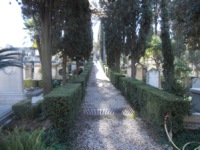
If you’ve been to Rome as I have many times you begin to look beyond the usual tourist haunts for places of interest. Of course there is no shortage of these–the city has layer upon layer of stories to tell.
One such place of interest is the English Graveyard, or more precisely the graveyard for non-Catholics.
There are two famous poets buried here Keats and Shelly.
I loved poetry as a teenager. Reams of beautiful words, gifts from my school days, are still available to me. There is certainly something to be said for learning poetry ‘off by heart’.
Ode to a Nightingale
My heart aches, and a drowsy numbness pains
My sense, as though of hemlock I had drunk,
Or emptied some dull opiate to the drains
One minute past, and Lethe-wards had sunk:
‘Tis not through envy of thy happy lot,
But being too happy in thine happiness,–
That thou, light-winged Dryad of the trees
In some melodious plot
Of beechen green, and shadows numberless,
Singest of summer in full-throated ease.
…Ode to a Grecian Urn
 O Attic shape! Fair attitude! with brede
Of marble men and maidens overwrought,
With forest branches and the trodden weed;
Thou, silent form, dost tease us out of thought
As doth eternity: Cold pastoral!
When old age shall this generation waste,
Thou shalt remain, in midst of other woe
Than ours, a friend to man, to whom thou sayst,
“Beauty is truth, truth beauty, -that is all
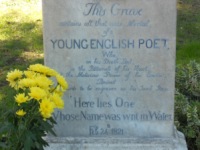
Ye know on earth, and all ye need to know.” Keats asked that his headstone remain anonymous and should state the following:
“Here lies One whose Name was Writ in Water“
His friends provided the explanation:
“This grave contains all that was mortal of a YOUNG ENGLISH POET who on his death bed in the bitterness of his heart, of the malicious power of his enemies, desired these words to be engraved on his tomb stone“
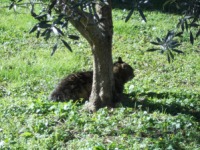 Further along I came across the resting place of Shelly (actually only his ashes). The inscription reads:
” Nothing of him that doth fade
But suffer a sea-change
into something rich and strange“The cemetery contains many strange and beautiful sculptures.

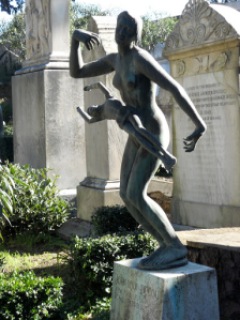
It is indeed tranquil and silent place.

Strange indeed!
-
Betty Casey One Life Happy Birthday

My sister Betty died this year.
At the time I could not bring myself to write about it but today, the 23rd of December, is Betty Casey’s birthday and I feel the need to comment.
Betty was the eldest of six children, I came in the middle, number three in line.
There was something magic about our childhood. We were reared in the Phoenix Park a vast enclosed piece of country located in the heart of the city of Dublin. Our father Harry was a gate keeper and we lived in a gate lodge.While I was young the universe was packed into that small lodge and its environs. What a universe that was! It extended only in one direction and that was up the park–past the married quarters of the Garda, past the depo, over to the People’s Gardens through the Hollow and of course, on into Dublin Zoo. This was our turf and the six of us and the other kids, friends and neighbours, were free to play, roam, explore and experience the world.
Here was the jungle where battles were fought and monsters lurked. Over there you could catch a whale in a pond. That’s the triangle where we played football. This is the tree I swung from.
On a path near the zoo I learned to ride a bike. It was a big black ugly ladies bike. I could not sit on the saddle I was too small. Reassured that my father had a good grasp of the back of the saddle we were encouraged to peddle away. Betty shrieked. The cycle wobbled and she was away The first to ride the bike. That was what big sisters did. They led the way.
There were mysterious stories from the zoo. Betty already had a job in the shops we were in awe. I couldn’t wait to get my chance and not long after my ninth birthday I was in as a pony boy. My job was to manage a queue of children waiting to ride the ponies. Fanny, Bubbles, May Blossom, Blackberry, Old Silver, Young Silver and the stallion Commando–these were now part of my life and would remain so for more than a decade.
Weekends would never be the same. At various times all six of us were working in the zoo. I was charging around with two ponies on a trap. Betty and others were in the shops or Pet’s Corner. On Sundays in the summer the zoo was packed and we were earning our keep. On a summer’s day the shops by the lake were “black”. Crowds needed to be catered for and despite the wasps, the cramped conditions and the spoilt kids we delivered a service. We were kids and it might be tempting to suggest that we were exploited but it was the very opposite. We loved every minute. We loved the responsibility, the social life, the animals, the notoriety and the money. The trailblazer of the Casey kids in the zoo was Betty. She led the way.
Years later each one of us travelled. Mainly to the UK but for me much shorter stints and much further away. My drive was wanderlust but for others, especially Betty, it was survival. In Ireland and in England Betty reared her family. It was never straightforward, like the bike there were wobbles, but she was in control and she knew what mattered. Betty’s kids, my nieces and nephews, are testament to her spirit. They are leaders like their mother.
In recent years Betty’s life became more complicated. She found happiness but perhaps it was too late. We are all vulnerable. Occasionally, in those last few months there were fleeting glimpses of the Betty we knew from childhood but in truth her spirit had faded. In the end it was sad and protracted.
It’s tough having your birthday just two days before Christmas. Presents get merged and the general festivities overshadow the specific. Many times I forgot to call, wish her a Happy Birthday, say that I was thinking about her, after all it was Christmas and we would all get together soon.
So Betty, Happy Birthday this time. You were a leader, a trailblazer and my big sister. I was proud to know you.
Leo


