-
Education Cuts Seem to be Inevitable
It seems to be on the cards that there will be cutbacks in education as Ireland struggles to put together a four year budget plan to grapple with the financial debt crisis.
I like to talk about learning rather than politics or economy in these posts but it seems that cuts will have to be made – indeed are being made – and these cuts will effect all our learning futures and therefore warrant consideration.As an educator I believe that, after the basic needs such as safety, health and sustenance are met, the primary task of any nation is the provision of education. Education is the means whereby culture and societal practices are developed and reproduced. Once we fail to educate then we fail as a society.
Furthermore, as John Dewey pointed out, the provision of open and accessible education is essential for the proper functioning of democracy. When we suppress education we undermine the process of developing new thinking, critical awareness, communicative discourse and creativity.However, I do not believe cutbacks in education can be avoided; particularly if spending on health and social welfare are also going to be curtailed. So here are three ideas where money can be saved with minimal negative impact on peoples lives and future potential.
- First, we could seriously revamp the functions of the State Exams Commission. This would involve abolishing the current Junior Certificate as a compulsory requirement for those remaining in school and its replacement by an expanded Leaving Certificate with a range of levels. The State Exams Commission should be renamed as the State Assessment Commission and its principle task should be to provide assessments for all pupils, regardless of age and ability, once they exit the school system. Assessments should be spaced through the school year and e-assessment technology should be harnessed to streamline the process.
- Second, we could redirect much of the spending that is currently provisioned for training into programmes that are more educational – instead of focusing on specific skills for the unpredictable jobs market it is better to develop generic skills such as problem solving, entrepreneurship and creativity. The third level sector, college’s such as National College of Ireland, are better placed to deliver appropriate provision for adult learning rather than the troubled state training agency of FAS.
- Thirdly, its time we looked more seriously at the potential of blended learning and the use of technology to support learning at all levels. I suggest that good pedagogically designed blended learning programmes can be more effective and engaging for learning. At the same time there are opportunities for more cost-effective delivery models. Currently at NCI and as part of an EU project I am working on new designs for learning in the workplace at college level. I believe this is an important area of future development for the sector. In my opinion, blended learning can structured so that student engagement is enhanced rather than diminished.
All of the ideas discussed above have the characteristic of a win win situation – such reforms would improve rather than diminish education while at the same time contribute to the financial savings that seem to be required.
-
Learning without Teachers
I met Sugata Mitra at On-Line Educa in Berlin two years ago and was very impressed by his research work and his thinking on how children learn.
This most recent presentation at the TED conference opens up a timely debate on the role of instruction in education.
It is easy to be sceptical about the findings from his research. One could argue that such insights are gleaned from very particular contexts and further investigation of the actual learning processes involved is necessary.
However, I am not really surprised that these effects are in evidence and they are compatible with the work of other educationalists such as Dewey, Vygotsky and Bruner.
Have a look at the video and see what you think.
I would be happy to have your comments.You May Also Like

Getting to Grips with Academic Writing
-
Uncategorised
We hold steadfast to our own theories of learning
I have always maintained that each of us has our own theory of learning and that we are prepared to defend it robustly.
This tendency to hold steadfast to one’s existing understanding of learning is what I call the “in my day” (IMD) phenomenon. You will find IMD’s in many conversations concerning education and school. You just need to be on the lookout and you will be surprised at the number of times they pop up. Parents, politicians, economists and most especially business employers are IMD specialists.
The simple premise of the IMD is that what worked for me and has made me successful must be right for everyone else.
It is understandable that insights gained from past experience are valuable but sometimes we fail to recognise the assumptions we take for granted. IMD statements exclude differences between individuals, changes in society, developments in education and the use of technology to support it.
Generally the older are wiser and experience counts for much. However, we also need to be mindful of the basis upon which we make judgements. This is especially the case in education.
-
Learning from Experience: recognition of Prior Experiential Learning
Want to gain admission to a course but your qualifications do not meet the entry requirements?
You may be able to use a Recognition of Prior Experiential Learning (RPEL) process
Many people have asked for more information on Recognition of Prior Experiential Learning (RPEL). I have prepared a presentation that explains the process and how it works in National College of Ireland. Comments are welcome.
-
Uncategorised
Leaving Certificate Results
Today’s top story is the issuing of results to almost fifty eight thousand (58,000) Leaving Certificate students.
This event is widely reported in national newspapers, radio and television news. Much of the coverage deals with the failure rates for different subjects. Of special interest is the success rates for Science, Engineering Technology and Mathematics- the so called STEM subjects. It is reported that some 4,300 students have failed Mathematics.
The availability of a talented young workforce is often cited as part of the attraction of Ireland as a location for inward economic investment. Poor results do not help the international perception of our education system. Employers are increasingly looking for critical thinking, creativity and problem solving skills in their new recruits. It is reasonable to ask to what extent the results of the Leaving Certificate Exam may be taken as an indication of a person’s future potential as an innovative thinker and an effective contributor to the knowledge economy.
Take for example the substantial cohort of young people who have failed Mathematics. Are we justified in writing off the potential of these people as college students, future inventors, knowledge workers, scientists, entrepreneurs and innovators? I feel not.
Letter to Sam (a fictional character representative of the 4,300):
Dear Sam,
Today you got your results and I guess it came as no surprise that you are one of the 4,300 students who failed mathematics. It must have been very disconcerting to listen to media reports on the importance of Mathematics for our future economy. Surely, you must be thinking that it will be very hard to get a job or go to college. What now are your career options and prospects for the future?
Sam I’m not going to say that that none of this counts and that the results of your Leaving Certificate are of no consequence – that’s certainly not the case! What I do say is that when you put things in perspective you have much more choice and more potential that you think.
Be very careful about accepting labels, especially labels that you give to yourself, at this stage in your life. You may wish to say I’m no good at maths! – perhaps this is something you’ve always believed about yourself and now you feel vindicated, you were right all along and your Leaving Cert results prove it. Well, that may be the case but it is also likely that other factors are in play. Have you ever heard of a self-fulfilling prophecy? Perhaps it was your own belief about being no good that caused you to apply little effort or energy to the subject. Of course, once you fall behind with Maths its harder and harder to catch up. So you need to genuinely ask yourself is it that you fell behind and simply need time to catch up or do you have a more fundamental problem with Maths.
Sam what are you good at? Is it that you are good at sport or do you know about cars, or fashion or music? Think about how you became good. How did you develop these skills? It took time and persistence even tenacity, lots of practice and most especially, you were interested and believed you could progress. This is how you became a skilled footballer (musician, mechanic, hairdresser and so on).You know other people who wish to be as good as you are and you might even say look its easy. Well to you its easy but it may be very daunting for other people – just like Maths is for you.
So you might ask is there really anybody who is genuinely no good at Maths or is it all about the perceptions, teachers and opportunities? The answer is complex – I mean yes and no – Maths generally involves abstract thinking and many people have a generalised difficulty with this form of thinking. The best way to explain abstract thinking is to compare it with its opposite – concrete thinking.
Here’s an example, a family of four are preparing to go on a motoring holiday and your task is to load the boot of the car. As you might expect some people have brought two suitcases and what’s more the car has a very small boot and the cases come in all shapes and sizes. Now in order to complete the task do you start to load and move each case testing where it will fit best (concrete thinking) or do you work out a scheme in your head as to how the whole lot will fit (abstract thinking)? In this example each approach has merit. Some people are ‘knackey’ they are good with their hands and they can visualise how things will fit together. This spacial ability is closely related to mathematical ability it is a really useful skill. However, some people use it in concrete situations and never really seem to be able to apply it in abstract form. In my opinion people who have good spacial ability have the potential to be good at Maths but they don’t always fulfil this potential.
Regardless, Sam you need to know that you will be learning throughout your life and the setback today may be an opportunity in disguise. State exams are just one measure of the potential of an individual and the Maths exam is just one aspect of that measure. To survive and thrive in this world we need to be intelligent in a multitude of different ways – we need language skills, social skills, kinaesthetic (movement) skills, awareness of nature, spacial skills and yes, mathematical and logical skills (see Howard Gardner’s works on multiple intelligence). Build on your strengths – society needs people with all these capacities and everyone has something to offer.
Best wishes for the future
Leo
-
Viktor Frankl: Man’s Quest for Meaning
If ever you think your life is miserable and you start to get downhearted then I have a book I recommend you read “Man’s Quest for Meaning” by Victor Frankl.
Frankl was born in Vienna in 1905 and even before the outbreak of World War 2 was an accomplished academic and psychotherapist. He was also a Jew and, along with his entire family, was imprisoned in a concentration camp. Man’s Quest for Meaning documents his personal experiences of Auschwitz and other camps. Only he and his sister survived everyone else who mattered to him: his wife, parents, siblings and friends were killed. A good summary of his life and work is provided by Dr. C. George Boeree here.
After the war, Frankl reestablished his career and produced this remarkable book which soon gained a substantial readership and acclaim.
I remember my reluctance to read the book – I was afraid I would find it depressing, after all, life in a concentration camp what could be uplifting about that? The opposite was the case, I was genuinely uplifted and this is is precisely the point that comes through in the text. If, even in the most forlorn circumstances, in the depths of hopelessness and the most inhumane conditions, if even there and then, people seek to bring meaning into their lives, they strive to build things, to organize, establish relationships and cling to ideas – this is surely an uplifting insight on our very existence.
Recently I found this web clip of Frankl – watch and listen to what he says here and read the book. You’ll find it difficult to moan about our own trivial challenges in the future. -
Uncategorised
TPACK: Technological Pedagogical and Content Knowledge
What makes a great teacher? This is a difficult but important question for education at all levels. One way to get to the answer is to think about individual teachers that you have encountered in your life. Somehow we all know great teachers when we meet them and of course, we certainly know poor teaching when we come across it.
I am not one of those who believes that teaching is a natural gift and some people are born to be teachers and others not. Most great teachers that I know work constantly on their own development as educators. A capacity for great teaching can be gained through experience and reflection and I believe that anybody who wants to be a great teacher can become a great teacher.
What then are the ingredients for successful teaching? Well, thinking about the teachers in my life, I know that teachers need to have a very good knowledge of a content area. I did science in college and I have some strong views on how we should teach science based on my own experiences as a student. Previously I commented on the lecture by Carl Wieman, the Nobel laureate in Physics. Wieman argues against the over reliance of explaining in science teaching – he suggests that we start with realistic goals and facilitate individual discovery through activities “doing science” rather than listening to it.
I attended my first lecture in Physics at UCD in 1977 I remember the lecturer Rev Dr Tom Burke asking the class what constitutes a force such as gravity. We were used to the school definitions such as the Newton’s gravitational force = M1 by M2 over R squared times G (the gravitational constant) and offered this as the answer. But Fr Burke asked further “sure that’s the formula but what is the gravitational force? What’s happening for example, between the Earth and the Moon that manifests itself as gravity?” We were stumped! When we left the lecture we were none too happy – our old world of Physics as the subject of certainty (you only needed to know the formula) was turned upside down. We were not given the answer. We were forced to think. I’m thinking about it still. Welcome to science. Fr Burke was a great science teacher.
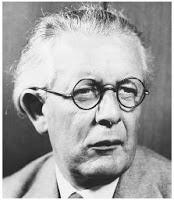
So, good knowledge of a content area is certainly a characteristic of an effective teacher. However, this on its own is not sufficient. Here is what Jean Piaget had to say about subject matter knowledge:
“Every beginning instructor discovers sooner or later that his first lectures were incomprehensible because he was talking to himself, so to say, mindful only of his point of view. He realizes only gradually and with difficulty that it is not easy to place one’s self in the shoes of students who do not yet know about the subject matter of the course.”
(Piaget 1962 p5)
Piaget suggests that it is not easy to place one’s self in the shoes of the learner. Just because we know something doesn’t mean that we can teach it. We use the term pedagogy to refer to knowledge about learning in others. A good teacher needs to have pedagogical as well as content knowledge.Lee Shulman (1986) suggested Pedagogical Content Knowledge (PCK) as a special kind of content knowledge important for teaching. There are two aspects of pedagogic knowledge – a kind of general or generic understanding of learning and teaching that is applicable across all subject areas and a second subject specific pedagogic knowledge. This is knowledge as to the teach-ability of aspects of a subject.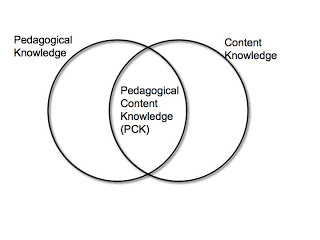 This may involve asking questions that encourage new thinking as occurred in my first Physics lecture. It may also involve identifying threshold concepts (Meyer & Land 2006), aspects of a subject area that open up understanding, and presenting these in ways that are accessible to students.
In a recent conversation a friend referred to a teacher as great with analogies and metaphors. A stock of appropriate analogies, metaphors, examples, illustrations and models is perhaps part of the PCK of any teacher.
Often PCK is represented as the intersection of two domains of knowledge pedagogy and content. This representation is useful for teachers and those involved in the professional development of teachers.Lee Shulman’s contribution has certainly helped researchers by providing a conceptual framework that encompasses the domains of knowledge associated with effective teaching. However, more recently it has been suggested that this framework needs to be extended to include the domain of technological knowledge.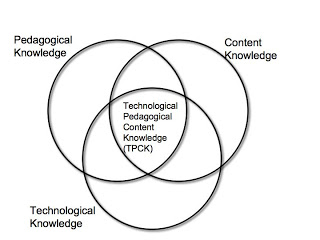 Mishra and Koehler (2006) have put forward the proposition that today’s teachers also require knowledge in a third domain – technology. Their representation extends Shulman’s PCK to become TPCK also called TPACK. They emphasise the value of the integration of these bodies of knowledge for teaching rather than considering each as a separate domain.
In this model, knowledge about content (C), pedagogy (P), and technology (T) is central for developing good teaching. However, rather than treating these as separate bodies of knowledge, this model additionally emphasizes the complex interplay of these three bodies of knowledge.
Mishra and Koehler 2006 p1025For example, it is not advocating “technology” per se be considered rather, it is what technology can do to facilitate learning. The argument is that the technologies of today offer new possibilities that were not considered when Shulman first put forward PCK.For me, I’m not so sure of the value of separating technology as a domain. As I mentioned above, part of the PCK for a good teacher is a stock of analogies, anecdotes and illustrations. All of these are tools – intellectual tools – that are used to facilitate student understanding.Through each generation the art and craft of teaching has evolved to accommodate the cultural and social milieu of the time. Despite what we often think there is nothing special about today, this time and these new technologies. Human cognition has evolved over thousands of generations and the essential mechanisms for learning are the same whether technology enhanced or not. In the Digital Literacy in Primary Schools (DLIPS) project we found that teachers were using strategies that involved project learning and technology. Yes of course their are some technical skills required, and of course we will need to provide additional training and professional development for teachers at all levels as technology evolves and makes new strategies and practices possible. However, my argument is that this should always be considered as part of the pedagogical content knowledge base of the teacher rather than a new domain.To add technology as a separate domain of competence has some advantages (as argued by Mishra and Koehler) but their are disadvantages: we may over-estimate the technology rather than the intellectual tool that the technology makes possible (film-makers tell stories – it is the story telling that has pedagogic value); we may alienate teachers who do not use technology (these may be great teachers also!) and finally, there is a danger of commercial influences driving technology into pedagogy.Regardless, I set out to answer the question “what makes a great teacher?”. For me, knowledge (PCK), an ability to motivate, a capacity to set achievable goals, to provide students with constant feedback on performance and a learner-centered approach to instruction – these are the ingredients of a great teacher.ReferencesCasey, L., Bruce, B. C., Martin, A., Shiel, G., Brown, C., Hallissy, M., et al. (2009). Digital literacy: New approaches to participation and inquiry learning to foster literacy skills among primary school children. Report funded by the Department of Education and Science. Available from http://hdl.handle.net/2142/9765.
Piaget, J. (1962). Play, Dreams and Imitation in Childhood. New York: Norton.
Shulman L S. (1986). Those Who Understand: Knowledge Growth in Teaching Educational Researcher, Vol. 15, No. 2, (Feb., 1986), pp. 4-14 American Educational Research Association
Meyer J. H. F. & Land R. 2006 (Eds.) Overcoming Barriers to Student Understanding: threshold concepts and troublesome knowledge. Routledge − Taylor & Francis Group, London and New YorkMishra P, Koehler MJ. 2006 Technological Pedagogical Content Knowledge. Teachers College Record Volume 108, Number 6, pp. 1017–1054
-
SITE Conference
I recently attended the SITE Conference in San Diego, California. SITE stands for the Society for the Information Technology and Teacher Education and it is one of the biggest conferences in this field. Chip Bruce and I had submitted a paper based on the Digital Literacy in Primary Schools (DLIPS) project.
I attended many other sessions and it was very useful to catch up with developments across the field. One thing that struck me is the use (perhaps overuse) of short abbreviations to describe areas of interest. Thus a session might be described as dealing with TPAC for SET in K-12 – decoded this means Mhisra and Koehler’s (2006) Technological, Pedagogical And Content Knowledge (TPACK – worth a future blog!) for Science Engineering and Technology (SET) subjects in primary and secondary schools (K-12).
The presentation associated with our paper is posted below. The basic idea is an exploration of the connection between learning as inquiry and new digital media. Essentially we argue for a new approach to pedagogy based on the Inquiry Cycle and making the most of digital media capabilities to initiate, sustain and enhance that cycle.
It’s not so much that the vision of learning as inquiry is new – it is in fact a well established idea but that the new media of today make it possible to realistically achieve in a school setting. See my previous blogs on An Organic Approach to Teaching and How Digital Media Make it Possible and my discussion and links on the Inquiry Cycle in my Why We Blog post for further insights.Digital literacy in primary school site presentation 2010View more presentations from Leo Casey.Mishra P, Koehler MJ. 2006 Teachers College Record Volume 108, Number 6, pp. 1017–1054
-
Uncategorised
Earthquake!!
Maire and I have just experienced an earthquake! We are here in San Diego for the weekend after the SITE conference. We had just been on a boat tour of the harbour and at some time before I was due to pick up a rental car. We decided to go to Borders bookshop to have some coffee and relax. Unusually I ordered frozen coffee and a cake – as they often do the server took my name and said he’d call me when it was ready. I heard “Leon” and presumed it was for me and made my way to the counter.
Woo! Woo! Woo! the earth began to shift. Maire got very flustered. I was a bit calmer. But the experience lasted maybe 30 seconds. It’s a very strange feeling. I experienced it once before in Athens in 1980. This was more sustained.
The intercom in the store asked us to leave. Contrary to what we’re supposed to do I made sure to collect my rucksack. People were very orderly as we all left the building. Outside we stood for several minutes while those with iphones checked their apps for updates. I remembered I had a camera and took some footage posted below. You get a sense of the nervous laughter and the very professional manner in which the Borders manager informed us of what was happening.
For the rest of the day people here were a bit on-edge. Yes the Californians may be used to tremors but this was big enough. We watched some of the news channels and realised that there were several quakes. At time of writing no one seems to have been injured.


