-
Uncategorised
On Motivation and Learning
Much of the scholarship on adult learning can be summarised in the following statement:
Adult’s learn what they want to learn and what they find useful and applicable to their life experience.
In contrast, young people, certainly up to teenage years, are happy to learn what is put before them. Adults, on the other hand, will discriminate and select when it comes to learning.
It stands to reason therefore that motivation for learning is an important topic in adult education. Motivation theories address the question of why we learn as distinct from cognitive theories that try to explain how we learn.
When we use the term “motivation” in everyday life it can mean several different things – we often say “the football team came out motivated by the half-time talk” or such a person is a “motivational speaker”. In these examples we see motivation as a kind of energy or mind set that can be triggered for short intervals of time. Another meaning we have for motivation suggests a long term quality, a propensity to achieve – one who is “motivated to get to the top”. But motivation is not always directed at achievement – when a crime is committed we know that every good detective looks for opportunity and motive in suspects.
One drawback of everyday language is that we tend to think of motivation in the singular – we look for one reason for a particular action. In reality, motivation is a complex matter; there is usually a mix of influences and mindset; circumstance and chance all play their part.
What then of motivation and learning? I suggest that we need to consider two types of factors – those that predispose a person to take on a learning project and opportunity factors connected with the circumstances and conditions of learning.
Let’s take a look at predisposition. If you ask adult returners, in a college for example, you will often hear people describe that they had been thinking about doing a course for a long time. In my research (on adult’s learning computer skills) I hear phrases such as: “I’ve always wanted to go back to school” or “I’ve been thinking about doing something about this for many years”. So it’s clear that many people nurture a desire for learning. What’s interesting is that many people report that they were so inclined over a long period of time. I think of this as a kind of priming. It stands to reason that even when so ‘primed’ some people will act to learn and others will remain with an unfulfilled desire.
So, the other set of factors come into play – these are connected with the opportunity. “I was in the supermarket and I seen the sign for the course and the two girls at the stand were very helpful” this is how one of my informants describes a moment of opportunity. At this point a person may (not necessarily as a conscious process) weigh up all the factors and ask questions such as:
What will I get from this?
How hard will it be?
How will other people regard my actions?
Will I have the time, space, money, support etc.?
This is the complex of motivation. And here I am just describing one decision point. Even when people start a course the questioning continues throughout.
As I said Adult’s learn what they want to learn and what they find useful and applicable to their life experience. -
Problem Based Learning: The Apprentice?
Those that know me will know that I am a fan of Problem-Based Learning, usually referred to as PBL.
Ireland’s version of “The Apprentice” is being aired on TV3 and watched by many including our household. The idea is that contestants are fighting it out to get a big job as apprentice to Bill Cullen (Ireland’s best known, self-made entrepreneur).
For each episode the contestants are asked to complete authentic tasks usually with a sales or design element.
We get to see them work in groups, select a project manager, set goals, solve problems and think and act creatively. As television it’s quite absorbing and informative and there is plenty of learning taking place, for the contestants and vicariously, for the the viewers.
When I first watched these sequences I was impressed to see a good instructional approach transferred to television.
However, all this is let down by the final sequences of each programme. These scenes take place in the boardroom where groups are asked to report on the process.
Bill is naturally a good teacher and in fairness, he tries to balance his negative criticism with supportive comments.
But the show’s structure calls for an inevitable reduction by one contestant (you’re fired!) each week. This leads to verbal abuse, recriminations and outright humiliation for some of the participants.
All this makes great television but the message is too savage for genuine learning and personal development.
Most importantly, Bill looks for “the creative spark” in the actions and thinking of the contestants.
Genuine creative thinking arises when we relax our learned inhibitions – creativity requires a safe and secure foundation (see Bowlby, for example).
Faced with the prospect of ridicule on national television few people are going to genuinely take a risk and truly express novel thinking.
We need innovation in the workplace – to nurture innovation we need to provide ‘safe spaces’ for exploration – we also need to encourage learning from failure as well as from success. -
My Philosophical Development by Bertrand Russell
I am reading a wonderful book called My Philosophical Development by Bertrand Russell – I picked up a 1959 first edition in a wonderful second hand bookshop, Trinity Books in Carrick On Shannon. This is like a beginners guide to Russell by himself and, in it he traces his thinking down through the years.
There is a particularly poignant section where Russell reproduces copies of his notes from his teenage years. He writes (p280): Just before and just after my 16th birthday, I wrote down my beliefs and unbeliefs, using Greek letters and phonetic spelling for the purposes of concealment.
What Russell was at pains to conceal at this young age were his doubts about religion and the existence of God. What troubled him was not necessarily the social consequences but rather, the intellectual consequences.
Here is is entry of April 29th 1988:In all things I have made a vow to follow reason, not the instincts inherited partly from my ancestors and gained gradually by selection and partly due to my education. How absurd it would be to follow these in the questions of right and wrong. For as I observed before, the inherited part can only be principles leading to the preservation of the species, or of that particular section of the species to which I belong. The part due to education is good or bad according to the individual education. Yet this inner voice, this God-given conscience which made Bloody Mary burn the Protestants, this is what we reasonable beings are to follow. I think this idea mad, and I endeavour to go by reason as far as possible. What I take as my ideal is that which ultimately produces greatest happiness of greatest number. Then I can apply reason to find out the course more conducive to this…
Not bad for a sixteen year old.
Seventy one years later, in 1959 the following occurred: Allen and Unwin published the book, Russell recorded a television interview included below and (of no relevance to Russell) I was born.
Fifty years after that, as a consequence of my bookshop brousing in Leitrim, I reproduce the thoughts of a teenager writing in a personal blog: I have made a vow to follow reason.
Yes you did Bertrand, yes indeed! -
Weekend in Rota d’Imagna
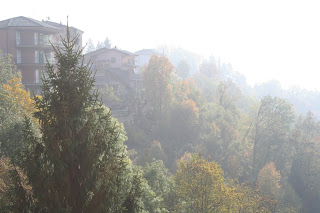 Maire and I and our Caoimhe (19) and Jim (16) decided to spend a short weekend away in Italy – we had spotted cheap flights to Bergamo on Ryanair and used Tripadvisor to scour the area nearby for cheap but good hotels.
We came accross Hotel Miramonti which is about 40 minutes from Bergamo up in the mountains.
The town was called Rota d’Imagna and it is very pleasently located high up in the alpine foothills.
 We also spent a day in Bergamo itself – this is a wonderful town especially the old city.
This was a great weekend – really enjoyable with just the four of us. Maire and I were especially keen to practice our Italian. But we had little opportunity as most people were so nice and of course, wanted to speak English to us.
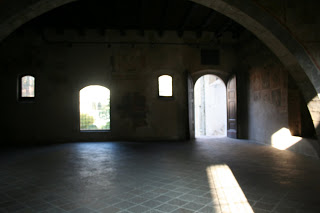
Jim was keen to practice his photography skills and indeed he took some very beautiful pictures.
It’s great just to go somewhere quiet. Rota d’Imagna was a quiet town.
Pictures are from the town of Bergamo. -
Problem Based Learning
 Students from the Post Graduate Diploma and Masters in Learning and Teaching participating in a Problem Based Learning Workshop in the Centre for Research and Innovation in Learning and Teaching at National College of IrelandThis year we are running a new course at National College of Ireland – the Post-Graduate Diploma and MA in Learning and Teaching. I am course director for this course and I present a module on Theories of Learning and Cognition.We have a core of sixteen students with some additional attendees from the PhD course and faculty development. The students come from a wide variety of backgrounds with one thing in common – a passion and commitment for learning and education.We used an instructional approach know as Problem-Based Learning (PBL) as a means of integrating the three semester one modules on Theories of Learning, Research Methods and Philosophy of Education.PBL was structured around a series of workshops on Tuesday evenings and Saturdays. My colleague Rachel Doherty from the School of Business organised the students in groups to complete a series of authentic tasks.In the first exercise the group tasks were to compose and present a series of student induction presentations – the kind that would be presented to new students starting a college course.
 Each group was given a different profile for the entry cohort. In one case the students were adult returners with no previous formal education, another had to prepare for recent graduates continuing to a post-graduate course and still another had to present to a group of busy professionals attending a career oriented course.Organised in this way students had to draw on theory, research and underlying philosophy to prepare their solutions to the problems. This is PBL in action.Afterwards, students were asked to write a reflection – on the whole PBL was very enthusiastically endorsed.From a teachers perspective there is a lot of work involved in preparing the workshops – thanks to Rachel for doing this – and we needed to work out a fairly detailed assessment matrix to make sure that individual and group participation was recognised. Most of the marks go for the process rather than the outcome – this is characteristic PBL.
 -
Uncategorised
Seminar on the Pedagogy of Messy Play
 Each Friday during term we hold professional development seminars for faculty and staff at NCI.
These events focus on learning, teaching and research and we always have interesting and engaging topics.
Today, our colleague Catriona Flood from the Early Learning Initiative at NCI presented a seminar on the pedagogy of messy play.
During the summer a number of messy play sessions were organised by the ELC and children and parents from our hinterland attended. The kids got stuck in so to speak and often when we looked out our windows into the enclosed garden at the college we were treated to the sight of a multitude of little ones splashing, banging, playing with sand, glup, paint and ‘coloured stuff’. Yes generally making a mess!
One might ask – is this really learning? Yes it is and it is in its purest form. The natural instincts for inquiry, socialising and ‘messing’ with the environment are fundamental for development and growth of thinking skills. Catriona’s presentation focused on the principles of early school education and the thinking behind each of the play activities. Participants at the seminar were also treated to some messy play objects which they duly played with.
Subsequently the discussion focused on the relationship between play and learning even in third level contexts. Play often provides a safe space where new roles and activities can be explored.
One further thought – the kids who participated in the messy play sessions had their first encounter with a college as 3 to 8 year-olds hopefully we’ll see them again as students in the future.

-
Uncategorised
Weekend in Paris to “Sea the Stars”
Ryanair have a lot to answer for.
A few weeks ago Eamon, a good friend of mine, rang me to say that he had spotted cheap flights to Paris for the last weekend in September – the Arc weekend.Eamon and I both had busy Septembers so this was great timing for a short break.
Our main interest was the Prix de L’Arc de Triomphe, perhaps the most prestigious race for top grade horses and this year something special was on the cards as Sea the Stairs an Irish (John Oxx) trained horse was on to complete a remarkable run of group one wins.
What this horse achieved in winning this race has never been completed before and without doubt makes him the most valuable horse in the world – watch and enjoy!
-
Uncategorised
Learning Italian Together (translated by babelfish)
La mia moglie Maire ed io ha deciso di imparare insieme l’italiano questo termine.Poichè siamo entrambe l’implicato nella formazione abbiamo pensato che fosse una buona idea imparare insieme la lingua.Dopo che molto cercando abbiamo trovato che il nostro istituto universitario della comunità locale ha fatto funzionare un corso di sera su Wednesday’ s alla volta che ci ha stato adatti.Ho mancato i primi due codici categoria dovuto altri impegni ed in modo da ero molto di scuse quando ho unito per la prima volta ieri il codice categoria.L’insegnante era fantastico – una giovane donna italiana molto amichevole che ha un regalo naturale come insegnante.Era grande – sono un principiante completo e con Maire (chi non aveva mancato i primi due codici categoria) abbiamo lottato con le introduzioni di base, vocabularly e la grammatica.Arrivederci per ora LeoMy wife Maire and I decided to learn Italian together this term. As we are both involved in education we thought it would be a good idea to learn the language together.
After much searching we found that our local community college ran an evening course on Wednesday’s at a time that suited us.
I missed the first two classes due to other committments and so was very apologetic when I joined the class for the first time yesterday.
The teacher was fantastic – a very friendly young Italian woman who has a natural gift as a teacher.It was great – I am a complete beginner and with Maire (who had not missed the first two classes) we struggled through basic introductions, vocabularly and grammar.
Bye for now
Leo
-
Our Digital World invades the Bicycle!
The Dublin bike scheme is a welcome addition to our city. It will be great for toursists and locals alike. Dublin is a relatively flat city and if you can brave the wind and the rain then cycling is a great way to get about.
I had seen the new stands being constructed and looked forward to the inauguration of this new service for many months now. How practical! How green! How good of our city and government to, at last, offer something for ordinary people to use and to enjoy.
So you can imagine my enthusium to read the practical details as they were published in the newspapers this weekend. Then I saw something that made me slightly uneasy:
Users, who must register online at www.dublinbikes.ie, pay a €10 annual membership fee and leave a €150 security deposit through a credit card or bank draft.
Mmm… I’ve been around long enough to realise that you can’t just leave bikes lying around and expect people to use and return with honour. No – the need for a deposit did not bother me – nor the €10 annual membership. Even the charges per hour are reasonable and it is understandable that we should be charged for such a service. No – none of these aspects would cause me to take to a blog and have a rant – no it’s this:
Users, who must register online…
Are you joking! Our government, our city will offer this service to some citizens – the digitally literate and broadband connected privileged majority. Tough on you if you don’t use the Internet, tough on you if you haven’t a credit card or if you are reluctant to set up a new direct debit on your bank account.
By the way, I went through this process on-line and it is one of the least user friendly experiences you could imagine – you will even need you IBAN number and an address with a compulsory post code (we don’t use post codes in Ireland). The company operating the service is JCDecaux (an advertising company) and although the front page of the website clearly displays the Dublin City Council logo when you go through the payment process you are actually dealing with a private company.
Now I don’t want to appear to whinge – for me the new service is of great value. But whatever happened to our notions of an egalitarian society – if we offer a service to people of the city then it should be available to all. Consider groups such as retired people (the older you are the less likely you are to be an Internet user), people who are currently having trouble with credit, perhaps unemployed, all of whom could reasonably be expected to be prime users of this service and yet even with cash in hand they cannot use the service.
Likely the explanation centres on creating an effective service with low administration costs. The irony should not be lost – the humble bicycle is simple and efficient but in order to use these city bikes you need the Internet and a bank account.
There is nothing worse than feeling left out – those who struggle with the Internet, fear it, or just havn’t figured it out are the forgotten many in our society. We are all citizens of this land and we should have a reasonable expectation to be treated equally.


