-
Uncategorised
What are we teaching in schools?
Two very interesting comment pieces appeared in today’s Irish Times. The editorial commented on the draft report by the National Economic and Social Forum on the connection between school literacy levels and social exclusion and inside, a piece by Breda O’Brien (link above) on creativity and second level education. It is interesting to connect the two pieces.
As a society we have a responsibility to prepare young people for the future – this is what we expect of our education system – but we cannot possibly know what the future has in store. As the educational philosopher John Dewey put it – the best we can do is to teach children how to experience the present to its maximum extent.
Our children are poorly served by an archaic education system where state exams focus on selective recall and pure luck. Notice that we have the State Exams Commission not the ‘educational assessment’ commission indicating that they are only concerned with ‘exams’ one form of educational assessment. This is like an orchestra that can play any music as long as it is composed by Mozart!
Future oriented skills such as critical thinking, inquiry, creativity and collaboration are largely undervalued in the present school system. Until we reform the pedagogy of schooling and assessment we will continue to suffer the consequences of poor literacy levels. And large numbers of young people from disadvantaged backgrounds will continue to face a future on the margins of society. -
Course Entry Requirements – Recognising Learning from Experience
If you are thinking about taking a course, for example any of the NCI courses in the prospectus, you may see in the entry requirements that it is necessary for students to have a specific level of degree (e.g. honours degree) or a certificate or diploma to gain entry.
These conditions are necessary so that all students are able to participate effectively and teaching staff can make certain assumptions about the level of prior knowledge people will have.
However, there is a down side to this in that sometimes very good potential students miss out because on paper they are not deemed to meet the entry level requirements.
We’ve all come across examples in our work where people with significant experience and competence in a particular field are not necessarily the most qualified in the formal academic sense.Not many people know this but there is a mechanism whereby anyone can obtain a formal academic credit (yes I mean a degree, diploma or certificate) by means of providing evidence that they have achieved the learning outcomes equivalent to a recognised qualification.No this is not some e-mail scam to give people cheap meaningless degrees from a little known US private college – this is the policy of our own Higher Education and Training Awards Council (HETAC) and it is enshrined in the legislation used to establish this national awarding authority.
Here is where you apply to HETAC for this process.
It is now accepted that there are three contexts in which learning occurs:
formal learning – this is when you undertake a course of study usually with a view to obtaining a formal award or qualification;
non-formal learning that takes place sometimes in the workplace (e.g. training courses) or community or voluntary sectors – although often assessed it does not normally lead to formal certification
and informal learning – sometimes referred to as experiential learning and takes place through life and is often not recognised a s learning by the individual concerned. Experience is the key driver for new knowledge and the development of competence.Educators now recognise that all three of these contexts are important sites for learning. The challenge is that accreditation bodies need formal systems to measure learning outcomes and understandably they require that potential candidates produce a portfolio of evidence which is accessed and verified by an academic panel.
To go back to the entry requirements for courses – did you know that it is possible to make a case that your extensive experience should be taken into account when apply for a course where, on paper you do not appear to meet the entry requirements.
All colleges operate such a scheme – this is especially the case in NCI where wider access to learning is our core mission.
The process requires that the applicant undergo some form of appraisal to demonstrate that they have achieved the equivalent learning outcomes as those with formal qualifications.
This may involve preparing a portfolio of experience or writing an essay or assignment to demonstrate your competence – in all events it will be evidence based.
If you really want to do the course and feel that you know more about the area through experience – you can prove your case through accreditation by prior experiential learning (APEL) – its more straightforward than you think.
So go on! What are you waiting for.
You May Also Like

Getting to Grips with Academic Writing
-
Uncategorised
Leaving Cert English Fiasco – There Was Another Way!
Big Problem!
In assessment terms, the majority of our state exams may be characterised by unseen (in advance) questions and time limited tests.
The shock news of today is the fact that through some unfortunate human error the questions for Leaving Cert English paper 2 were inadvertently distributed to a small group of students intending to sit paper 1.
“The integrity of the exam had been compromised by the regrettable incident” said the Minister for Education Batt O’Keefe.
The State Exams Commission considered they had no option but to cancel today’s paper 2 exam and ordered that a new paper 2 should be taken by students this Saturday.
This is no small inconvenience it is very distressing for the students concerned, it will cost a lot of money and it has discredited the operational effectiveness of those responsible for organising the exams.Was there any alternative?
The simple answer is yes and it is a great shame that some lateral thinking was not applied to the problem.
The issue had to do with the consequences of some students knowing the questions one day in advance.
Let’s suppose that we want the exam process to adhere to two principles that may have been undermined by the leaking of the questions in advance – the first is the ‘unseen’ nature of the test and the second is the principle of ‘fairness’ in that some students will have seen the questions and some may not.Seen and Unseen Exam Questions
Let us deal with the consequences of students seeing the questions in advance. What if the papers were corrected with this knowledge in mind? Open book and open or seen question (i.e. the questions known in advance) exams are not at all unusual in the third level sector.
Once the person correcting the scripts knows the conditions under which the exam was taken it is simply a matter of taking this into account.
It’s really no big deal that the students knew one day in advance which poets they will have to write about.
The other, much more important, issue is that of fairness. A situation where some students knew the questions and others did not would violate this principle and would be unacceptable.
The Department of Education claims that they found out about the breach of security at 4pm yesterday afternoon and had to make a decision on the resit within a very short time frame. I have some sympathy for them and someone has to answer for the fact that the error was not reported sooner.
But was that the right or only decision available?
No!
I suggest that the Department should have published English paper 2 there and then and used the news media to disseminate that fact.In this way all students could read the paper and prepare on equal terms.
There was no ideal solution once the security of the system broke down but publishing the exam paper would certainly have been the least worst option.
Perhaps the whole fiasco will provide a stimulus for some much needed rethinking on how we assess learning at a national level.
-
Ian Paisley Comes to NCI
Dr Ian Paisley arrived at National College of Ireland as part of the Legends in Your Lunchtime series.
The idea is a series radio interviews with famous people recorded in front of an audience at the college. Newstalk and Metro partner with NCI for these events.

Paisley can still attract a crowd.I have to say I have very mixed feelings about Paisley. Like many people who lived in the Republic throughout the troubles I regarded Paisley as the epitome of unionist intransigence. No one can say for certain but fixed and extreme views on both sides meant that a resolution came about only after many, many more years than necessary.
Paisley must shoulder his share of responsibility for this.
Still, as I sat near the front of the lecture theatre, I could not help but be taken in by the warm, affable manner of the 82 year old Paisley.
George Hook as the interviewer is old enough to remember how in the bad old days Paisley used to storm out of TV studios if he did not like the question or the tone of the interviewer.

George sat stern faced in the lead up and I wondered if he’d be up for the task.
Paisley himself sat well back and placed his well-worn copy of the King James Bible on the table in front of him.
And so down to business….

George started on comfortable ground “tell us about your mother and growing up in Ballymena”.
The early exchanges were were a tame affair – even Paisley wanted to up the ante
“If you strike an Ulster man he’ll strike you back – it’s as simple as that”. This was how Paisley summed up the troubles.
George decided that this was warning enough and kept the next few questions along the religious theme asking about Paisley’s bible and his days in a seminary in Wales.
Soon George got into his stride and decided to lob in a few testing questions to get the big man going – “sure you and the pope have a lot in common” he quipped. Paisley had heard that one before and quickly pointed to his book – a direct line to God.
George realised that Paisley was not going to run and decided to ask the big question. “What if your wrong – what if you die and there is no God – I have to confess I worry about that myself” – George was honest enough about his own doubts.

Ian has been preaching all his life and rattled off a great platter of God-affirming experiences. George looked almost convinced and I thought we were going to witness a live conversion.But Hookie was wiley enough and there were other questions to ask – what about the peace process? Do we really need a border?
All the time Paisley’s responses were clear and predictible.
So now we have a new Paisley – a big teddy bear – or really a dinosaur confident in his religion and ready to meet his maker.
It was good to witness this and it’s a great example of what third level institutions should do to open minds and to engage with wider issues.
I caution that we should never glorify the obstenate, retrenched or bigitoted behaviours of the past past but equally we should be open and receptive to those who make peace.
After all the good book says:
“Blessed are the peacemakers, for they will be called sons of God” (Matthew 5:9)
. -
The Child Abuse Report – Adults now Children then
I can’t let this week go by without commenting on the publication of the report on abuses in the Irish education system by members of religious orders.
The report was particularly scathing of the Christian Brothers.
I went to a Christian Brothers school and indeed was walloped, slapped and beaten like many others. There was violence in my schooling but also lots of good stuff and on balance I got away lightly.
In light of the report I wish to comment again on the phenomenon of Learning Identity – I talked about this in a previous blog.
As you might expect my ‘learning identity’ is made up of two components – my view of learning and my view of myself as a learner. For many adults, including the victims of abuse in educational institutions, learning identity established in childhood remains fixed throughout life.
The consequences of the deplorable schooling system are still being felt today – people have fragmented learning identies. For many, even to think about formal education will give rise to extreme anxiety.
As such, these people miss out on the opportunities to progress and to participate effectively in society.
For those of us involved in current adult education provision – we need to think first and foremost about how to deal with learning identity.
We have a lot of work to do rebuilding the trust and confidence of adult learners – convincing them that current pedagogic practice is not like school and that they have a lot to offer as lifelong learners.
We will never adequately compensate the victims but we should strive to limit the negative impact on their lives today.
Everyone has the right to learn throughout life – this is especially the case for those whose childhood opportunities were so cruelly denied.
-
Carl Wieman Lecture
I attended a lecture in DIT Bolton Street by Dr Carl Wieman titled
“Science Education in the 21st Century; using the methods of science to teach science”
.
This was of great interest to me as in the distant past I studied science and, like many others, I believe that we need to do more to stimulate effective practices in science eduction.Many science teachers at school and college level are passionate about their work and are often willing to explore new pedagogic methods to stimulate student engagement.
Wieman focused on teaching methods and as his title suggests he uses analytical methods to assess different approaches and strategies.
He contrasts two educational models:
Model 1
Teacher encounters a new problem or concept
Teacher figures it outTeacher explains to students
Students demonstrate that either (a) they know or (b) they don’t know the concept or problem
If outcome (a) – student learning is effective
If outcome (b) – student not making sufficient effort (lazy student!)Model 2
Teacher encounters a new problem or concept
Teacher figures it outTeacher establishes learning goals
Teacher guides student activities (the design of these activites is the practice of teaching and is informed by research and expeience)
Teacher measures learning outcomes
(a) students solve relevant problems
(b) students cannot solve the problems
If (a) all well and if (b) quesion either the goals or the activities (note not the student effort)Wieman of course advocates the second model and he maintaines that through well planned activities and frequent data gathering and analysis the ‘goals and activities’ approach is consistently better for student problem performance and concept attainment.
Expertise
Experts regardless of context (scientists, musicians and chess players) are characterised by three components
(1) access to lots of factual subject-specific knowledge
(2) an ability to recognise patters – an organisational framework
(3) an ability to self-monitor one’s thinkingPerhaps traditional teaching has emphasised the first of these components and neglected the other two components.
All of this makes a clear case for greater use of problem based learning.
One thing I disagreed with was when Carl Wieman said that in thinking about his ideas on teaching we should ignore the fact that he has a Nobel prize for science – oh no – not at all. We would not all be there if he had not achieved so much and his opinion does carry significant scientific authority.
Wieman’s ideas on teaching are very much in keeping with current thinking in the scholarship of learning and teaching – what is really encouraging is that a great scientist is advocating that we think again about our approach to education.
Perhaps more will listen to such a voice.
-
Dachau
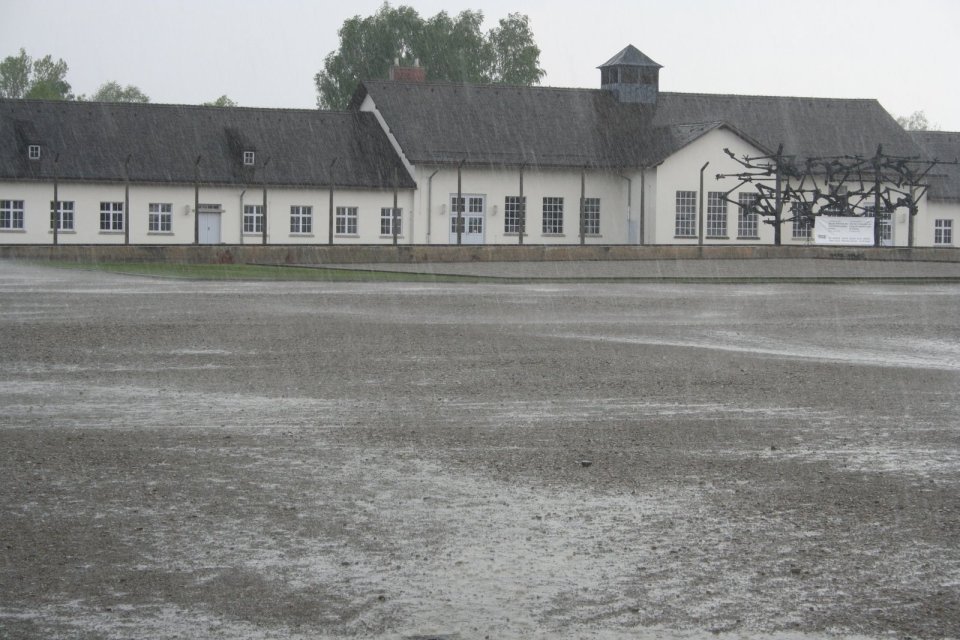
This is Dachau – the first concentrati on campt built by the Nazis.
Be careful not to become smug when you visit this place – we are all convinced that such a place could never exist again and that there is no way that ‘normal’ people would be convinced to co-operate if it was attempted.I spent some time in Munich when I was in my twenties (circa 1980) – I had a fantastic time and made many good friends. Although I knew about Dachau I never went to visit. My wife, Maire gave me a wonderful present of a trip back to Munich for the May weekend and this is how I came to take the picture of the square in Dachau KZ.Look closely and you will see that it is pelting rain.
There was a great crack of thunder and lightening – it struck quite close and left a strong lingering smell of ozone – all of this served to magnify the sense of unease at visiting this place.
Much has been said about these places – I feel that everyone should take time to reflect on how evil can come about and be sustained.
Dachau is a medieval town and the guide books emphasise that it was always a nice place to visit.
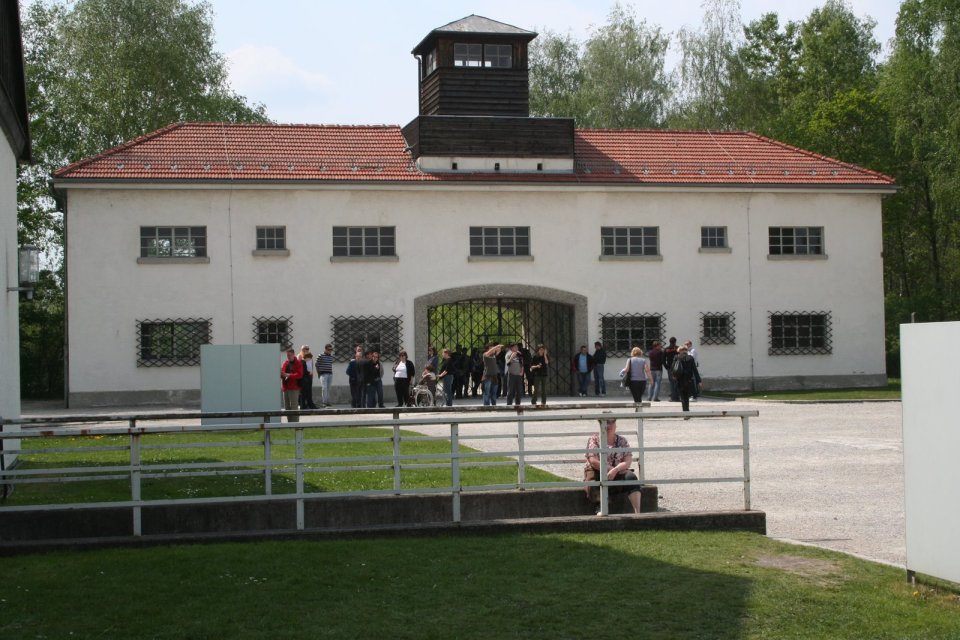
I was struck by the ordinariness of the place – including the camp.
Look at this picture of the gatehouse – it’s not very big and it is reasonably well designed – when you read about what went on here it is difficult to believe that this same building was used to subdue, torture and murder people. “In this room on the second floor was the Gestapo interrogation room”.
What unspeakable stories are locked within these walls.
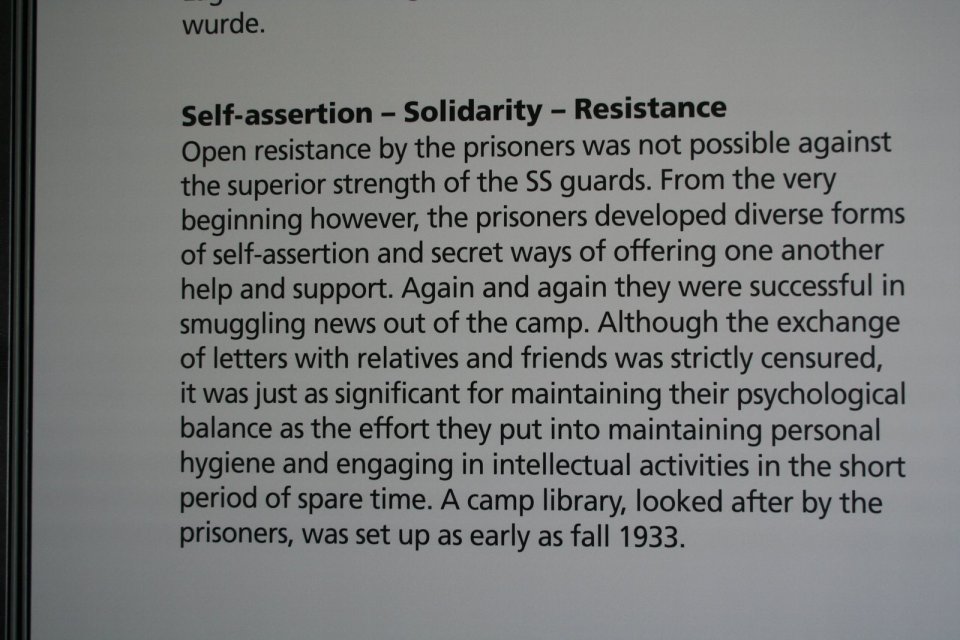
Even here – people sought to be competent and fulfilled.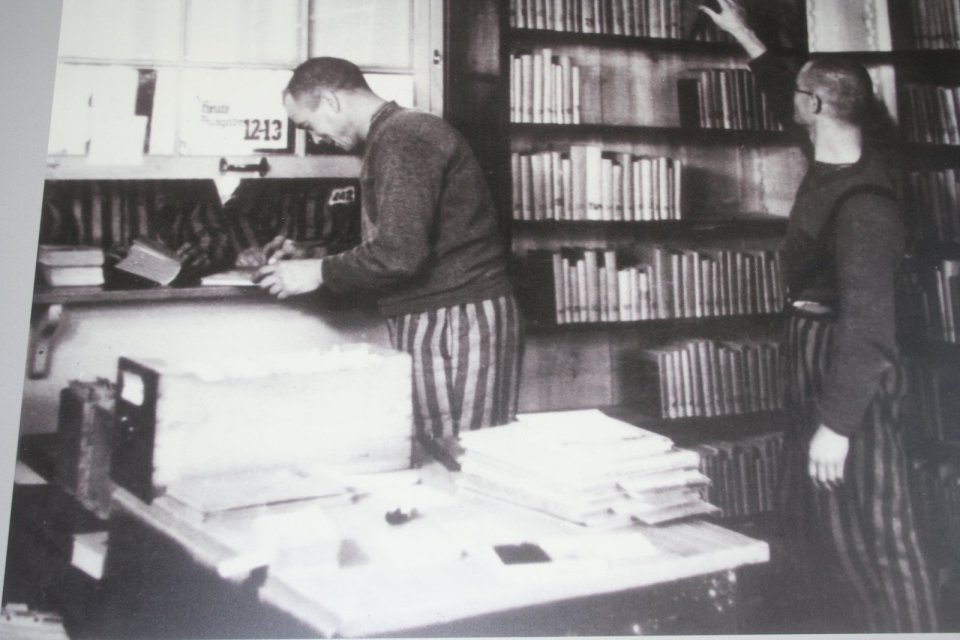
These pictures show the library at Dachau and the work of an artist interned here.
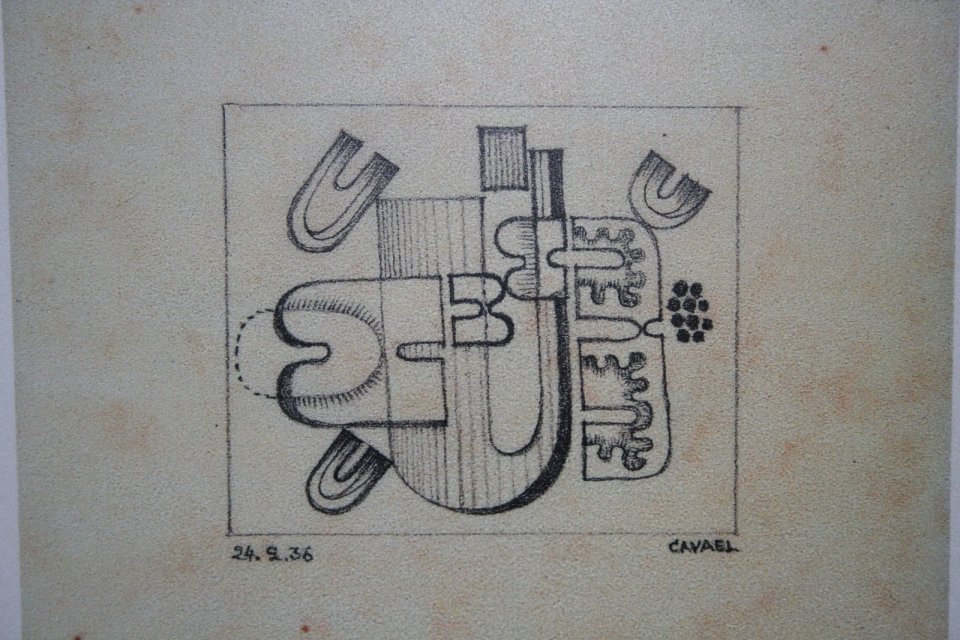
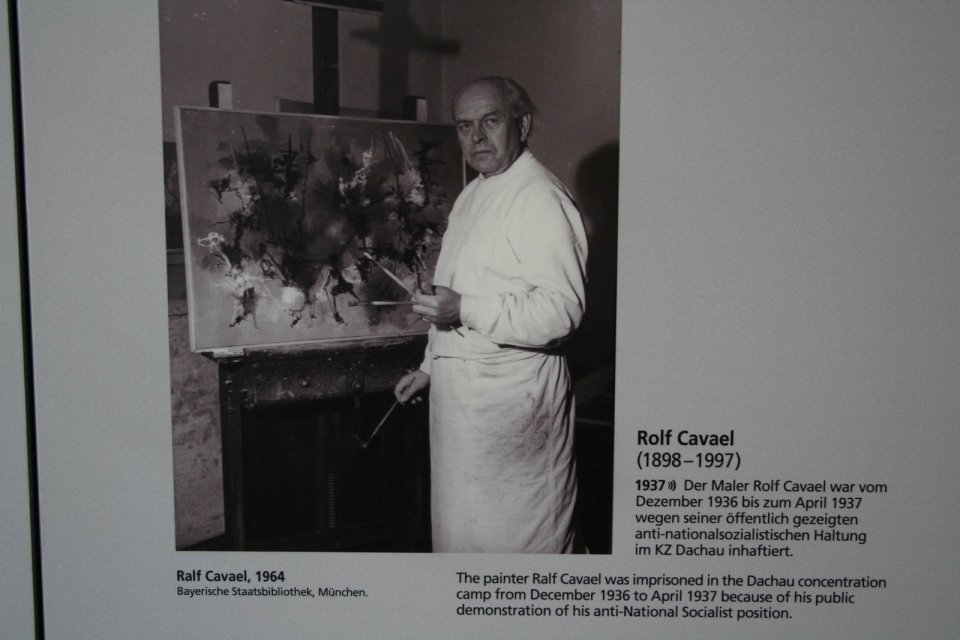

-
Plagiarism Reframed
Mention plagiarism to any third level academic and you are likely to be greeted with groans and laments.
This is one topic that gets into people’s hearts – it leads to animated discussions and hard views. It is unwise to be regarded as soft on the issue.
It is annoying, very annoying to be reading something presented as a student’s original work when it dawns on you – this is familiar – or – this is not the same style of writing as expected.
Plagiarism is genuinely offensive to many academics – it offends one’s sense of academic integrity and is regarded as a dishonourable practice and a form of cheating.
Many also feel that the student is trying to make a fool out of them – the tables are reversed – instead of the assignment being a test of the student it is a test of the examiner.
Assuming the examiner will not spot the obvious is a form of insult.In most institutions plagiarism is treated as a disciplinary rather than learning or teaching matter – student’s face expulsion, suspension and fines if they are found guilty of the charge.
Remarkably, despite clearly stated policies and warnings to students – it seems that the incidence of plagiarism is increasing rather than decreasing. All in all it is of great concern and worry.
There is a need for a radical rethink of how we conceptualise and deal with plagiarism.Most treatments of plagiarism begin with a definition and they look to dictionaries as the source (always a worrying sign) – something like – plagiarism is the act of passing off other peoples written work as your own etc..
Much of the academic practice centres on how to spot plagiarism and how to punish it. There is a good business in the technology of plagiarism detection (most people know the Turnitin software).
Of course, as the technology on the detection side gets better – so too there are many more Internet sources to copy and even services that will write your assignments for a fee.
We have the plagiarism wars – each side trying to outwit the other. As with all wars there are casualties on both sides.“If I was you I wouldn’t start from here at all” said the wise Kerryman when asked for directions. So with plagiarism let’s leave it for a while and come at the problem from an entirely different starting point.
A constructivist pedagogy assumes that we build new knowledge through the interaction of present and past experiences. I like to refer to this process as the act of making meaning. For example, when I read good theory the ideas resonate with me – I connect these new insights with my past experiences. An essential characteristic of the constructivist model of learning is that making meaning is a unique and personal process. There is no universal knowledge just personalised knowledge.
Dewey contrasts the traditional and constructivist approaches to learning:
On the one hand, learning is the sum total of what is known, as that is handed down by books and learned men. It is something external, an accumulation of cognitions as one might store material commodities in a warehouse. Truth exists ready-made somewhere. Study is then the process by which an individual draws on what is in storage.
On the other hand, learning means something which the individual does when he studies. It is an active, personally conducted affair.(Dewey, 1944 p 335)Dewey’s own vision was in keeping with the latter active notion of learning expressed above. If you agree with a constructivist model of learning (and most theorists do) then there is no such thing as purely original work. Even these words as I write are made up of insights and ideas from many sources – true I have integrated these with my own.
So for most of this text – which I claim as my own writing – I am making meaning from multiple sources from people, experiences and feelings in my past. Note that where I cite from Dewey above I indicate in the format that these are Dewey’s exact words – I am inviting you the reader to make your own meaning.
When students are given written assignments they are being asked to make meaning not to reproduce knowledge.
Plagiarism is a refusal or failure to make meaning.
There are many reasons why people refuse or fail to make meaning. Sometimes students are confused about what is expected, some students are reluctant to express their own ideas as they feel this is not real learning. Other students worry about their ability to write and are in awe of other peoples words – how could I write it better than an expert. Some cultures are more reluctant to question great writings and individual meaning making is discouraged.
And yes – some students are genuinely dishonest and are attempting to cheat the system.
How can we deal with plagiarism?
The first point is that prevention is far better than cure. Cheating is really only significant where high stakes assessment is involved. In other words when students are being ‘tested’ and the result forms part of their grade. A strategy of providing early ‘low stakes’ or formative assessment events will provide feedback to students who miss-learn what is expected of them when they write.Secondly, academic writing requires additional skills and specialist knowledge such as how to format, cite and prepare bibliographies. As with all skills people learn best by a mix of rule learning and practice. When used properly, citations and quotations may provide a form of scaffold for the novice academic writer while he or she is finding their own voice and meaning. But many students at this stage fail to apply the citation rules and often regard them as incidental – a question of format rather than core content. Early and frequent opportunities to practice academic writing with rapid feedback on errors and progression will counter this.
Finally, what of the cheats – what’s really happening here? I believe cheating is also a consequence of miss-learning. It is a failure to learn values. The values of academic integrity and the collaborative quest of knowledge underpins the third level education system. This frequently gets mixed up with the economics of qualifications and the preparation and entry points for jobs. A student who cheats believes that there is a short cut to a qualification and that the assessment is too blunt an instrument to catch them.
This may say something about the standards and practice of assessment as well as the character of the student.
References
Dewey, J. (1944). Democracy and education (First Free Press Paperback ed.). New York: Macmillan.You May Also Like
Getting to Grips with Academic Writing
-
Learning Assessment Through Life
I attended an excellent workshop today on the topic of assessment and learning. The workshop was delivered by Professor Sally Brown of Leeds Metropolitan University in the UK. The attendees consisted of a mix of our own faculty at National College of Ireland and teachers from some of the other colleges around the country as part of the Learning Innovation Network.
Sally started by inviting participants to reflect on how learning assessments have impacted on all our lives.
This exercise got me thinking about the idea of a lifespan perspective on assessment – key moments of assessment and how significant their influence can be.
When I was in school we were streamed in classes A B C etc.. I remember being asked a question when I was being assessed for 2nd class primary school (I would have been about 8 at the time). After infant school in a convent I went to a Christian Brothers School and on the first day the brother gave us a one-to-one interview that lasted about two minutes (or at least that is my recollection of it). I was asked “what is eight plus five?”. I actually knew the answer but I could not respond because I was so terrified of the situation.
I ended up in a B stream and I remain convinced that the decision was made on the basis of the brief interview and my inability to respond. Through my years at school a pattern was repeated – I would move from the top of a B stream to the bottom of an A stream as a consequence of some test or other.
Maybe this was no bad thing for me and I have always been comfortable with my recollections of school (see my earlier piece on learning identity).
I also recall how assessment has always been connected with qualifications. Sally Brown is a big advocate of
“assessment for learning rather than assessment of learning”.
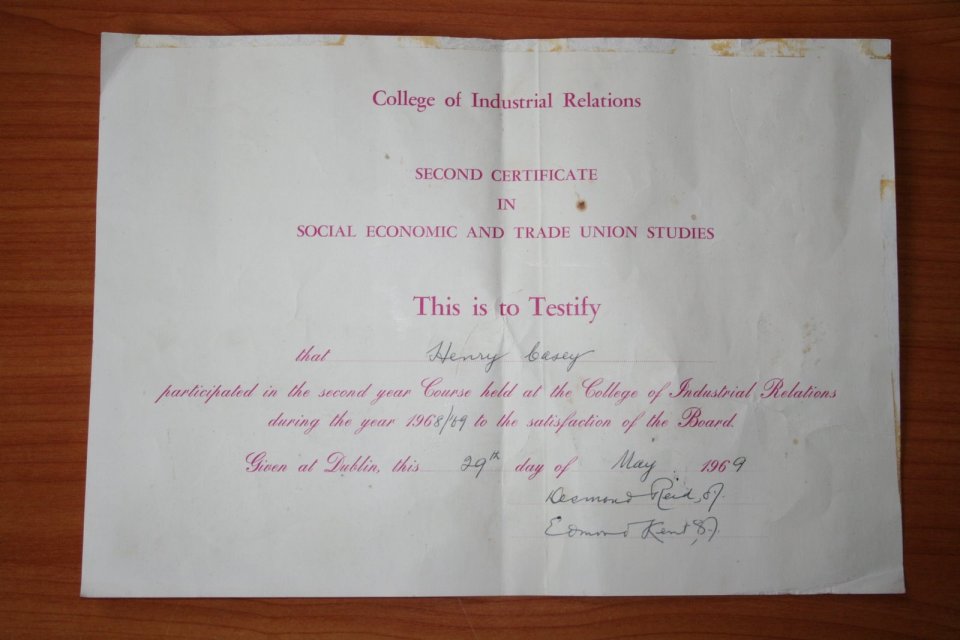
When I joined NCI – my mother was quick to point out that my father had studied in the old College of Industrial Relations when it was based in Ranelagh.
My father, Har was an active trade unionist and he had a strong sense of social justice which extended from his support for co-workers to participating on a picket of Dunnes Stores in solidarity with a shop worker dismissed for refusing to handle South African produce during the apartheid era.
My mother rooted out Har’s old certificate in Trade Union Studies and gave it to me. In all likelihood there was some form of assessment involved in this course I don’t know but I have the evidence of certification.
Yes, all our lives are shaped and influenced by educational assessment and certification.
As educators, we have a big responsibility to arrange assessment that is conducive to learning and is effective and fair. You’ll never know for how long or how extensive its influence may be.You May Also Like
Getting to Grips with Academic Writing


