The Cycle of Life
Thoughts about life in Ireland, cycling and what I've learned along the way
-
November 2010 Ireland in Turmoil – The Relevance of Habermas and the Theory of Communicative Action
It may seem odd to make a connection between the current upheavals – the political, economic and national identity crisis in Ireland – and the work of Jurgen Habermas, a German social philosopher and critical theorist born in 1929. However, I believe that insights from the work of Habermas have something to offer by way of explanation for the current predicament in which we now find ourselves and more enticingly, may also provide useful pointers for our emancipation through discourse and communicative action.
Habermas is still a very active writer and he comments regularly on political and social issues of our time. You can keep up to date with his outputs via the Habarmas forum website. Of note also is that Habermas was a recent recipient of the Ulysses Medal conferred by UCD – an interesting interview conducted by the Irish Times is also available.
The most notable work by Habermas is The Theory of Communicative Action published in German in 1981 and translated to English in 1984. This publication is in two volumes: Volume 1: Reason and the Rationalization of Society and Volume 2: Lifeword and System: A Critique of Functionalist Reason. These works integrate and draw upon the work of other critical thinkers (Mead, Durkheim, Weber, Adorno, Marx) to unfurl Habermas’ own insights on language, reason, rationality, society, discourse and communications. The works of Habermas are the subject of active scholarship and because of the (relative) recency and complexity of his theories most people have not had a chance to become acquainted with his ideas and to make meaningful connections to their own life and circumstances.
What I’d like to do is to introduce some of the core concepts from Habermas’ work and to invite the reader to reflect on the implications for what is happening today. These are my interpretations of Habermas; understandably, I have had to summarise and reduce some quite complex theory. What’s intended here is a beginners guide, an appetiser – if you want the main course go directly to the works cited above.
Instrumental and Communicative Rationality
Let’s start where Habermas starts with a re-examination of the notion of rationality. In Reason and the Rationalization of Society Habermas suggests that we distinguish between two forms of rationality; first cognitive-instrumental rationality and secondly communicative rationality.The first of these relates to how we act instrumentally on the world – this is the realm of science, mastery of the environment and logical problem solving. When we make predictions based on empirical evidence or use mathematics to propose new theories of physics or even apply our knowledge of forces and structures to build bridges, in all these practices, we draw on instrumental rationality.
In contrast, communicative rationality is a wider concept and
“… carries with it connotations based ultimately on the central experience of the unconstrained, unifying, consensus-bridging force of argument of speech, in which different participants overcome their merely subjective views and, owing to the mutuality of rationally motivated conviction, assure themselves of both the unity of the objective world and the intersubjectivity of their lifeworld.”
(Habermas, 1984, Vol 1 p 10)What does Habermas mean by this? Look again at the quotation above and consider what he is suggesting. He is proposing that communicative rationality is process oriented rather than mastery or output oriented. What is this process? It is the ‘consensus-bridging force of argument’.Here is my own explanation for understanding communicative rationality. Let’s say that you are a jury member in a criminal trial and on completion of the hearing you retire with others to consider a verdict. You consider the evidence – forensic scientists have made assertions, witnesses described their perspectives – all together the case is quite compelling: the woman certainly killed her husband. But was it murder or self-defence? Together you discuss further aspects of the case. Was she defending herself, or her children, did she have other options? Was her action justified? In this scenario we see both forms of rationality at work – instrumental reasoning establishes the basic ‘facts’ but in this case, and many aspects of human endeavour, we need another form of thinking, we need to deal with something altogether more complex (guilt versus justification) and instrumental reasoning is of little value. We need a process of communicative rationality to establish an acceptable truth. In our society we see this as a collective process – that’s why we have juries and even when we rely on judges for verdicts they need to cite precedence – wisdom from the collective.
The Lifeworld
Habermas also introduces the concept of lifeworld (Lebenswelt). In deriving this concept Habermas builds on the work of the learning theorist, Jean Piaget. Piaget is best known for his stage theory – descriptions of the phases in which children develop cognitive structures for abstract reasoning and formal thought. Piaget’s basic idea is to distinguish between two forms of learning – that which adds to our existing knowledge and that which transforms the structures we use to deal with new knowledge. It is through this second form of learning (often called development) that we develop our capacity for thinking. As adults we have developed these structures into rather elaborate models of the world. It’s as if we have an internal working model of the universe that we constantly adjust as we gain more and more insights from the external world through experience. So, for Habermas, this internal lifeworld is of critical importance when it comes to communication.Here is my own explanation. Suppose people are engaged in conversation about the “knowledge economy”. For each participant, we can regard the subjective view of what constitutes the knowledge economy as comprising part of their lifeworld. Obviously, for a socially-construed construct such as the knowledge economy, there will be elements of common understanding among the participants. However, it is also likely that their will be considerable differences among the participants as to what constitutes the knowledge economy. Each participant will bring their own pre-formed assumptions into the conversation. Lifeworld’s are both personal and social, and this is why Habermas talks about ‘the intersubjectivity of their lifeworld’ in the quotation above. Habermas argues that “subjects (LC people) acting communicatively always come to an understanding in the horizon of a lifeworld” (p 70). So it is through these conversations, or larger communicative processes, that we form and change the foundational assumptions upon which we build our understanding of the world.
Discourse and Communicative Action
We use the term discourse to describe the truth seeking process or quest involving communicative rationality. In this we seek a course of action that best serves the needs of society – the common good so to speak. Thus, the discursive process may be regarded as a universal value underpinning humanity; transcending cultural, religious and social norms (this relates back to Kant’s notion of universalism) . What I am really saying, and what I think is the key message from Habermas, is that quality in how we listen, discuss, argue, accept (other perspectives), reason and decide is an essential quality and is core to what it means to be human.What constitutes the ideal argument? Or to put it another way, what are the ideals of argument? Habermas proposes ‘discourse ethics’ as a means of articulating these ideals. Simon Chambers discussion on “Discourse and Democratic Practices” summarises Habermas:
Communicative actors are primarily interested in mutual understanding as opposed to external behavior. Therefore, they attempt to convince each other that there are inherently good reasons to pursue one course of action over another. Only the “force of the better argument” should have the power to sway participants. Discourse, as an idealization of this kind of activity, must set conditions such that only rational, that is, “argumentative convincing,” is allowed to take place. It must be a structure that is immunized in a special way against repression and inequality.
The immunization is gained through a set of rules designed to guarantee discursive equality, freedom, and fair play: No one with the competency to speak and act may be excluded from discourse; everyone is allowed to question and/or introduce any assertion whatever as well as express her attitudes, desires, and needs; no one may be prevented, by internal or external coercion, from exercising these rights.
Ireland Today
Where and how can we participate in discourse to find the best way forward for the common good? The first and most important point is that collectively we have failed so far because we have ‘out-sourced’ argument. We have left it to the politicians, media commentators and academics to do our reasoning for us. When we seek expertise to fix the problem we look to the epitome or instrumental rationalists, the economists, for guidance. But our problem is not economic, or political or cultural or national; it is the abandonment of discourse.We are all responsible!
.
-
SITE Conference
I recently attended the SITE Conference in San Diego, California. SITE stands for the Society for the Information Technology and Teacher Education and it is one of the biggest conferences in this field. Chip Bruce and I had submitted a paper based on the Digital Literacy in Primary Schools (DLIPS) project.
I attended many other sessions and it was very useful to catch up with developments across the field. One thing that struck me is the use (perhaps overuse) of short abbreviations to describe areas of interest. Thus a session might be described as dealing with TPAC for SET in K-12 – decoded this means Mhisra and Koehler’s (2006) Technological, Pedagogical And Content Knowledge (TPACK – worth a future blog!) for Science Engineering and Technology (SET) subjects in primary and secondary schools (K-12).
The presentation associated with our paper is posted below. The basic idea is an exploration of the connection between learning as inquiry and new digital media. Essentially we argue for a new approach to pedagogy based on the Inquiry Cycle and making the most of digital media capabilities to initiate, sustain and enhance that cycle.
It’s not so much that the vision of learning as inquiry is new – it is in fact a well established idea but that the new media of today make it possible to realistically achieve in a school setting. See my previous blogs on An Organic Approach to Teaching and How Digital Media Make it Possible and my discussion and links on the Inquiry Cycle in my Why We Blog post for further insights.Digital literacy in primary school site presentation 2010View more presentations from Leo Casey.Mishra P, Koehler MJ. 2006 Teachers College Record Volume 108, Number 6, pp. 1017–1054
-
Why We Blog
 Yes! With some help from the marketing department of the best college in Ireland (click here to find out).
I can proudly report that
Leo’s Learning Blog has been nominated for the Irish Blog Awards in the category of Best Specialist Blog.Well, surely this is something to blog about!
Yes! but before I get too carried away I note that there are many excellent blogs in this category including Eugene’s Blog, Deryk Thormy’s Blog and Jimmy Hill’s Blog.
So what’s going on with blogging?
What are we all doing and more importantly why do people blog?As you might expect I have a learning theory that might explain, in part, what may be happening.
I refer you the work of John Dewey (1859 – 1952) the American educationalist and philosopher and the further insights of Professor Chip Bruce a “master blogger” of many years, a great scholar and a friend of mine.
Chip and others have developed the notion of an Inquiry Cycle model of learning based on 4 basic human impulses identified by John Dewey (for a fuller treatment I recommend you read Chips Bruce’s work here).
The basic idea is that we all have a tendency to learn through a cyclical process involving Ask, Investigate, Create, Discuss and Reflect – as in the diagram below (source Chip Bruce):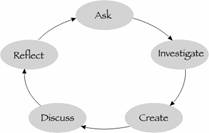
I contend that this is precisely what we seem to be doing when we blog.
We start by asking some kind of question, in my case for example:
Can we measure learning?
Top Ten Insights on Learning
The question “ask” or inquiry begins with the writer but gets passed on to the reader.
Next we “investigate” to get new insights and often source and build on the ideas of others. And, as a natural consequence, we seek to build on the ideas of others – this is the “create” part of the cycle.
With new insights and ideas its only natural (literally) that we seek to share, communicate and “discuss” with others – hence all this blogging.
Finally we we think back on the experience and “reflect” and this, in turn, initiates the cycle again.We live in a complex and challenging and for me, this blog helps me to sort things out – it is part of my inquiry, my way of making meaning and my learning.
-
Lord Mayor’s Commission on Employment
 The Lord Mayor of Dublin, Cllr. Emer Costello, is to be commended for establishing a Commission on Employment for Dublin.
This is an inspired and necessary goal for the City Council and tackling unemployment or, to put it more positively, creating employment is essential for the future well-being of all who live and work in our city.
The Lord Mayor’s Commission has set up working groups on a number of key areas: (1) Unemployment & Employment, (2) Business, Entrepreneurship & Finance, (3) Education, Skills and Training, and (4) Volunteering & the Social Economy.
The commission have invited submissions and I have copied below my own contribution on the area of Education, Skills and Training.
Dublin City of Learning
Let’s stop and think and about learning. No I don’t mean schooling, or formal training or the pursuit of new qualifications. I want us to think about learning – what it means for each each of us and how it gives purpose to our lives.
We learn throughout our lives and each time we face new challenges, we take on new information, adapt our thinking and develop new skills. We learn how to build our identity as we emerge from teenage years, we learn relationships with our partners, to be successful parents and to face the horizon of our life.
The workplace is a specific context of learning and for those who are employed, valuable learning is embedded in the contribution of work effort. This is especially true for the so-called ‘smart economy’. In fact, economies of the kind envisioned in the government plan are better described by the on-going process ‘learning’ rather than the end-state ‘smart’ or ‘knowledgeable’.
This is not just a flaw in the language it is much more fundamental. People who find themselves unemployed are often people who know how to learn but who find themselves without a meaningful context for learning. This is the tragedy.
Some knowledge economy rhetoric does them no service – to talk about the need to upskill people to a condition of ‘smartness’ is to completely miss the point of how knowledge contributes to economic growth. If, on the other hand, we think process then we can make a much more plausible case – that learning itself can lead to innovation and contribute to economic and social well-being.
So when we ask “what can the City of Dublin do to ensure future employment and well-being of its people?” I suggest that we create a vision of a Dublin City of Learning.
What we mean is a city where learning is regarded as an activity rather than a commodity, and where we strive to provide contexts and meaning for everyone so that the learning process is nurtured and sustained through unemployment, retirement or other circumstances of disengagement.
There are many ways in which this vision can be brought about, and there are many challenges to be overcome. This submission does not provide all the answers. But if we get our thinking right from the start, if we challenge flawed policies and if we genuinly consider what it means to learn then we will have made a good first step. After all, it’s the process that matters, this is what will get us there in the end.
As to an action that Dublin City Council can lead and support I suggest the following:Dublin City of Learning Web Site
The best of the Internet is socially constructed. This process of construction is itself a learning process and for the millions of authors of Wikipedia, writers of blogs and contributors to Facebook, web boards and Twitter, participation in the social Internet brings meaning and purpose to their lives.
We are a city – not just buildings and spaces but a city of people.
With some basic infrastructure and initial support we could create a new structure for Dublin in the on-line world. Not like the institutional web sites that abound but something akin to the social spaces that we all enjoy.
Everyone who lives in, or has an interest in the city will be encouraged to contribute. Some can contribute technical expertise, some as editors and lead writers, some as teachers to help those who need support with the technical and writing skills. We will need projects to develop new areas of interest by theme or location, we will need to capture the stories of our city, install a photographic collection, display the paintings of our citizens and celebrate the achievements of all our sports people.
If we do this we will have the best resource ever to advertise the experience of Dublin to those who wish to visit, we will create a valuable resource for future generations but above all, we will be Dublin City of Learning. -
Weekend in Rota d’Imagna
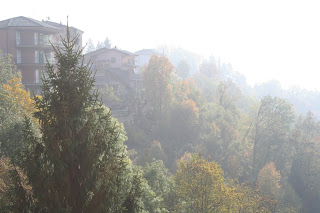 Maire and I and our Caoimhe (19) and Jim (16) decided to spend a short weekend away in Italy – we had spotted cheap flights to Bergamo on Ryanair and used Tripadvisor to scour the area nearby for cheap but good hotels.
We came accross Hotel Miramonti which is about 40 minutes from Bergamo up in the mountains.
The town was called Rota d’Imagna and it is very pleasently located high up in the alpine foothills.
 We also spent a day in Bergamo itself – this is a wonderful town especially the old city.
This was a great weekend – really enjoyable with just the four of us. Maire and I were especially keen to practice our Italian. But we had little opportunity as most people were so nice and of course, wanted to speak English to us.
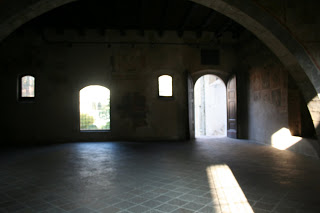
Jim was keen to practice his photography skills and indeed he took some very beautiful pictures.
It’s great just to go somewhere quiet. Rota d’Imagna was a quiet town.
Pictures are from the town of Bergamo. -
Our Digital World invades the Bicycle!
The Dublin bike scheme is a welcome addition to our city. It will be great for toursists and locals alike. Dublin is a relatively flat city and if you can brave the wind and the rain then cycling is a great way to get about.
I had seen the new stands being constructed and looked forward to the inauguration of this new service for many months now. How practical! How green! How good of our city and government to, at last, offer something for ordinary people to use and to enjoy.
So you can imagine my enthusium to read the practical details as they were published in the newspapers this weekend. Then I saw something that made me slightly uneasy:
Users, who must register online at www.dublinbikes.ie, pay a €10 annual membership fee and leave a €150 security deposit through a credit card or bank draft.
Mmm… I’ve been around long enough to realise that you can’t just leave bikes lying around and expect people to use and return with honour. No – the need for a deposit did not bother me – nor the €10 annual membership. Even the charges per hour are reasonable and it is understandable that we should be charged for such a service. No – none of these aspects would cause me to take to a blog and have a rant – no it’s this:
Users, who must register online…
Are you joking! Our government, our city will offer this service to some citizens – the digitally literate and broadband connected privileged majority. Tough on you if you don’t use the Internet, tough on you if you haven’t a credit card or if you are reluctant to set up a new direct debit on your bank account.
By the way, I went through this process on-line and it is one of the least user friendly experiences you could imagine – you will even need you IBAN number and an address with a compulsory post code (we don’t use post codes in Ireland). The company operating the service is JCDecaux (an advertising company) and although the front page of the website clearly displays the Dublin City Council logo when you go through the payment process you are actually dealing with a private company.
Now I don’t want to appear to whinge – for me the new service is of great value. But whatever happened to our notions of an egalitarian society – if we offer a service to people of the city then it should be available to all. Consider groups such as retired people (the older you are the less likely you are to be an Internet user), people who are currently having trouble with credit, perhaps unemployed, all of whom could reasonably be expected to be prime users of this service and yet even with cash in hand they cannot use the service.
Likely the explanation centres on creating an effective service with low administration costs. The irony should not be lost – the humble bicycle is simple and efficient but in order to use these city bikes you need the Internet and a bank account.
There is nothing worse than feeling left out – those who struggle with the Internet, fear it, or just havn’t figured it out are the forgotten many in our society. We are all citizens of this land and we should have a reasonable expectation to be treated equally.
-
Learning Identity and Learning Italian
In previous posts I spoke about learning identity.
I emphasised that we all carry many (often unquestioned) assumptions about who we are and who we can be as learners. The notion of learning identity is proposed as a component of one’s overall self-identity. I argued that learning identity is often framed in one’s school years and can remain fixed through life especially for non-participants in further formal learning.
In my own research on participation in the digital world I came accross learning identity as an important influence on people’s decisions to enroll on basic computer courses. The recurrent theme is captured in the phrase “I was no good in school”.
Well, I decided to turn the spotlight inwards and direct my scrutiny at my own learning identity. I have always believed that I am no good at language learning. My French is dreadful despite struggeling through six years of it in school. I can speak a bit of German because I lived in Munich for a time after college but here’s the thing about German – outside of Germany no one wants to speak it!
So I’m going to learn Italian.
-
NAMA – having a haircut or taking a bath!
This week experienced a turning point in the public consciousness regarding NAMA the National Asset Management Agency.
People are asking questions – really fundamental questions – about the wisdom of the government’s strategy of using NAMA to buy up the bad loans from the banks.If ever we need a very public debate about what we should do – this is the time and this is the issue. The amount of money involved is staggering – decisions made in the next few months will have implications for generations to come. It is not good enough to say that we can’t understand what’s going on, each of us has a responsibility to get to grips with the nature of the problem and the proposed solution.
What’s noticeable is the way language is used to filter our thinking.
Toxic
We describe the loans as “toxic” thereby conveying an almost medical imagery – that of surgically removing the bad stuff so that we can cure the situation.Haircut
This is the very gentle description for the reduction in the value of the loan book that should be considered. So one hears we’ll take those 90 billion worth of loans and give them a haircut of say 30% so NAMA will pay about 60 billion for them.
This is really soft language – what could be more reasonable than a haircut!Market Value and Long-term Economic Value (LEC)
Poor us! We really don’t appreciate the complexities of the word “value”. We are told that the market value of the 90 billion loan book is only 30 billion but we should pay more we should really take account of the long-term economic value – the “lec” so to speak.So now we have some new maths:
30 billion euros is really 60 billion lecs
90 billion with a haircut gives 60.Any three card trickster would be proud.
-
Slea Head

We decided to spend some days in Dingle, County Kerry.
Why Dingle?
Well this is a place that I’ve always had a fondness for and it has been many years since I visited.I made a documentary in the mid-1980s called Up Sraid Eoin (John Street) – it was the story of the Dingle wren boys. We filmed it one St Stephens Day and it was broadcast on RTE the following year.I had been introduced to Dingle while I was working in UCD’s Audio Visual Centre – we spent a whole summer recording stories and music for the Department of Irish Folklore/Irish Folklore Commission.The irony was that we were using television to capture the last remnants of an oral storytelling tradition that was dying out because of the pervasiveness of television.I learned so much through these projects and although I was responsible for sound and video I really did not have enough Irish to understand what was being said. Strange that the way it worked out I was happy to be there and to listen to the rhythm of the telling and observe the engagement of the listeners as they fell under the spell of a great story-teller.
We traveled the length and of Ireland mainly coastal regions and Gaeltacht areas.
All this came back when we visited Slea Head on a wonderful day last Friday. We stopped at the beehive huts – reportedly 2000 BC.The photo is of myself and my son Jim.
Folklore in Irish is called bealoideas – literally translated this means education of the mouth.
There was a time before literacy when knowledge was passed on between generations using the spoken word. When you think about it stories are a means of engagement and the best stories – the ones that are more likely to be passed through the ages – are the ones that resonate and have meaning for people.
Karl Jung pointed this out but it has been known since ancient times.

Great stories survive through a kind of evolutionary process. Great story-tellers were highly respected in rural communities that is until television.The Blaskets and Slea Head remind us of our past and the heritage we share with our ancestors – not just those who inhabited the bee-hive huts four thousand years ago but also the people who in my lifetime and in my presence recalled the wondrous tales that are perhaps as old as the stones.


