-
Learning Identity and Learning Italian
In previous posts I spoke about learning identity.
I emphasised that we all carry many (often unquestioned) assumptions about who we are and who we can be as learners. The notion of learning identity is proposed as a component of one’s overall self-identity. I argued that learning identity is often framed in one’s school years and can remain fixed through life especially for non-participants in further formal learning.
In my own research on participation in the digital world I came accross learning identity as an important influence on people’s decisions to enroll on basic computer courses. The recurrent theme is captured in the phrase “I was no good in school”.
Well, I decided to turn the spotlight inwards and direct my scrutiny at my own learning identity. I have always believed that I am no good at language learning. My French is dreadful despite struggeling through six years of it in school. I can speak a bit of German because I lived in Munich for a time after college but here’s the thing about German – outside of Germany no one wants to speak it!
So I’m going to learn Italian.
-
Wikipedia as a source in academic writing
Have you ever heard of Johann Heinrich Pestalozzi?
Pestalozzi was a Swiss educationalist – he had interesting ideas for progressive education – at the start of the nineteenth century he was advocating an enlightened approach to schooling.Perhaps in a future blog I will further discuss Pestalozzi but the topic I have set out above is Wikipedia and I have introduced Pestalozzi as an example to support a point I wish to make.
 Could I invite you the reader to open a new tab and look up Pestalozzi in Wikipedia.
 There you will find an excellent illustrated article containing biographical details and illustrations. It is a good place to start if you wish to find out more about this influential thinker.
Notice that the bottom of the entry there is a list of references and links for further reading (I have inserted these below). Starting with these references and links you now have a means to explore the writings of Pestalozzi and commentary thereon.
For me this is the best use of Wikipedia – I find it a great starting point and signpost to other materials.
Is Wikipedia itself an appropriate source? In other words, if I write an essay should I cite Wikipedia as my source? I believe that, for academic purposes, Wikipedia is not an adequate source. My main reason is the lack of visibility of the writers.Each time I use Wikipedia I can make my own judgment as to whether the information is accurate and useful – I base this on other readings and resources. I would be very reluctant to put forward an idea and to suggest that my source for this is a page on Wikipedia. There is always someone somewhere who is the source and it is always better to go back to the original.
Still – its a fantastic resource and an excellent place to start if you need to find out about something or someone – did I mention Pestalozz – look him up in Wikipedia but don’t stop there!
References
Considerably more late-twentieth-century scholarly work on Pestalozzi has been published in the German language than in English.
- Biber, George Eduard. Henry Pestalozzi and his Plan of Education. Orig. pub. London: John Souter, School Library, 1831. Repub. ISBN 1-85506-272-0. Among the earliest and probably the most influential 19th-century account of Pestalozzi’s work in English, this was widely read in America (for instance, by Bronson Alcott and Ralph Waldo Emerson) and in England. Contains translated excerpts from many of Pestalozzi’s works.
- Silber, Kate. Pestalozzi: The Man and his Work. London: Routledge and Kegan Paul, 1960. ISBN 0-7100-2118-6. Written by a German-speaking lifelong Pestalozzi scholar, this remains the most recent complete biography in English.
- This article incorporates text from the Encyclopædia Britannica, Eleventh Edition, a publication now in the public domain.
[edit] External links

Wikimedia Commons has media related to: Johann Heinrich Pestalozzi 
Wikiquote has a collection of quotations related to: Johann Heinrich Pestalozzi - Encyclopaedic documentation about Pestalozzi – Publisher: Swiss association „Verein Pestalozzi im Internet“
- PestalozziWorld biographical links – A handful of short and longer biographies and references to his methods
 “Pestalozzi and Pestalozzianism“. Catholic Encyclopedia. New York: Robert Appleton Company. 1913. http://en.wikisource.org/wiki/Catholic_Encyclopedia_(1913)/Pestalozzi_and_Pestalozzianism.
You May Also Like

Getting to Grips with Academic Writing
-
NAMA – having a haircut or taking a bath!
This week experienced a turning point in the public consciousness regarding NAMA the National Asset Management Agency.
People are asking questions – really fundamental questions – about the wisdom of the government’s strategy of using NAMA to buy up the bad loans from the banks.If ever we need a very public debate about what we should do – this is the time and this is the issue. The amount of money involved is staggering – decisions made in the next few months will have implications for generations to come. It is not good enough to say that we can’t understand what’s going on, each of us has a responsibility to get to grips with the nature of the problem and the proposed solution.
What’s noticeable is the way language is used to filter our thinking.
Toxic
We describe the loans as “toxic” thereby conveying an almost medical imagery – that of surgically removing the bad stuff so that we can cure the situation.Haircut
This is the very gentle description for the reduction in the value of the loan book that should be considered. So one hears we’ll take those 90 billion worth of loans and give them a haircut of say 30% so NAMA will pay about 60 billion for them.
This is really soft language – what could be more reasonable than a haircut!Market Value and Long-term Economic Value (LEC)
Poor us! We really don’t appreciate the complexities of the word “value”. We are told that the market value of the 90 billion loan book is only 30 billion but we should pay more we should really take account of the long-term economic value – the “lec” so to speak.So now we have some new maths:
30 billion euros is really 60 billion lecs
90 billion with a haircut gives 60.Any three card trickster would be proud.
-
Uncategorised
Knowledge Surveys
I came across an interesting piece on Knowledge Surveys from Edward Knuhfer and Dolores Knipp (linked above).
They advocate the use of Knowledge Surveys as a tool in support of learning and instruction.
These surveys consist of a series of questions – similar to a set of exam questions – but the difference is that the learner is asked not to answer the question but to rate their own ability to respond.For example – consider the following questions:
Q1 Describe three characteristics of an constructivist theory of learning?
Q2 Compare constructivism with social constructivism?
Q3 Outline practical applications of a behaviorist approach to learning?
Now, in a traditional assessment the student would be asked to write short essays on the above.
With a knowledge survey the student is asked to rate their level of knowledge as:
A – I feel confident that I could answer this question
B – I know about 50% of what may be involved and perhaps if I went away for twenty minutes I could find the missing information
C – I am not confident that I would be able to answer this question at all
Do you get the gist? The knowledge survey gauges a student’s perception of their own ability.
Knowledge Surveys may be very useful particularly at the beginning of new courses or topics. A word of caution though – students may not always have or report a reliable estimate of their own ability.
-
Slea Head

We decided to spend some days in Dingle, County Kerry.
Why Dingle?
Well this is a place that I’ve always had a fondness for and it has been many years since I visited.I made a documentary in the mid-1980s called Up Sraid Eoin (John Street) – it was the story of the Dingle wren boys. We filmed it one St Stephens Day and it was broadcast on RTE the following year.I had been introduced to Dingle while I was working in UCD’s Audio Visual Centre – we spent a whole summer recording stories and music for the Department of Irish Folklore/Irish Folklore Commission.The irony was that we were using television to capture the last remnants of an oral storytelling tradition that was dying out because of the pervasiveness of television.I learned so much through these projects and although I was responsible for sound and video I really did not have enough Irish to understand what was being said. Strange that the way it worked out I was happy to be there and to listen to the rhythm of the telling and observe the engagement of the listeners as they fell under the spell of a great story-teller.
We traveled the length and of Ireland mainly coastal regions and Gaeltacht areas.
All this came back when we visited Slea Head on a wonderful day last Friday. We stopped at the beehive huts – reportedly 2000 BC.The photo is of myself and my son Jim.
Folklore in Irish is called bealoideas – literally translated this means education of the mouth.
There was a time before literacy when knowledge was passed on between generations using the spoken word. When you think about it stories are a means of engagement and the best stories – the ones that are more likely to be passed through the ages – are the ones that resonate and have meaning for people.
Karl Jung pointed this out but it has been known since ancient times.

Great stories survive through a kind of evolutionary process. Great story-tellers were highly respected in rural communities that is until television.The Blaskets and Slea Head remind us of our past and the heritage we share with our ancestors – not just those who inhabited the bee-hive huts four thousand years ago but also the people who in my lifetime and in my presence recalled the wondrous tales that are perhaps as old as the stones.

-
Uncategorised
On Holiday in Nerja
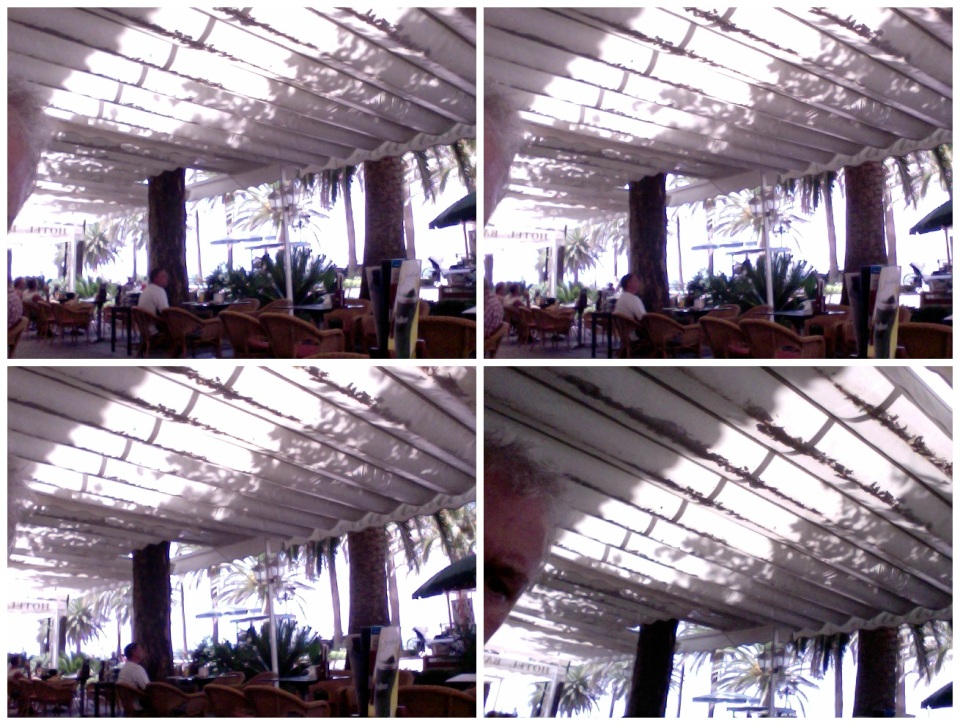
I am not quite a techie – I use technology as a means to an end rather than an end in itself. The most used tool that I own is my laptop, it is my companion and I take it everywhere.
I have been using a Mac notebook for the last three years (or is it 4?) and in recent times it has shown signs of wear and tear – the power cable broke, the processor became very slow and I had to replace the battery.
So I decided to invest in a new MacBook Pro and I took delivery of it just the day before my holidays here in Nerja.
As I write these words I am sitting at a cafe by the side of the Balcon (literally translated as the balcony) and of course I am using the new laptop.
Macs have a built in camera facility – the software that supports it is called Photo Booth and I have just taken the picture sequence.
Nerja is a lovely town with just the right balance between tourism and local culture. There are restaurants everywhere and as my friend and colleague Eugene points out there are plenty of wireless hot spots.
I really like the small Spanish eateries that seem to combine a bar and seafood restaurant. These are not the posh places they have plastic tables and chairs and you are unlikely to get air conditioning. But whow! try a plate of grilled sardines – delicious. -
TED Talks Arthur Benjamin does “Mathemagic”
Have a look at this – Arthur Benjamen calls himself a math magician but there’s no magic involved just a great level of skill with numbers.
Now have a look at what Arthur Benjamen says about teaching mathematics:
Does he have a point?
-
PhD Viva Voce
For the last three and a half years I have been working on my PhD. This week – last Thursday to be specific – I completed my Viva Voce and the successful outcome was essentially the last step in the process.
Phew!
My thesis is called Pathways to Competence and Participation in the Digital World – it is a study of the learning journey of adults who take up computer skills for the first time.
It’s a nice feeling to complete research especially when the topic has always been of interest to me. It is great to have had the opportunity to learn in this way.
No doubt there is more to be done and I am planning some publications and perhaps a few blogs in the future will feature ideas from my research.
For now I am reflecting on why I decided to do a PhD in the first place and how I feel about that now.
I genuinely wanted to know more about the field of education – although I have extensive experience in terms of business and media especially television production – scholarly research is another way of looking at the world.
I have always been intrigued by learning – why and how we learn and (as a great learning theorist Knud Illeris puts it) why we sometimes don’t.
Throughout our life, learning is perhaps the most important continuous process that we engage in. I continue to enjoy the journey. -
The Road – by Cormac Mc Carthy
 I am a slow reader by choice.
I like to take my time with a book especially when it is well crafted and beautiful.
McCarthy’s ‘The Road’ took some time – although it is not a big read and the comments on the cover suggested that it may (and should) be read in one session – I did the opposite and read two or three pages each night over the last few weeks.
Why does this book resonate?
At one level it could be described as bleak, lacking in plot and gruesome.
But there is something captured here that is difficult to describe and yet powerfully familiar.
It may be that this novel somehow connects with our collective unconscious and reveals a stark truth about existence.
Can’t really work it out … no need just let it be.


