-
Alienation and Learning
I want to talk about alienation as I believe it to be a topic of concern to most of us and it is an important influence on how we live our lives today.Karl Marx was one of the first to highlight how the structures of modern society inevitably lead to alienation. He describes how, in industrial settings, many workers are alienated from the products they produce. For example, an assembly line worker is far removed from the completed product.
The alienation of the worker in his product means not only that his labor becomes an object, an external existence, but that it exists outside him, independently, as something alien to him, and that it becomes a power on its own confronting him.
Marx K, Economic and Philosophic Manuscripts of 1844. First Manuscript p29

In contrast, many professionals such as teachers, architects, entrepreneurs and hairdressers remain closely affiliated with their productive output.
There are other ways in which we experience alienation in the modern world.
Often we experience alienation as customers when organisations conceive their clientèle in purely economic terms. We may experience this in for example, in airline, telecommunications and fast food industries – customer-provider interactions are kept to a minimum and are strictly orchestrated – we are reduced to commodities and with each transaction the organisation becomes more powerful at our expense.
Alienation is not the same as isolation or disengagement. It is potentially more sinister – it involves a diminution of aspects of human nature. It is not simply ignoring someone it’s a more active process of regulation and imposition of externally convenient limits.
Alienation is part of the price we pay for progress and economy. If we want cheap air travel, digital devices and convenient nourishment then we will experience alienation. Most people can cope and are willing to accept much in exchange for greater freedom at other times.

Similarly, all those ‘small cogs in a big wheel’ workers in multi-nationals, manufacturing industries and the like, certainly do experience alienation from product. However, in contrast with the 1800’s when Marx first wrote about the topic, there are many possibilities for fulfilment in other ways. People work in teams, take pride in achieving goals and have very rich lives outside of the workplace.
Today, we experience new and often more powerful manifestations of alienation. One of the most prevalent is the way in which we treat people who are unemployed as economic commodities. Certain skills are no longer regarded as useful while others are in demand. The simplistic solution of reskilling is often proposed as a quick-fix for a more complex state of affairs.
Participation is the opposite side of alienation and I argue that ‘learning to participate’ is the big, on-going task of adult education. We will continue to experience alienation throughout our lives – for some it’s caused by new technology, others experience it in employment or as customers. The antidote to alienation is participation and the path to participation is through learning.
Participation is empowering, it involves purposeful activity that enriches the person while working with others. It can manifest as engagement in the digital world but it is also evident in conscious decisions not to follow the trend. When we learn to participate it may involve acquisition of new skills and competence but it is also an autonomous and liberating action.
Alienation is a powerful influence on all our lives. This is especially the case during hard times. It is important that we establish strong foundations for our own well-being. Otherwise we become vulnerable, at risk of being overwhelmed by external forces. We build our strength by becoming knowledgeable and making our own meaning. This is what we do.
-
Learning about Thinking from James Joyce
In my view one of the best ways to study learning and thinking is to look to literature and in this arena one figure stands out for the manner in which he conveys the human thought process in print. I am of course referring to James Joyce.
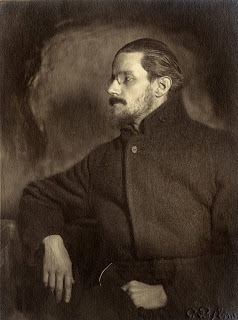 In this short review I present some aspects of Joyce’s work from the perspective of insights on how we think and learn.
My argument is that great literature resonates with our thought processes. In reading Joyce we are provided with a working model of the inner structures and mechanisms through which we experience the world.
I approach this analysis from the perspective of the average reader rather than the rich practice of Joycean scholarship. As such, my remarks are confined to my own, somewhat surface, impressions and interpretations of the literature. Almost at every point in Joyce’s work there are many layers of meaning and great pleasure can be derived from reading and rereading the passages.
My analysis is based around five short lessons:
Lesson One The Inner Narrator
Consider the opening lines from A Portrait of the Artist as a Young Man:
Once upon a time and a very good time it was there was a moocow coming
down along the road and this moocow that was coming down along the road
met a nicens little boy named baby tuckoo…
His father told him that story: his father looked at him through a
glass: he had a hairy face.In this passage we are introduced to Stephen Dedalus as a child. The language is obviously childlike and there is a wonderful lyrical-jaunty quality about it. But who is the narrator? Is it Stephen or someone else? If it is someone else what age is the narrator?
The use of subjective narration and narrative ambiguity is to be found throughout Joyce’s work. Joyce’s storytellers are never neutral they add to the meaning and the memory.
The short story ‘A Painful Case’ from the Dubliners collection provides an apparently more straightforward example of self-narration in a description of the lonely main character of Mr Duffy:
He had an odd autobiographical habit which led him to compose in his mind from time to time a short sentence about himself containing a subject in the third person and a predicate in the past tense. He never gave alms to beggars, and walked firmly, carrying a stout hazel.
What’s interesting here is that this ‘odd autobiographical habit’ seems also to be in evidence in the first quotation above. I suggest that when the narrator says ‘his father told him that story’ it is actually Stephan recalling his childhood. The text reproduces these are memories infused as they are with the sensual realism of childhood experience together with evidence of more complex structures over-layered through adult recall and retelling.
The take-away from this lesson is that ‘we are the stories we tell’ and we construct these stories through our own inner narrative.
Lesson Two Structure and Meaning
There is a wonderful Irish tune called the Mason’s Apron that has about six parts and when its played well it provides a great platform for musicians to show off their skills by varying the style and tempo whilst still finding a way pack to the central theme.
In the same way Joyce’s Ulysses is a structural masterpiece not because it displays one great structural device but because it has so many. One way of appreciating this entire work is to see it as an exhibition of structural virtuosity.
In addition to varieties of inner and outer narration, there is an episode written as a play complete with stage directions, there is also a section using newspaper narrative with headlines and a section (scholars call it the Ithaca episode) written as if it was meant to be learned by rote in the form of question and response. This hilarious situation involves the two characters Leopold Bloom and Stephen Dedalus who are both quite drunk as they arrive at Bloom’s home in Eccles Street:
What action did Bloom make on their arrival at their destination?
At the housesteps of the 4th of the equidifferent uneven numbers, number 7 Eccles street, he inserted his hand mechanically into the back pocket of his trousers to obtain his latchkey.Was it there?
It was in the corresponding pocket of the trousers which he had worn on the day but one preceding.Why was he doubly irritated?
Because he had forgotten and because he remembered that he had reminded himself twice not to forget.What were then the alternatives before the, premeditatedly (respectively) and inadvertently, keyless couple?
To enter or not to enter. To knock or not to knock.Bloom’s decision?
A stratagem. Resting his feet on the dwarf wall, he climbed over the area railings, compressed his hat on his head, grasped two points at the lower union of rails and stiles, lowered his body gradually by its length of five feet nine inches and a half to within two feet ten inches of the area pavement, and allowed his body to move freely in space by separating himself from the railings and crouching in preparation for the impact of the fall.This is great fun to read and the structure is often referred to as the catechism approach. Joyce was perhaps poking fun at the teaching methods he encountered for religion and theology.
The take-away from this lesson is to recognise how we embed meaning in the structures and manner in which we communicate.
Lesson Three HypertextMost people involved in computer science will recognise the term ‘hypertext’ (it is in fact the ‘h’ in the familiar http string that we find in Internet addresses). However, the origins of the term predate the Net. In the 1960’s Theodore H Nelson described the term as electronic text that was characterised as non sequential. By this he was referring to the reader’s ability to trace a series of different paths through the same piece of text. If you want a good example of this then look up ‘hypertext’ on wikipedia and see where your reading takes you.
Reading hypertext is an active process as it involves choice and exploration of layers of meaning. This characteristic is also true of great works of literature (I am not the first to posit this idea and should you so wish you can hypertext off to study Derrida, Foucault and Landow).
Long before the Internet Joyce understood the power of interconnection, inference, hints and echoes in literature. Throughout Ulysses there is an obvious underlying intertextual resonance with Homer’s Odyssey. However, the hyper-textual framework extends throughout the novel and it conveys a much deeper, broader and inter-connected network of meaning. For example, one of the characters Stephen Dedalus was first encountered in an earlier novel by Joyce, while the timeframe as one day (16th of June 1904) starts twice: once with Stephen and once with Leopold.
Each episode has an underlying theme and it’s almost impossible to read the main text without your thoughts spinning off in many different directions. In the extract below from Sirens we encounter a form of musical overture to Bloom’s later erotic observations of waitresses in the Ormond Hotel:
BRONZE BY GOLD HEARD THE HOOFIRONS, STEELYRINING IMPERthnthn thnthnthn.
Chips, picking chips off rocky thumbnail, chips. Horrid! And gold flushed more.
A husky fifenote blew.
Blew. Blue bloom is on the
Gold pinnacled hair.
A jumping rose on satiny breasts of satin, rose of Castille.
Trilling, trilling: I dolores.
Peep! Who’s in the… peepofgold?
Tink cried to bronze in pity.
And a call, pure, long and throbbing. Longindying call.
Decoy. Soft word. But look! The bright stars fade. O rose! Notes chirruping answer. Castille. The morn is breaking.
Jingle jingle jaunted jingling.The take-away from this lesson is that much of our thinking is characterised as more like a hyper-textual network of associations rather than any logical, hierarchical or similarly organised system.
Lesson Four A Theory of Aesthetics
In the Portrait there are a series of episodes involving Stephen working through some theological and philosophical arguments. The following extracts are spoken by Stephen as a college student to a fellow student called Lynch and concern the essence of beauty – I suggest that Joyce’s own views that are in evidence here:… Plato, I believe, said that beauty is the splendour of truth. I don’t think that it has a meaning, but the true and the beautiful are akin. Truth is beheld by the intellect which is appeased by the most satisfying relations of the intelligible; beauty is beheld by the imagination which is appeased by the most satisfying relations of the sensible. The first step in the direction of truth is to understand the frame and scope of the intellect itself, to comprehend the act itself of intellection.
and later when they argue on the subjectivity of beauty
This hypothesis, Stephen repeated, is the other way out: that, though the same object may not seem beautiful to all people, all people who admire a beautiful object find in it certain relations which satisfy and coincide with the stages themselves of all esthetic apprehension. These relations of the sensible, visible to you through one form and to me through another, must be therefore the necessary qualities of beauty. Now, we can return to our old friend saint Thomas for another pennyworth of wisdom.
Even though these arguments are provided as the student Stephen working through his own approach to philosophy (and there is much evidence in the text of a kind of an innocent, tentative naivety in this) we are presented, as in the case of the examples above, with some very useful insights.
The take-away from this lesson is Joyce’s affirmation of what Jurgan Habermas later refers to as communicative rationality – process by which societal constructs such as beauty, truth and justice are formed.
Lesson Five Stream of Consciousness
Finally, Joyce is well known for his use of a stream-of-consciousness technique to convey an impression of how people think.The frequently cited example is perhaps the Molly Bloom soliloquy which comes at the end of Ulysses. The extract I present here is from an earlier part of the book where Stephen is walking on the beach. I have inserted a dash / to indicate the transition from narrator to stream-of-consciousness and back.
His gaze brooded on his broadtoed boots, a buck’s castoffs, /nebeneinander/. He counted the creases of rucked leather wherein another’s foot had nested warm. /The foot that beat the ground in tripudium, foot I dislove. But you were delighted when Esther Osvalt’s shoe went on you: girl I knew in Paris. Tiens, quel petit pied! Staunch friend, a brother soul:
Wilde’s love that dare not speak its name. His arm: Cranly’s arm. He now will leave me. And the blame? As I am. As I am. All or not at all.
nebeneinander. He counted the creases of rucked leather wherein another’s foot had nested warm. The foot that beat the ground in tripudium, foot I dislove. But you were delighted when Esther Osvalt’s shoe went on you: girl I knew in Paris. Tiens, quel petit pied! Staunch friend, a brother soul: Wilde’s love that dare not speak its name. His arm: Cranly’s arm. He now will leave me. And the blame? As I am. As I am. All or not at all.The take-away from this lesson is in the form of ‘exhibit a’ – this is what we are taking about when we think of ‘thinking’. Surprisingly, we don’t get grammar as we know it, there seems to be little by way of logical progression or obvious structure and yet we have to agree (I certainly do) that this exhibit rings very true. I have often argued that writing is a form of thinking and that a consequence of the writing process is the manner in which it forces us to impose progressive arguments and logical structure on our thoughts. Thankfully, stream-of-consciousness as above would seem to be the norm though.
In the preceding discussion I have presented, what I choose to call, five lessons from Joyce that provide insights on how we think and how we experience the world. These are just the tip of the iceberg and further reading of Joyce will continue to provide a powerful lens through which we can view our own minds and those of others.
-
Ssshhh!!! Exams in Progress!
This is a quiet but busy time in National College of Ireland semester one exams are now in progress. We are encouraged to keep as quiet as possible as each room on the campus is now used to its fullest extent to facilitate the process.
There is always tension associated with exams. Students of all ages and all backgrounds find the prospect of being tested daunting. This is very understandable we live in a culture of measurement and accountability and education is an expensive process. So, especially for the self-motivated, we all want to see how much we know and how well we have progressed.
As discussed previously, there is a useful distinction between goals and achievements that are measured by independent criteria such as exams or tests and other achievements that are socially referenced such as how other people regard performance.
For many students the exam results provide important feedback on how they have coped with the learning challenges associated with a course. At some point in the future the result–put simply as a number–will be revealed.
However, this will only be a very small part of the story. The student, and the student alone, will know how to interpret it.
Best of luck to all concerned.
You May Also Like

Getting to Grips with Academic Writing
-
What are New Year’s resolutions and why they seldom work

New Year’s Celebration fireworks at Carton House, Maynooth Happy New Year!
It’s the start of 2011 and last night we celebrated as we said goodbye to 2010 and welcomed the turn over to a New Year.
At New Year and perhaps birthdays or other recurring significant dates we often conduct a self-appraisal and make decisions about our future behaviour.
This is typically framed as a New Year’s Resolution:
I will go to the gym and loose weight;
I will give up smoking;
I will do a course;
I will complete an unfinished project (I know someone who has resolved to complete her master’s dissertation).So what’s really happening–why do we make such self-resolutions? How likely are we to succeed in changing our own behaviour as a result of such public and private utterances?
Last night I had an idea (my first of 2011) that is to develop a Theory of Resolutions. Like many good theories will build extensively on the work of others. Don’t worry that I state my goal in such grand terms as ‘a theory’ – I am simply attempting to provide a new perspective on the familiar, a framework for understanding and making sense of an aspect of our life. There is no proof. The quality indicator for such a theory is its utility – is it useful and does it help?
Actually, when you think about it, although New Year’s resolutions are seen as part of the festive ritual there is often a very serious side to them. Promises are frequently connected with one’s health and well-being: smoking, weight loss, alcohol etc.. These can be life changing, even life saving. We are not dealing here with trivia. The stakes can be very high indeed and therefore, I argue, we need a better understanding of what’s going on. Hence my theory.

Proposition One: Resolutions arise from Self-desire
Desire is a necessary but not a sufficient condition for motivation. We desire many things but very few of our desires or wishes are fulfilled. For example, I could place a bet on a racehorse to win at long odds. I may wish it to come first but there is little I can do about it other than wait and observe the outcome.So, we can desire things that we can do nothing about “I wish for fine weather on my holiday” or , in contrast, we may desire things that we have capacity to act toward “I wish to go back to college and get a degree“. A desire, together with a capacity to act, becomes motivation.
I argue that resolutions are predicated by a specific type of desire. I call this Self-desire. Note that I am using the proper noun ‘Self’ indicating how we each think about who we are. A way of understanding this is to think in terms of selfing – a lifelong constructive process of framing, shaping and refining our self-image (think beyond the pictorial to the wider concept of image involving attributes, characteristics, values etc.). The Self is the outcome of this process at any point in time.
It’s as if there is an on-going project ‘project-self’ that we engage in throughout our lives. We have desires or wishes that centre on the Self. We desire to be liked, to be virtuous, to be successful and so on. At any point in time, of these desires, there are some that we have the potential to act upon and others that will remain forever unfilled.
New Year resolutions may therefore be considered as expressions of desire, a desire to improve the Self; for example, to be the non-smoker, the thin person, the controlled drinker or the successful student.

Proposition Two: Resolutions are Goal Statements
We set goals all the time and the day-to-day trajectory of our lives may often be regarded in terms of goal-directed behaviour.
Often such goals are implicit we don’t even think about our actions in terms immediate goals. We set long-term goals and many of our actions are a means to an end.
However, there are times such as at the beginning of a New year when we state certain goals explicitly.
It is useful to think about different types of goals. Firstly, one can distinguish between goals that relate to mastery or competence and goals that relate to (social) performance. Consider, for example a stated goal such as to exercise regularly. There may be a mastery component to this goal “I can bound up four flights of stairs without loosing breath” and there may be a performance component “I will look great and people will admire my fitness”.There is another distinction in relation to goals that is also useful: ‘approach’ and ‘avoidance’ goals. Consider a typical approach goal stated as “I will pass my driving test” and the same desire expressed as an avoidance goal “I will not fail my driving test“.
Notice that desires can be expressed as any combinations of ‘mastery’, ‘performance’, ‘approach’ or ‘avoidance’. Similarly, new year’s resolutions can be expressed in terms of each of these types of goal-statement. For each there are certain characteristics and it’s useful to recognise these:
- Mastery Goals can usually be measured against some pre-determined independent criterion (e.g. to be a certain desired weight) as such, they are easy to set in specific terms and progress toward a mastery goal can be effectively measured.
- Performance Goals are less well defined but are very powerful in terms of incentive (note the discussion above on the Self). Further, positive encouragement from others can be very affirming for those trying to achieve challenging goals.
- Approach Goals are stated in terms of a desirable outcome and as, such they provide an incentive to act toward rather than away from a target.
- Avoidance Goals are necessary in certain situations (for example to stay away from danger) but for many aspects of human life they are problematic. In academic contexts they can lead to exam anxiety and the paralysis associated with fear of failure.

Proposition Three: The illusion of will powerNow that we have some framework in which to understand the nature of our resolutions it’s time to ask how successful we are at keeping them.
An underlying assertion that I make here, based only on my experience, is that we, including especially myself, are not very good at fulfilling such resolutions.
Even if we disregard the cases where we set resolutions trivially, perhaps in response to being asked to quickly supply one, even if we ignore these as not real examples of a resolution, we still seem to have a poor record. Why then is this the case?
One reason is that we often engage in quite literally ‘wishful thinking’; in other words, we focus on the desire rather than the means to achieve it. As stated above, desire without a means to act is quite impotent.
Furthermore, when we make resolutions we tend to focus on significant and previously unachieved outcomes. So we set the stakes very high, usually at the level of life-changes, but we often fail to recognise that these will take planning and effort over time. We wish the result instantly and in fact get some small part of that wish fulfilled through the statement of the resolution (see performance goals above).
A third reason is that we frequently misunderstand the role and the potential of will power. Let me take as an example a person who desires to give up smoking. It is now generally understood that giving up cigarettes is not an easy achievement and people make a serious appraisal of the effort involved prior to resolving to give them up. Here is a typical sequence of events:
- In the beginning our subject estimates the scale of the challenge and deems it to be significant and therefore calls upon a great effort of will power.
- This works well for let’s say the first week – the person has successfully used significant will power to deal with what is perceived as a significant challenge.
- What then happens? Having managed to stay ‘off them’ for week the subject makes a revised estimate of the scale of the challenge. This revision is downward on the basis that the challenge has already been met successfully for the first week. Of course, less will power will be required to meet this diminished challenge.
- Inevitably, sometime around the second or third week temptation arises. An argument is made that having been ‘successful” in giving up cigarettes up to now there is no reason to believe that just one lapse will scupper the whole project. Where is will power? It is stood down because of recent success!
Summary
I have tried here to provide some insight into the nature of New Year’s resolutions and, rather grandly I admit, I have called it a Theory of Resolutions.In this I have provided three propositions:
First, that resolutions are connected with Self-desires and are part of the process of self improvement that we engage in throughout our lives.
Second, I have argued that we should consider resolutions in terms of explicitly stated goals and I provided a classification of goals in terms of mastery, performance, approach and avoidance goals. And thirdly, I have discussed the illusion of will power and how we have a tenancy to apply an effort of will only when we consider a project as daunting. Early success in such a project can be misinterpreted as evidence of efficacy (easiness) and hence the investment of effort is reduced. This can seriously undermine the intended outcome.So if you have made a New year’s resolution keep these propositions in mind and I hope you will be successful in 2011.
Further Reading
As stated the ideas contained herein build on the work of others.For a fuller treatment of the differences between desire and motivation I refer the reader to my own PhD thesis:
- Casey, L (2009) Pathways to Competence and Participation in the Digital World. NUIM PhD Dissertation. Available from http://eprints.nuim.ie/1545/
For further reading on the ideas of self see:
- McAdams, D. P. (1996). Personality, modernity, and the storied self: A contemporary framework for studying persons. Psychological Inquiry, 7(4), 295.
- McAdams, D. P., Josselson, R., & Lieblich, A. (2006). Identity and story: Creating self in narrative: American Psychological Association, Washington, DC.
The classification of goals draws primarily on the works of Dweck and Elliot see, for instance:
- Dweck, C. S., & Molden, D. C. (2005). Self-theories. In A. J. Elliot & C. S. Dweck (Eds.), Handbook of competence and motivation New York: The Guildford Press.
- Elliot, A. J. (1999). Approach and avoidance motivation and achievement goals. Educational Psychologist, 34(3), 169-189.
- Elliot, A. J. (2005). A conceptual history of the achievement goal construct. In A. J. Elliot & C. S. Dweck (Eds.), Handbook of competence and motivation. New York: The Guilford Press.
- Elliot, A. J., & Dweck, C. S. (2005). Competence and motivation. In A. J. Elliot & C. S. Dweck (Eds.), Handbook of competence and motivation New York: The Guildford Press.
- Elliot, A. J., & McGregor, H. A. (2001). A 2 x 2 achievement goal framework. Journal of Personality and Social Psychology, 80(3), 501-519.
- Elliot, A. J., & Reis, H. T. (2003). Attachment and exploration in adulthood. Journal of Personality and Social Psychology, 85(2), 317-331.
- Elliott, E. S., & Dweck, C. S. (1988). Goals -an approach to motivation and achievement. Journal of Personality and Social Psychology, 54(1), 5-12.
The discussion on will power derives from arguments made by Gregory Bateson on the nature of alcoholism in his book Steps to an ecology of mind.
You May Also Like
Getting to Grips with Academic Writing
-
Learning without Teachers
I met Sugata Mitra at On-Line Educa in Berlin two years ago and was very impressed by his research work and his thinking on how children learn.
This most recent presentation at the TED conference opens up a timely debate on the role of instruction in education.
It is easy to be sceptical about the findings from his research. One could argue that such insights are gleaned from very particular contexts and further investigation of the actual learning processes involved is necessary.
However, I am not really surprised that these effects are in evidence and they are compatible with the work of other educationalists such as Dewey, Vygotsky and Bruner.
Have a look at the video and see what you think.
I would be happy to have your comments.You May Also Like
Getting to Grips with Academic Writing
-
Uncategorised
We hold steadfast to our own theories of learning
I have always maintained that each of us has our own theory of learning and that we are prepared to defend it robustly.
This tendency to hold steadfast to one’s existing understanding of learning is what I call the “in my day” (IMD) phenomenon. You will find IMD’s in many conversations concerning education and school. You just need to be on the lookout and you will be surprised at the number of times they pop up. Parents, politicians, economists and most especially business employers are IMD specialists.
The simple premise of the IMD is that what worked for me and has made me successful must be right for everyone else.
It is understandable that insights gained from past experience are valuable but sometimes we fail to recognise the assumptions we take for granted. IMD statements exclude differences between individuals, changes in society, developments in education and the use of technology to support it.
Generally the older are wiser and experience counts for much. However, we also need to be mindful of the basis upon which we make judgements. This is especially the case in education.
-
Uncategorised
Leaving Certificate Results
Today’s top story is the issuing of results to almost fifty eight thousand (58,000) Leaving Certificate students.
This event is widely reported in national newspapers, radio and television news. Much of the coverage deals with the failure rates for different subjects. Of special interest is the success rates for Science, Engineering Technology and Mathematics- the so called STEM subjects. It is reported that some 4,300 students have failed Mathematics.
The availability of a talented young workforce is often cited as part of the attraction of Ireland as a location for inward economic investment. Poor results do not help the international perception of our education system. Employers are increasingly looking for critical thinking, creativity and problem solving skills in their new recruits. It is reasonable to ask to what extent the results of the Leaving Certificate Exam may be taken as an indication of a person’s future potential as an innovative thinker and an effective contributor to the knowledge economy.
Take for example the substantial cohort of young people who have failed Mathematics. Are we justified in writing off the potential of these people as college students, future inventors, knowledge workers, scientists, entrepreneurs and innovators? I feel not.
Letter to Sam (a fictional character representative of the 4,300):
Dear Sam,
Today you got your results and I guess it came as no surprise that you are one of the 4,300 students who failed mathematics. It must have been very disconcerting to listen to media reports on the importance of Mathematics for our future economy. Surely, you must be thinking that it will be very hard to get a job or go to college. What now are your career options and prospects for the future?
Sam I’m not going to say that that none of this counts and that the results of your Leaving Certificate are of no consequence – that’s certainly not the case! What I do say is that when you put things in perspective you have much more choice and more potential that you think.
Be very careful about accepting labels, especially labels that you give to yourself, at this stage in your life. You may wish to say I’m no good at maths! – perhaps this is something you’ve always believed about yourself and now you feel vindicated, you were right all along and your Leaving Cert results prove it. Well, that may be the case but it is also likely that other factors are in play. Have you ever heard of a self-fulfilling prophecy? Perhaps it was your own belief about being no good that caused you to apply little effort or energy to the subject. Of course, once you fall behind with Maths its harder and harder to catch up. So you need to genuinely ask yourself is it that you fell behind and simply need time to catch up or do you have a more fundamental problem with Maths.
Sam what are you good at? Is it that you are good at sport or do you know about cars, or fashion or music? Think about how you became good. How did you develop these skills? It took time and persistence even tenacity, lots of practice and most especially, you were interested and believed you could progress. This is how you became a skilled footballer (musician, mechanic, hairdresser and so on).You know other people who wish to be as good as you are and you might even say look its easy. Well to you its easy but it may be very daunting for other people – just like Maths is for you.
So you might ask is there really anybody who is genuinely no good at Maths or is it all about the perceptions, teachers and opportunities? The answer is complex – I mean yes and no – Maths generally involves abstract thinking and many people have a generalised difficulty with this form of thinking. The best way to explain abstract thinking is to compare it with its opposite – concrete thinking.
Here’s an example, a family of four are preparing to go on a motoring holiday and your task is to load the boot of the car. As you might expect some people have brought two suitcases and what’s more the car has a very small boot and the cases come in all shapes and sizes. Now in order to complete the task do you start to load and move each case testing where it will fit best (concrete thinking) or do you work out a scheme in your head as to how the whole lot will fit (abstract thinking)? In this example each approach has merit. Some people are ‘knackey’ they are good with their hands and they can visualise how things will fit together. This spacial ability is closely related to mathematical ability it is a really useful skill. However, some people use it in concrete situations and never really seem to be able to apply it in abstract form. In my opinion people who have good spacial ability have the potential to be good at Maths but they don’t always fulfil this potential.
Regardless, Sam you need to know that you will be learning throughout your life and the setback today may be an opportunity in disguise. State exams are just one measure of the potential of an individual and the Maths exam is just one aspect of that measure. To survive and thrive in this world we need to be intelligent in a multitude of different ways – we need language skills, social skills, kinaesthetic (movement) skills, awareness of nature, spacial skills and yes, mathematical and logical skills (see Howard Gardner’s works on multiple intelligence). Build on your strengths – society needs people with all these capacities and everyone has something to offer.
Best wishes for the future
Leo
-
Uncategorised
TPACK: Technological Pedagogical and Content Knowledge
What makes a great teacher? This is a difficult but important question for education at all levels. One way to get to the answer is to think about individual teachers that you have encountered in your life. Somehow we all know great teachers when we meet them and of course, we certainly know poor teaching when we come across it.
I am not one of those who believes that teaching is a natural gift and some people are born to be teachers and others not. Most great teachers that I know work constantly on their own development as educators. A capacity for great teaching can be gained through experience and reflection and I believe that anybody who wants to be a great teacher can become a great teacher.
What then are the ingredients for successful teaching? Well, thinking about the teachers in my life, I know that teachers need to have a very good knowledge of a content area. I did science in college and I have some strong views on how we should teach science based on my own experiences as a student. Previously I commented on the lecture by Carl Wieman, the Nobel laureate in Physics. Wieman argues against the over reliance of explaining in science teaching – he suggests that we start with realistic goals and facilitate individual discovery through activities “doing science” rather than listening to it.
I attended my first lecture in Physics at UCD in 1977 I remember the lecturer Rev Dr Tom Burke asking the class what constitutes a force such as gravity. We were used to the school definitions such as the Newton’s gravitational force = M1 by M2 over R squared times G (the gravitational constant) and offered this as the answer. But Fr Burke asked further “sure that’s the formula but what is the gravitational force? What’s happening for example, between the Earth and the Moon that manifests itself as gravity?” We were stumped! When we left the lecture we were none too happy – our old world of Physics as the subject of certainty (you only needed to know the formula) was turned upside down. We were not given the answer. We were forced to think. I’m thinking about it still. Welcome to science. Fr Burke was a great science teacher.
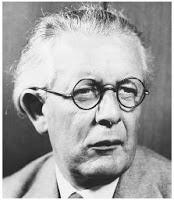
So, good knowledge of a content area is certainly a characteristic of an effective teacher. However, this on its own is not sufficient. Here is what Jean Piaget had to say about subject matter knowledge:
“Every beginning instructor discovers sooner or later that his first lectures were incomprehensible because he was talking to himself, so to say, mindful only of his point of view. He realizes only gradually and with difficulty that it is not easy to place one’s self in the shoes of students who do not yet know about the subject matter of the course.”
(Piaget 1962 p5)
Piaget suggests that it is not easy to place one’s self in the shoes of the learner. Just because we know something doesn’t mean that we can teach it. We use the term pedagogy to refer to knowledge about learning in others. A good teacher needs to have pedagogical as well as content knowledge.Lee Shulman (1986) suggested Pedagogical Content Knowledge (PCK) as a special kind of content knowledge important for teaching. There are two aspects of pedagogic knowledge – a kind of general or generic understanding of learning and teaching that is applicable across all subject areas and a second subject specific pedagogic knowledge. This is knowledge as to the teach-ability of aspects of a subject.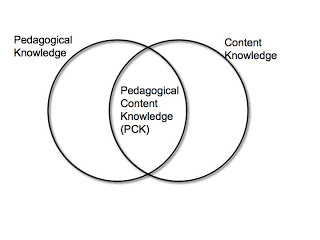 This may involve asking questions that encourage new thinking as occurred in my first Physics lecture. It may also involve identifying threshold concepts (Meyer & Land 2006), aspects of a subject area that open up understanding, and presenting these in ways that are accessible to students.
In a recent conversation a friend referred to a teacher as great with analogies and metaphors. A stock of appropriate analogies, metaphors, examples, illustrations and models is perhaps part of the PCK of any teacher.
Often PCK is represented as the intersection of two domains of knowledge pedagogy and content. This representation is useful for teachers and those involved in the professional development of teachers.Lee Shulman’s contribution has certainly helped researchers by providing a conceptual framework that encompasses the domains of knowledge associated with effective teaching. However, more recently it has been suggested that this framework needs to be extended to include the domain of technological knowledge.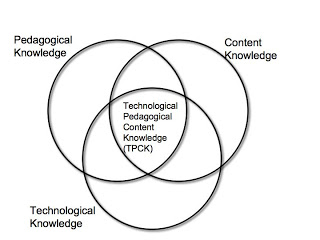 Mishra and Koehler (2006) have put forward the proposition that today’s teachers also require knowledge in a third domain – technology. Their representation extends Shulman’s PCK to become TPCK also called TPACK. They emphasise the value of the integration of these bodies of knowledge for teaching rather than considering each as a separate domain.
In this model, knowledge about content (C), pedagogy (P), and technology (T) is central for developing good teaching. However, rather than treating these as separate bodies of knowledge, this model additionally emphasizes the complex interplay of these three bodies of knowledge.
Mishra and Koehler 2006 p1025For example, it is not advocating “technology” per se be considered rather, it is what technology can do to facilitate learning. The argument is that the technologies of today offer new possibilities that were not considered when Shulman first put forward PCK.For me, I’m not so sure of the value of separating technology as a domain. As I mentioned above, part of the PCK for a good teacher is a stock of analogies, anecdotes and illustrations. All of these are tools – intellectual tools – that are used to facilitate student understanding.Through each generation the art and craft of teaching has evolved to accommodate the cultural and social milieu of the time. Despite what we often think there is nothing special about today, this time and these new technologies. Human cognition has evolved over thousands of generations and the essential mechanisms for learning are the same whether technology enhanced or not. In the Digital Literacy in Primary Schools (DLIPS) project we found that teachers were using strategies that involved project learning and technology. Yes of course their are some technical skills required, and of course we will need to provide additional training and professional development for teachers at all levels as technology evolves and makes new strategies and practices possible. However, my argument is that this should always be considered as part of the pedagogical content knowledge base of the teacher rather than a new domain.To add technology as a separate domain of competence has some advantages (as argued by Mishra and Koehler) but their are disadvantages: we may over-estimate the technology rather than the intellectual tool that the technology makes possible (film-makers tell stories – it is the story telling that has pedagogic value); we may alienate teachers who do not use technology (these may be great teachers also!) and finally, there is a danger of commercial influences driving technology into pedagogy.Regardless, I set out to answer the question “what makes a great teacher?”. For me, knowledge (PCK), an ability to motivate, a capacity to set achievable goals, to provide students with constant feedback on performance and a learner-centered approach to instruction – these are the ingredients of a great teacher.ReferencesCasey, L., Bruce, B. C., Martin, A., Shiel, G., Brown, C., Hallissy, M., et al. (2009). Digital literacy: New approaches to participation and inquiry learning to foster literacy skills among primary school children. Report funded by the Department of Education and Science. Available from http://hdl.handle.net/2142/9765.
Piaget, J. (1962). Play, Dreams and Imitation in Childhood. New York: Norton.
Shulman L S. (1986). Those Who Understand: Knowledge Growth in Teaching Educational Researcher, Vol. 15, No. 2, (Feb., 1986), pp. 4-14 American Educational Research Association
Meyer J. H. F. & Land R. 2006 (Eds.) Overcoming Barriers to Student Understanding: threshold concepts and troublesome knowledge. Routledge − Taylor & Francis Group, London and New YorkMishra P, Koehler MJ. 2006 Technological Pedagogical Content Knowledge. Teachers College Record Volume 108, Number 6, pp. 1017–1054
-
Uncategorised
Really Useful Websites on Learning and Teaching
As a follow-up to my previous blog on the Top Ten Insights on Learning I would like to provide a list of web sources and resources that may act as good places to start with insights on learning and teaching.
I’ll try to give a brief description of each and why it makes the cut for me.
Starting Points: Aggregation Sites
Theory into Practice (TIP)
Greg Kearsley has put together an excellent resource that deals with a wide variety of learning theories. This is an excellent starting point and it will give the beginner a good appreciation of the breath of theories and their practical applications.Emtech’s Learning Theories
This is another excellent starting point with a comprehensive list of learning theory orientations. What I like about this list is that each section is authored by a different person and you can cite each as an individual resource.Martyn Ryder’s Instructional Design Models
Martyn Ryder’s very comprehensive listing of instructional design and learning theory resources -this site is well maintained, comprehensive and deals with an wide expanse of theoretical orientations.Learning and Teaching
Teaching Tips Index
This is another great starting point for lot’s of interesting exploration. The index is compiled by the faculty development team at Honolulu Community College. I’ve looked at many of these teacher development sites and I have to say this is certainly one of the best!Angles on Learning
James Atherton’s resource for called: An introduction to ideas about learning for college, adult and professional education – brings together ideas about learning for college, adult and professional education. Great piece of work!The ETL Project
This project sought to identify evidence-based good practice in teaching-learning environments for a range of undergraduate courses.National Survey of Student Engagement If you are genuinely interested in what goes on in college classrooms then this site dealing with an extensive US research project is a good place to start.
Doing What Works
This is a US Government site that promotes research-based educational practices. This resource is particularly relevant for primary and second level teachers.Learning Research
ERIC
The Education Resources Information Center – a search-able database containing loads of journal articles and other resources on education and learning.Education and Policy
European Commission
The Education and Training Directorate of the European Commission – a good starting point for EU and national policy documents.


