-
Uncategorised
On Holiday in Nerja
I am not quite a techie – I use technology as a means to an end rather than an end in itself. The most used tool that I own is my laptop, it is my companion and I take it everywhere.
I have been using a Mac notebook for the last three years (or is it 4?) and in recent times it has shown signs of wear and tear – the power cable broke, the processor became very slow and I had to replace the battery.
So I decided to invest in a new MacBook Pro and I took delivery of it just the day before my holidays here in Nerja.
As I write these words I am sitting at a cafe by the side of the Balcon (literally translated as the balcony) and of course I am using the new laptop.
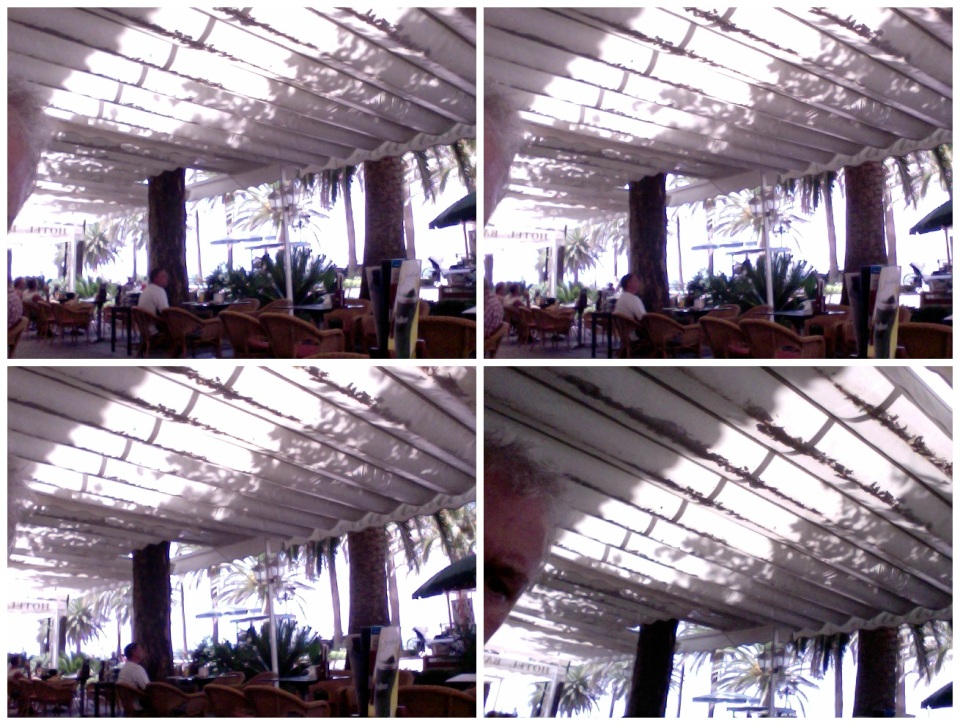
Macs have a built in camera facility – the software that supports it is called Photo Booth and I have just taken the picture sequence.
Nerja is a lovely town with just the right balance between tourism and local culture. There are restaurants everywhere and as my friend and colleague Eugene points out there are plenty of wireless hot spots.
I really like the small Spanish eateries that seem to combine a bar and seafood restaurant. These are not the posh places they have plastic tables and chairs and you are unlikely to get air conditioning. But whow! try a plate of grilled sardines – delicious. -
Learning Assessment Through Life
I attended an excellent workshop today on the topic of assessment and learning. The workshop was delivered by Professor Sally Brown of Leeds Metropolitan University in the UK. The attendees consisted of a mix of our own faculty at National College of Ireland and teachers from some of the other colleges around the country as part of the Learning Innovation Network.
Sally started by inviting participants to reflect on how learning assessments have impacted on all our lives.
This exercise got me thinking about the idea of a lifespan perspective on assessment – key moments of assessment and how significant their influence can be.
When I was in school we were streamed in classes A B C etc.. I remember being asked a question when I was being assessed for 2nd class primary school (I would have been about 8 at the time). After infant school in a convent I went to a Christian Brothers School and on the first day the brother gave us a one-to-one interview that lasted about two minutes (or at least that is my recollection of it). I was asked “what is eight plus five?”. I actually knew the answer but I could not respond because I was so terrified of the situation.
I ended up in a B stream and I remain convinced that the decision was made on the basis of the brief interview and my inability to respond. Through my years at school a pattern was repeated – I would move from the top of a B stream to the bottom of an A stream as a consequence of some test or other.
Maybe this was no bad thing for me and I have always been comfortable with my recollections of school (see my earlier piece on learning identity).
I also recall how assessment has always been connected with qualifications. Sally Brown is a big advocate of
“assessment for learning rather than assessment of learning”.
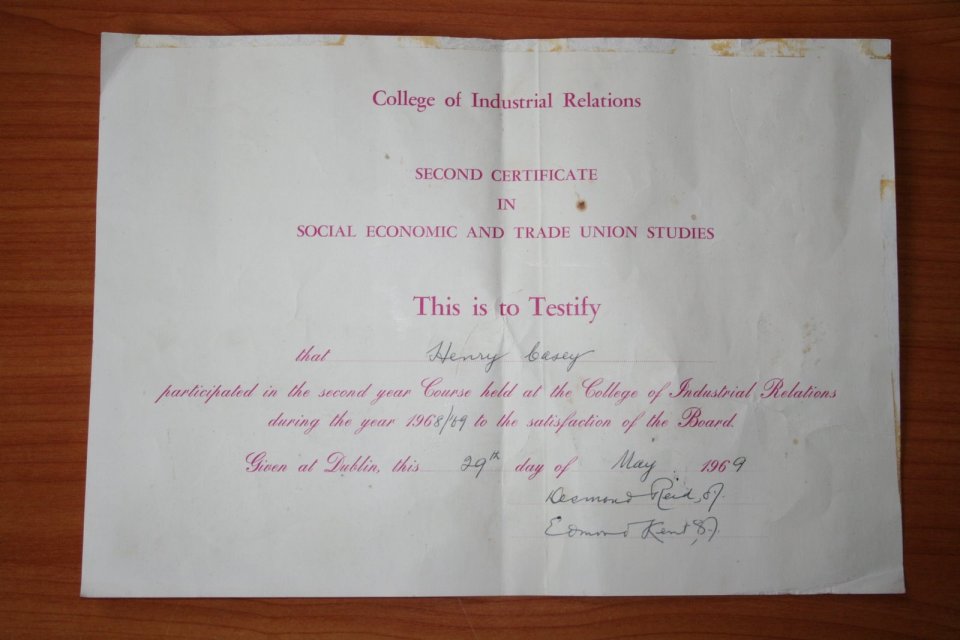
When I joined NCI – my mother was quick to point out that my father had studied in the old College of Industrial Relations when it was based in Ranelagh.
My father, Har was an active trade unionist and he had a strong sense of social justice which extended from his support for co-workers to participating on a picket of Dunnes Stores in solidarity with a shop worker dismissed for refusing to handle South African produce during the apartheid era.
My mother rooted out Har’s old certificate in Trade Union Studies and gave it to me. In all likelihood there was some form of assessment involved in this course I don’t know but I have the evidence of certification.
Yes, all our lives are shaped and influenced by educational assessment and certification.
As educators, we have a big responsibility to arrange assessment that is conducive to learning and is effective and fair. You’ll never know for how long or how extensive its influence may be.You May Also Like

Getting to Grips with Academic Writing
-
The Skillful Teacher
I came across this quotation from Confucius many months ago
and I have been waiting for an opportune time to include it in my blog.
Please forgive Confucius for his use of the term 'man' only in his description
of the skillful teacher. The most skillful teachers I know are women.When a superior man knows the causes which make instruction successful,
and those which make it of no effect, he can be a teacher of others.
Thus in his teaching, he leads and does not drag;
he strengthens and does not discourage;
he opens the way but does not conduct to the end
without the learner's own efforts.
Leading and not dragging produces harmony.
Strengthening and not discouraging makes attainment easy.
Opening the way and not conducting to the end makes the learner thoughtful.
He who produces harmony, easy attainment,
and thoughtfulness may be pronounced a skillful teacher.
– Confucius,Book XVI – HSIO KI (Record on the Subject of Education)
Isn't it remarkable how Confucius seems to capture all that we would now
call best practice in teaching others.
She leads but does not drag
Most learning practitioners would agree with this - for adults the mantra
is adults learn what they want to learn and what they find useful.
One can facilitate, encourage and lead people in the pursuit of
learning outcomes but there are few situations where compulsory
learning is successful.
She strengthens and does not discourage
Positive affirmation and feedback when matched with realistic goals will
enable learning.
She opens the way but does not conduct to the end
without the learner's own efforts
This is wonderful advice. To 'open the way' could suggest something like 'scaffolding'
a term used in constructivist approaches to learning. What is suggested here is that a teacher
may provide just the appropriate level of support for learning but in the end the
outcomes will be achieved by the learner's own effort.
Leading and not dragging produces harmony
Yes!
Strengthening and not discouraging makes attainment easy
Absolutly!
Opening the way and not conducting to the end makes the learner thoughtful
and willing to invest the mental effort
She who produces harmony, easy attainment,
and thoughtfulness may be pronounced a skillful teacher
I know many who fit this description. -
Looking for Leo Casey’s Blog?
You May Also Like

Learning as Lifelong, Worldwide and Values-Deep
-
Uncategorised
लीर्निंग फ्रॉम स्लुम्दोग Slumdog Millionaire
Slumdog Millionaire – Official Movie Site
This was a super film that pushed and pulled at your emotions throughout -the direction, editing, photography and acting all combined to create an absolutly absorbing experience. I think great films live on in your head after you’ve seen them and this was the case with Slumdog.
What of the story! Without giving too much away – the basic premise centres on the Indian version of the TV show Who Wants to be a Millionaire. People (especially the police) do not believe how the young tea boy from the Mumbai slums can answer all the quiz show questions. He must be cheating! How could he know all this stuff? We find out that he really does know the answers because each question connected with particular events and experiences in his life history.
This film is a good example of important connection between experience and learning. Some people describe themselves as not having much learning and yet the may have many years experience in work or other areas of activity. This experience counts for learning and for anyone thinking about returning to learning it’s a good idea to think about all of your experience as a strong foundation for any course you intend to undertake.
If your interested look out for a follow up posting on constructivist learning theory.
-
Storyteller’s Concert in Lough Rynn Castle

So we were down in Leitrim for the weekend and didn’t we discover as we arrived that this was the most interesting of weekend’s to be in Mohill. The Storytelling festival and the horse fair were both on. Maire and I went to a storytelling concert in Lough Rynn castle and it was an enthralling experience. What struck me above all was the manner in which we become mesmermised by good stories and how the craft of storytelling is still very important in the modern world.
Coincidentally the previous day we had a Friday lunchtime seminar on learning and teaching in the College and the importance of stories and good case studies was emphasised. The role of narrative as a vehicle for learning has always been important -it is perhaps the oldest way of education.
Often I come across instrumental approaches to teaching -the idea is to break up the content and to distil the important points and ‘give’ notes to students for later reproduction. We then seem baffled when there is little retention or deep level learning. The stark presentation of abstract concepts is of little value to students grappling with these concepts for the first time.
Old wisdom was handed down through generations embedded within the stories of the time. These stories act like egg yoke providing nourishment to the knowledge and ideas buried within the narrative.
Of particular interest was the genesis story as told by Clare Muireann Murphy which she attributes to a fellow story teller from Spain. In that story God creates man and women and makes them blind and set apart across a river in huts surrounded by noisey leaves so that He could hear if they got up to anything. Inevitably lust plays its part and they are cast out and as in other versions we have woman as crafty instigator and man as mindless instinct.
I believe that genesis stories are archetypes describing the nature of human learning and development. A kind of ‘curiosity killed the cat’. Except that the place where Adam and Eve start out Eden -a garden or as in Clare’s story a hut by a river is usually portrayed as nice but empty. Something is missing? And surely what’s absent is inquiry, questioning and curiosity -in the Spanish story the two participants find their eyelids covered over by skin. When they release their eyes (which were always underneath) they get up to devilment. But its pleasurable and compelling and eventually they are cast out of the place of tranquility.
This is the human prediciment -we strive to change and progress and with these strivings we bring risk upon ourselves. But this is what we do -this is what we’ve always done and for all the Edens I prefer to take my chances with curiosity and spend my time out here outside the garden. -
An Organic Approach to Teaching and How Digital Media Make it Possible
In recent years the trend in digital media design has been toward extending the natural reach of human capacities.
Digital cameras for example are not just getting smaller and lighter but they are becoming easier to use. Background technologies now compensate for low light levels, camera shake, poor composition and other errors. All the user needs to do is point and click.
The irony is that increasingly complex technology often gives rise to simpler and more natural functionality. Give a camera to a six year old and watch what happens.
The same trend can be seen in other designs -technologies such as the wii controller, voice recognition and intuitive Internet interfaces are helping to hide technology and foreground functionality. Ironically, these advanced digital technologies are becoming more transparent and users take them for granted. These designs give rise to new possibilities in teaching and learning.
Traditionally, we’ve organised much of school teaching around the development of essential skills the so-called 3r’s -reading, writing and arithmetic. There are few who would deny the importance of these skills for the modern world and because they are important we can’t wait to get our children up to speed as early as possible. The progress of children in learning these skills is constantly measured and we’ve developed standards such as reading age -we can even compare these standards with those of children in other countries.
Our school system has an end point -the Leaving Certificate for most. Once again there is much measurement and comparison at the output stage. This sorting and grading process helps decide who will progress to what courses in higher and further education.
Why is our education system structured in this way? It is a combination of multitude of factors and influences historical, cultural and practical. Class rooms of today have changed little in the last one hundred years both in the layout and in the activities that take place within.
This is not to deny the great advances that have been made in terms of pedagogic innovation, the professionalism of teachers or the excellent work of the numerous bodies associated with educational reform and continuous improvement. However, relative to other areas of society schools and specifically the craft and science of teaching has not been permitted to achieve it’s full potential in preparing our children for a future where the only certainty is that it will be radically different from what we know today.
I argue that just like modern farming we have over-engineered our education system, we have over-relied on fostering narrow skills, we are obsessed with measurement, we continuously intervene in learning, we confine the site of learning to the classroom and we strive to make people homogeneous in their thinking. All of this leads in the end to economic and social perils.
Just like farming we need a new approach and what I call for is a kind of organic movement in learning and teaching.
We need to recognise that learning is a natural process, that all people are curious and have a desire to be competent and connected in society. We need to appreciate the inquiry cycle of ask, investigate, create, communicate and reflect. Above all we need to provide children with the tools that help them learn the world through inquiry.
Why has this not happened before and why is it possible now? The answer is simple about a hundred years ago we removed the site of learning from the lived-world and placed it within the confines of the class room. While many students cope by acquiring there understanding of the world through the abstract processes facilitated by the 3 r’s -many others are left behind. Without the essential skills they are left out, unconnected and disengaged.
Until now that is. Well designed digital technologies afford connection, engagement, expression, creativity and learning. They facilitate these transparently -without the need for complex prerequisite skills. Children now have access tools that extend their natural capacities to communicate, participate and make meaning of the world. In the classrooms we’ve observed as part of the Digital Literacy in Irish Primary Schools (DLIPS) research project we’ve seen this process in action. Like the example we witnessed of inner city 8 year old boys working in groups making banana splits and recording the process -a role for each child one on the camera, one peeling and slicing, one sloshing on the cream and one writing down the process. Later their picture story set to music, projected and replayed in celebration of all that had been achieved and most significantly achieved by all.
And at last, either now or in the very near future, teachers can get on with what they do best -making learning happen. These teachers who harness the natural conditions of learning will better prepare students for the future.
And yes we will still have the 3r’s but they’ll stand for something different -R for real questioning, R for relatedness to community and R for reflection on practice. This will be organic teaching made possible with digital media. Watch this space. -
Uncategorised
Great Music and Quick Fingers

Had a call from Tom with an out of the blue to join him and his son Shane at a gig in town -part of the Ireland Guitar Festival. Josco Stephan and his band and later joined by Tommy Emmanuel were the bill for the night. I have to confess that I had not heard of these before and was not sure what to expect. As the small theatre filled up (The Suger Club) I was convinced that everyone attending was a guitar head and was a little worried that the show would be my taste. How wron I was! These guys were brilliant! and one of the freshest sounds that I’ve heard in years. Technically the musicians were awesome but more than that they lived every note and made the music meaningful engaging. Have a look at the you tube videos and see what I mean and watch out if they ever come your way. Afterwards Tom, Shane and I had a really interesting conversation over dinner on whether music and art were historically situated in culture or more fundamentally rooted which minds me to point the reader toward this podcast from Benjamin Zander http://www.ted.com/index.php/talks/benjamin_zander_on_music_and_passion.htmlwhich addresses the same issue.
-
The Web and the Unconscious
 Most psychoanalytical models of the human mind use a depth metaphor to suggest the division between the conscious and the unconscious. Typically Jungian approaches use the idea that the mind is like an island jutting out of the sea with only so-much showing above the surface. The visible component represents the conscious, the tidal zone the personal unconscious and the zone below the collective unconscious.
A sense of depth is itself a value laden construct. We envisage the bottom of the sea with ugly fish and black darkness. That’s a scary unconscious.There is another way of looking at this what I think is a more useful metaphor.
Look at the following system -the Internet. We could, metaphorically, view this as a form of cognitive consciousness. Alongside this we have individual and societal processes that build, shape and grow the Internet system. This other system is not overtly evident on the Internet it is only accessible through the symbol system of the net. If we were to imagine an alien species that had no way of contacting humans but by some fluke of science could find access to the entire Internet we could ask -what way would they ‘model’ human beings from the evidence available to them? How accurate would this be?
In the same way we do not have direct access to our unconscious and we rely on language and symbol systems to model it.


