-
Learning, Participation and After Virtue
What makes a good person?
This is an old and important question. Philosophers and theologians through the years have sought an answer including Aristotle, Aquinas, Hume, Kierkegaard, Newman, Nietzsche and others.
Alasdair MacIntyre provides a useful analysis of the history of thinking on this question and the current state of moral philosophy in his books After Virtue (1984) and Whose Justice? Which Rationality? (1988). MacIntyre argues that a full understanding of moral philosophy today is constrained by failure to appreciate historical context.
He proposes a disquieting scenario to illustrate what he deems the state of affairs today. Imagine, he suggests, through some terrible catastrophe all the scientists in the world were wiped out and with them the thinking and practice they engaged in. Some time later, when people seek to revive science they would only be partly successful; they would have to rely on clues from remnants of documentation, pieces of laboratory apparatus and a scattering of folk ideas. The practice of science would be gone.
Although MacIntyre uses this vista to illustrate how, he believes, we have lost the way (and means) of moral philosophy, he is also making a point about ‘practice’. Human activities directed and sustained toward a particular goals are practices. Thus science and its sub-fields are practices, as are many of the activities we engage in such as medicine, engineering, academic scholarship, the arts and sports etc.. MacIntyre (1981a p30) makes clear his understanding of practice:
By a ‘practice’ I am going to mean any coherent and complex form of socially established cooperative human activity through which goods internal to that form of activity are realised in the course of trying to achieve those standards of excellence which are appropriate to, and partially definitive of, that form of activity, with the result that human powers to achieve excellence, and human conceptions of the ends and goods involved, are systematically extended.
To me, this conceptualising of practice, internal goods and the extension thereof resonates with work by Davidov, Engeström and other proponents of Activity Theory and Learning as Expansion. It is also consistent with the arguments I make (Casey, 2013) that the ultimate goal, purpose and direction, or telos, of learning is toward participation in practice. MacIntyre argues that ‘internal goods’ are always shared and belong to the practice. Internal goods act for the betterment of practice. I think this is what we mean when we use phrases like ‘in the service of Science’ or for ‘contributions to Agriculture’.
In order to answer the question of what makes a good person you would need to provide a context. A good scientist would be a person who extends the practice of science through participation and the realisation of internal goods particular to science. A good person today (in a general way) participates. Through participation we share in the development of, and are in the service of, societal practices. What is virtuous today differs from what was considered virtuous in the past. Why? Because practices have evolved and extended. Our understanding of issues such as climate change, world hunger, human rights and even ‘how we learn’ are the internal goods of the present time. With that in mind I’ll leave the last word to MacIntyre on his definition of a virtue:
A virtue is an acquired human quality the possession and exercise of which tends to enable us to achieve those goods which are internal to practices and the lack of which effectively prevents us from achieving any such goods.
MacIntyre (1981a p32)
References
Casey, L. (2013). Learning Beyond Competence to Participation. International Journal of Progressive Education Special issue: Educating for Democracy and the Process of Authority, 9(2), 45-61. Available from http://goo.gl/Pg0T3O
MacIntyre, A. (1981). After Virtue: A study in moral theory (London, Duckworth).
MacIntyre, A. (1981a). The nature of the virtues. Hastings Center Report, 11(2), 27-34.
MacIntyre, A. C. (1988). Whose justice? Which rationality? : Duckworth London.
-
Learning about Thinking from James Joyce
In my view one of the best ways to study learning and thinking is to look to literature and in this arena one figure stands out for the manner in which he conveys the human thought process in print. I am of course referring to James Joyce.
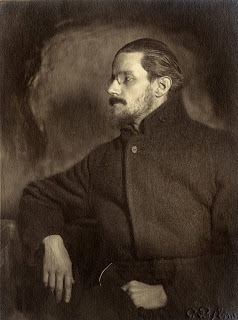 In this short review I present some aspects of Joyce’s work from the perspective of insights on how we think and learn.
My argument is that great literature resonates with our thought processes. In reading Joyce we are provided with a working model of the inner structures and mechanisms through which we experience the world.
I approach this analysis from the perspective of the average reader rather than the rich practice of Joycean scholarship. As such, my remarks are confined to my own, somewhat surface, impressions and interpretations of the literature. Almost at every point in Joyce’s work there are many layers of meaning and great pleasure can be derived from reading and rereading the passages.
My analysis is based around five short lessons:
Lesson One The Inner Narrator
Consider the opening lines from A Portrait of the Artist as a Young Man:
Once upon a time and a very good time it was there was a moocow coming
down along the road and this moocow that was coming down along the road
met a nicens little boy named baby tuckoo…
His father told him that story: his father looked at him through a
glass: he had a hairy face.In this passage we are introduced to Stephen Dedalus as a child. The language is obviously childlike and there is a wonderful lyrical-jaunty quality about it. But who is the narrator? Is it Stephen or someone else? If it is someone else what age is the narrator?
The use of subjective narration and narrative ambiguity is to be found throughout Joyce’s work. Joyce’s storytellers are never neutral they add to the meaning and the memory.
The short story ‘A Painful Case’ from the Dubliners collection provides an apparently more straightforward example of self-narration in a description of the lonely main character of Mr Duffy:
He had an odd autobiographical habit which led him to compose in his mind from time to time a short sentence about himself containing a subject in the third person and a predicate in the past tense. He never gave alms to beggars, and walked firmly, carrying a stout hazel.
What’s interesting here is that this ‘odd autobiographical habit’ seems also to be in evidence in the first quotation above. I suggest that when the narrator says ‘his father told him that story’ it is actually Stephan recalling his childhood. The text reproduces these are memories infused as they are with the sensual realism of childhood experience together with evidence of more complex structures over-layered through adult recall and retelling.
The take-away from this lesson is that ‘we are the stories we tell’ and we construct these stories through our own inner narrative.
Lesson Two Structure and Meaning
There is a wonderful Irish tune called the Mason’s Apron that has about six parts and when its played well it provides a great platform for musicians to show off their skills by varying the style and tempo whilst still finding a way pack to the central theme.
In the same way Joyce’s Ulysses is a structural masterpiece not because it displays one great structural device but because it has so many. One way of appreciating this entire work is to see it as an exhibition of structural virtuosity.
In addition to varieties of inner and outer narration, there is an episode written as a play complete with stage directions, there is also a section using newspaper narrative with headlines and a section (scholars call it the Ithaca episode) written as if it was meant to be learned by rote in the form of question and response. This hilarious situation involves the two characters Leopold Bloom and Stephen Dedalus who are both quite drunk as they arrive at Bloom’s home in Eccles Street:
What action did Bloom make on their arrival at their destination?
At the housesteps of the 4th of the equidifferent uneven numbers, number 7 Eccles street, he inserted his hand mechanically into the back pocket of his trousers to obtain his latchkey.Was it there?
It was in the corresponding pocket of the trousers which he had worn on the day but one preceding.Why was he doubly irritated?
Because he had forgotten and because he remembered that he had reminded himself twice not to forget.What were then the alternatives before the, premeditatedly (respectively) and inadvertently, keyless couple?
To enter or not to enter. To knock or not to knock.Bloom’s decision?
A stratagem. Resting his feet on the dwarf wall, he climbed over the area railings, compressed his hat on his head, grasped two points at the lower union of rails and stiles, lowered his body gradually by its length of five feet nine inches and a half to within two feet ten inches of the area pavement, and allowed his body to move freely in space by separating himself from the railings and crouching in preparation for the impact of the fall.This is great fun to read and the structure is often referred to as the catechism approach. Joyce was perhaps poking fun at the teaching methods he encountered for religion and theology.
The take-away from this lesson is to recognise how we embed meaning in the structures and manner in which we communicate.
Lesson Three HypertextMost people involved in computer science will recognise the term ‘hypertext’ (it is in fact the ‘h’ in the familiar http string that we find in Internet addresses). However, the origins of the term predate the Net. In the 1960’s Theodore H Nelson described the term as electronic text that was characterised as non sequential. By this he was referring to the reader’s ability to trace a series of different paths through the same piece of text. If you want a good example of this then look up ‘hypertext’ on wikipedia and see where your reading takes you.
Reading hypertext is an active process as it involves choice and exploration of layers of meaning. This characteristic is also true of great works of literature (I am not the first to posit this idea and should you so wish you can hypertext off to study Derrida, Foucault and Landow).
Long before the Internet Joyce understood the power of interconnection, inference, hints and echoes in literature. Throughout Ulysses there is an obvious underlying intertextual resonance with Homer’s Odyssey. However, the hyper-textual framework extends throughout the novel and it conveys a much deeper, broader and inter-connected network of meaning. For example, one of the characters Stephen Dedalus was first encountered in an earlier novel by Joyce, while the timeframe as one day (16th of June 1904) starts twice: once with Stephen and once with Leopold.
Each episode has an underlying theme and it’s almost impossible to read the main text without your thoughts spinning off in many different directions. In the extract below from Sirens we encounter a form of musical overture to Bloom’s later erotic observations of waitresses in the Ormond Hotel:
BRONZE BY GOLD HEARD THE HOOFIRONS, STEELYRINING IMPERthnthn thnthnthn.
Chips, picking chips off rocky thumbnail, chips. Horrid! And gold flushed more.
A husky fifenote blew.
Blew. Blue bloom is on the
Gold pinnacled hair.
A jumping rose on satiny breasts of satin, rose of Castille.
Trilling, trilling: I dolores.
Peep! Who’s in the… peepofgold?
Tink cried to bronze in pity.
And a call, pure, long and throbbing. Longindying call.
Decoy. Soft word. But look! The bright stars fade. O rose! Notes chirruping answer. Castille. The morn is breaking.
Jingle jingle jaunted jingling.The take-away from this lesson is that much of our thinking is characterised as more like a hyper-textual network of associations rather than any logical, hierarchical or similarly organised system.
Lesson Four A Theory of Aesthetics
In the Portrait there are a series of episodes involving Stephen working through some theological and philosophical arguments. The following extracts are spoken by Stephen as a college student to a fellow student called Lynch and concern the essence of beauty – I suggest that Joyce’s own views that are in evidence here:… Plato, I believe, said that beauty is the splendour of truth. I don’t think that it has a meaning, but the true and the beautiful are akin. Truth is beheld by the intellect which is appeased by the most satisfying relations of the intelligible; beauty is beheld by the imagination which is appeased by the most satisfying relations of the sensible. The first step in the direction of truth is to understand the frame and scope of the intellect itself, to comprehend the act itself of intellection.
and later when they argue on the subjectivity of beauty
This hypothesis, Stephen repeated, is the other way out: that, though the same object may not seem beautiful to all people, all people who admire a beautiful object find in it certain relations which satisfy and coincide with the stages themselves of all esthetic apprehension. These relations of the sensible, visible to you through one form and to me through another, must be therefore the necessary qualities of beauty. Now, we can return to our old friend saint Thomas for another pennyworth of wisdom.
Even though these arguments are provided as the student Stephen working through his own approach to philosophy (and there is much evidence in the text of a kind of an innocent, tentative naivety in this) we are presented, as in the case of the examples above, with some very useful insights.
The take-away from this lesson is Joyce’s affirmation of what Jurgan Habermas later refers to as communicative rationality – process by which societal constructs such as beauty, truth and justice are formed.
Lesson Five Stream of Consciousness
Finally, Joyce is well known for his use of a stream-of-consciousness technique to convey an impression of how people think.The frequently cited example is perhaps the Molly Bloom soliloquy which comes at the end of Ulysses. The extract I present here is from an earlier part of the book where Stephen is walking on the beach. I have inserted a dash / to indicate the transition from narrator to stream-of-consciousness and back.
His gaze brooded on his broadtoed boots, a buck’s castoffs, /nebeneinander/. He counted the creases of rucked leather wherein another’s foot had nested warm. /The foot that beat the ground in tripudium, foot I dislove. But you were delighted when Esther Osvalt’s shoe went on you: girl I knew in Paris. Tiens, quel petit pied! Staunch friend, a brother soul:
Wilde’s love that dare not speak its name. His arm: Cranly’s arm. He now will leave me. And the blame? As I am. As I am. All or not at all.
nebeneinander. He counted the creases of rucked leather wherein another’s foot had nested warm. The foot that beat the ground in tripudium, foot I dislove. But you were delighted when Esther Osvalt’s shoe went on you: girl I knew in Paris. Tiens, quel petit pied! Staunch friend, a brother soul: Wilde’s love that dare not speak its name. His arm: Cranly’s arm. He now will leave me. And the blame? As I am. As I am. All or not at all.The take-away from this lesson is in the form of ‘exhibit a’ – this is what we are taking about when we think of ‘thinking’. Surprisingly, we don’t get grammar as we know it, there seems to be little by way of logical progression or obvious structure and yet we have to agree (I certainly do) that this exhibit rings very true. I have often argued that writing is a form of thinking and that a consequence of the writing process is the manner in which it forces us to impose progressive arguments and logical structure on our thoughts. Thankfully, stream-of-consciousness as above would seem to be the norm though.
In the preceding discussion I have presented, what I choose to call, five lessons from Joyce that provide insights on how we think and how we experience the world. These are just the tip of the iceberg and further reading of Joyce will continue to provide a powerful lens through which we can view our own minds and those of others.
-
My Philosophical Development by Bertrand Russell
I am reading a wonderful book called My Philosophical Development by Bertrand Russell – I picked up a 1959 first edition in a wonderful second hand bookshop, Trinity Books in Carrick On Shannon. This is like a beginners guide to Russell by himself and, in it he traces his thinking down through the years.
There is a particularly poignant section where Russell reproduces copies of his notes from his teenage years. He writes (p280): Just before and just after my 16th birthday, I wrote down my beliefs and unbeliefs, using Greek letters and phonetic spelling for the purposes of concealment.
What Russell was at pains to conceal at this young age were his doubts about religion and the existence of God. What troubled him was not necessarily the social consequences but rather, the intellectual consequences.
Here is is entry of April 29th 1988:In all things I have made a vow to follow reason, not the instincts inherited partly from my ancestors and gained gradually by selection and partly due to my education. How absurd it would be to follow these in the questions of right and wrong. For as I observed before, the inherited part can only be principles leading to the preservation of the species, or of that particular section of the species to which I belong. The part due to education is good or bad according to the individual education. Yet this inner voice, this God-given conscience which made Bloody Mary burn the Protestants, this is what we reasonable beings are to follow. I think this idea mad, and I endeavour to go by reason as far as possible. What I take as my ideal is that which ultimately produces greatest happiness of greatest number. Then I can apply reason to find out the course more conducive to this…
Not bad for a sixteen year old.
Seventy one years later, in 1959 the following occurred: Allen and Unwin published the book, Russell recorded a television interview included below and (of no relevance to Russell) I was born.
Fifty years after that, as a consequence of my bookshop brousing in Leitrim, I reproduce the thoughts of a teenager writing in a personal blog: I have made a vow to follow reason.
Yes you did Bertrand, yes indeed!


